Why Visit the Mezquita of Córdoba – And Why It Stays With You
The Mezquita of Córdoba is one of those rare places where time doesn’t just seem to slow; it layers. You stand under its forest of red-and-white arches and feel Roman columns beneath your fingers, an Islamic prayer hall stretching away into shadow, and a soaring Renaissance cathedral bursting upward through the center like a stone tree that refused to stop growing. It is not simply a monument; it’s a millennia-long argument in brick, marble, and light.
I’ve been coming back to the Mezquita since my student days, and each return—most recently in spring 2026—feels different: sometimes hushed and devotional at 8:30 a.m. when the first light catches the mihrab; sometimes crowded and pulsing on a hot May afternoon between festival parades. Yet it never feels overrun in the way some European icons do. The building absorbs people the way its stone absorbs light.
What makes the Mezquita of Córdoba special is not just its beauty, but its contradictions: the mosque-cathedral, the orange trees and Roman bridge just outside, the tight white lanes of the old Jewish quarter, the patios full of flowers, and the fact that you can emerge from 1,200 years of history and be sipping an ice-cold fino sherry or tucking into slow-cooked rabo de toro within minutes.
This 2026 long-form travel guide is for travelers who want more than a snapshot: couples plotting a romantic weekend, families curious about history, solo wanderers with a notebook in their bag, and anyone piecing together a 2–4 day itinerary for the Mezquita and its surrounding quarters. I’ll walk you through the most famous sights and the quieter corners I’ve grown to love, with practical details, personal anecdotes, and honest tips about when it’s worth lingering—and when to escape down a side street for tapas.
Table of Contents
- Why Visit the Mezquita of Córdoba
- How the Mezquita Is Laid Out & How It Evolved
- 12 Key Quarters, Monuments & Sites Around the Mezquita
- 1. The Mezquita Interior: Forest of Arches
- 2. Patio de los Naranjos
- 3. Renaissance Cathedral & Choir
- 4. Bell Tower (Torre-Campanario)
- 5. Roman Bridge & Puerta del Puente
- 6. Calahorra Tower & Guadalquivir Banks
- 7. Jewish Quarter (Judería) & Synagogue
- 8. San Basilio & the Patios Quarter
- 9. Alcázar de los Reyes Cristianos
- 10. Plaza de la Corredera & Mercado
- 11. Palacio de Viana & Courtyards
- 12. Medina Azahara (Day Trip from the Mezquita Area)
- 2–4 Day Itineraries Focused on the Mezquita & Old Córdoba
- Traditional Cuisine & Local Food Around the Mezquita
- Evenings at the Mezquita: Night Atmosphere & Experiences
- Cultural Etiquette & Local Customs
- Events, Festivals & What’s New in 2026–2027
- Day Trips & Nearby Attractions
- Practical Travel Tips & Logistics
- Summary & Best Seasons to Visit
How the Mezquita Is Laid Out & How It Evolved
The Mezquita rises just inside the old city walls, a huge, almost fortress-like rectangle pressed against the river. Unlike many European cathedrals, you don’t approach along a grand axial boulevard; you slip in from narrow lanes, the walls appearing almost suddenly between whitewashed houses and terracotta roofs.
In broad strokes, imagine the complex as three chronological layers:
- Roman & Visigothic Foundations (2nd–7th centuries) – Bits of Roman temple and later Visigothic church are reused in the columns and capitals. You’ll literally see Roman fluting next to Islamic horseshoe arches.
- Umayyad Mosque (8th–10th centuries) – The original mosque, repeatedly expanded southward toward the river, created the vast hypostyle prayer hall. This is the famous “forest of columns,” plus the glittering mihrab and maqsura from the 10th century.
- Christian Cathedral (13th–16th centuries) – After the Christian conquest in 1236, the mosque was converted into a cathedral. Chapels were added around the edges, and in the 16th century the massive Gothic–Renaissance nave and choir were inserted into the middle.
Today you’ll likely enter either through the Puerta del Perdón into the Patio de los Naranjos, or from the riverside via the main ticket entrance on the north side. From there, the usual visitor flow moves: Patio → mosque-cathedral interior → cathedral choir → mihrab & maqsura → side chapels → back out to the patio and the old town.
But the building rewards wandering. Over multiple visits, I’ve found my favorite sequence is to loop in a rough clockwise spiral: enter via the Patio, cross into the cool half-light of the mosque, drift diagonally toward the mihrab, then swing around the cathedral nave, ending near the Chapel of Villaviciosa before finally exiting back under the orange trees. This way you feel the gradual shift from open, low arches to vertical, Gothic drama.
12 Key Quarters, Monuments & Sites in and Around the Mezquita
1. The Mezquita Interior: Forest of Arches & Hypostyle Hall
If there’s a single image that defines Córdoba, it’s the repeating red-and-white arches of the Mezquita’s hypostyle hall. I’ve seen it on posters in Madrid train stations and in art books in Tokyo, but nothing prepares you for stepping through the threshold and feeling the temperature and light drop. In summer 2025, I visited on a 40°C afternoon; the interior felt like a stone oasis, its air cool and faintly dusty with incense.
The hall was begun in 785 under Abd al-Rahman I and expanded multiple times. To picture it, imagine a grid of columns—over 850 survive—each topped with a double-tiered arch that allows greater height without needing massive walls. The red-and-white voussoirs (arch stones) echo earlier Roman and Byzantine designs, but the rhythm they create here is uniquely Andalusian: hypnotic, almost musical.
How to explore it:
- Arrive early. In 2026, morning free-entry hours (usually around 8:30–9:30 a.m.; check current times) remain the best way to experience the hall semi-empty, especially in shoulder seasons. I love entering from the northern side and walking straight toward the faint glow of the mihrab.
- Walk diagonally. Instead of following the straightforward north–south axis, cross the columns on the diagonal. The arches line up and then misalign in a way that plays tricks with your depth perception.
- Seek out reused Roman columns. Look for mismatched capitals—Corinthian here, composite there—and notice how many are slightly different heights. The builders compensated for this with brick and mortar, a practical solution that inadvertently creates charming irregularities.
Family-friendly? Surprisingly yes. Children tend to react with delight to the “forest of stone.” I sometimes suggest a gentle “column treasure hunt” to friends traveling with kids: count how many different capital designs you can spot, or find the column with visible drill marks.
Tips: Wear shoes with some grip—the polished stone can be slightly slick. Photography is allowed without flash, but tripods and drones are prohibited. Be mindful that this is an active cathedral; masses and private services occur, so respect roped-off areas and moments of silence.
2. Patio de los Naranjos: Orange Trees & Water Channels
The Patio de los Naranjos is your antechamber to the Mezquita: a rectangular courtyard shaded by rows of orange trees, with a grid of narrow stone channels feeding fountains. Before worshipers entered the mosque, this is where ritual ablutions were performed, the same way many Islamic courtyards functioned across Al-Andalus.
Personally, I think of it as Córdoba’s living room. On a crisp January morning in 2026, I watched pensioners in flat caps huddled in quiet conversation on benches, tour groups swirling briefly and then dissolving, and a pair of art students sketching the bell tower framed between branches.
What to look for:
- Water channels. Follow the tiny runnels that crisscross the ground. They’re a reminder that this was once a sophisticated hydraulic system, essential in an arid climate.
- Puerta del Perdón. The gate on the western side, with its Mudejar decorations and green doors, is a photogenic entrance and a nice example of how Islamic and Christian aesthetics coexist.
- Bell tower views. From the courtyard, tilt your head up to admire the tower (once the mosque’s minaret). I find late afternoon light best, when the stone turns honey-colored.
Best time: Early morning for quiet reflection, or golden hour for photography. In spring, the faint scent of orange blossom lingers; in May 2026, I could smell it even through my mask during a brief cold.
Family & accessibility: Benches and level paving make this a good resting spot for anyone needing a break. There are some slight slopes, but it’s generally wheelchair-friendly.
3. Renaissance Cathedral & Choir: A Church Inside a Mosque
Walk far enough into the Mezquita and the delicate rhythm of low arches is suddenly interrupted by vast Gothic pillars and a soaring vault overhead. This is the cathedral nave and choir, inserted into the heart of the mosque in the 16th century. King Charles V famously regretted the alteration, reportedly saying, “You have destroyed something unique to make something commonplace.” Yet standing here, the contrast is undeniably powerful.
On one of my recent visits, I attended a short organ recital here during the Noche Blanca del Flamenco weekend. The sound filled the nave, then spilled into the surrounding arches, softening at the edges as if the mosque itself were swallowing it.
Highlights:
- Choir stalls. Carved from dark wood and bristling with figures—saints, prophets, and allegorical creatures. Look closely at the individual faces; some are surprisingly expressive, even mischievous.
- Main altarpiece. A swirl of gilded Baroque exuberance. I’ve stood here with fellow travelers who loved it and others who found it overbearing; either way, it provokes a reaction.
- Dome & clerestory. Step back and tilt your head to appreciate how the high windows pour light down into what is otherwise a relatively dim ensemble of stone.
Photography tip: Stand at the edge where the mosque’s arches meet the cathedral pillars and frame both in one shot. This is the image that best tells the story of the building’s layered identity.
Quiet moments: During mid-afternoon in winter, when tour groups thin out, you can sometimes find a pew and sit in near-silence. I’ve done this more than once to scribble notes; ushers don’t mind as long as you’re discreet and respectful.
4. Bell Tower (Torre-Campanario): Looking Back over the Old Town
The bell tower, once the mosque’s minaret, is your best aerial introduction to Córdoba’s historic core. Hidden within its current Baroque skin are the bones of the original minaret; climbing it feels like ascending through layers of time.
On a clear February morning in 2026, with a crisp blue sky, I booked the first tower slot of the day. The light was still low enough to throw sharp shadows along the tiled roofs, and the Sierra Morena hills were a faint blue line on the horizon.
Practicalities:
- Tickets & time slots. Tower access is by timed ticket, separate from the main Mezquita entry. In peak season, reserve ahead online or buy as soon as you arrive for the day. Groups are small, which preserves the experience.
- Stairs. The climb is moderate, with some narrow sections and low ceilings. There are rest points, but it’s not ideal for those with serious mobility issues or severe vertigo.
- Viewpoints. There are usually one or two intermediate landings before the main viewing platform, each offering slightly different perspectives.
What you’ll see: Directly below, the chessboard of the Patio de los Naranjos and the roof of the Mezquita, surprisingly low compared to the tower. To the south, the Roman bridge spanning the Guadalquivir. To the north, a patchwork of whitewashed houses, church towers, and the distant modern city. I like to trace later walking routes from up here: “We’ll head that way to the Judería, then loop around to Plaza de la Corredera.”
Best time to climb: Morning in summer (to avoid heat and haze); golden hour in autumn and winter. Avoid midday in July–August unless you love squinting into harsh light and baking in a bell tower.
5. Roman Bridge & Puerta del Puente: The Mezquita’s Front Porch on the River
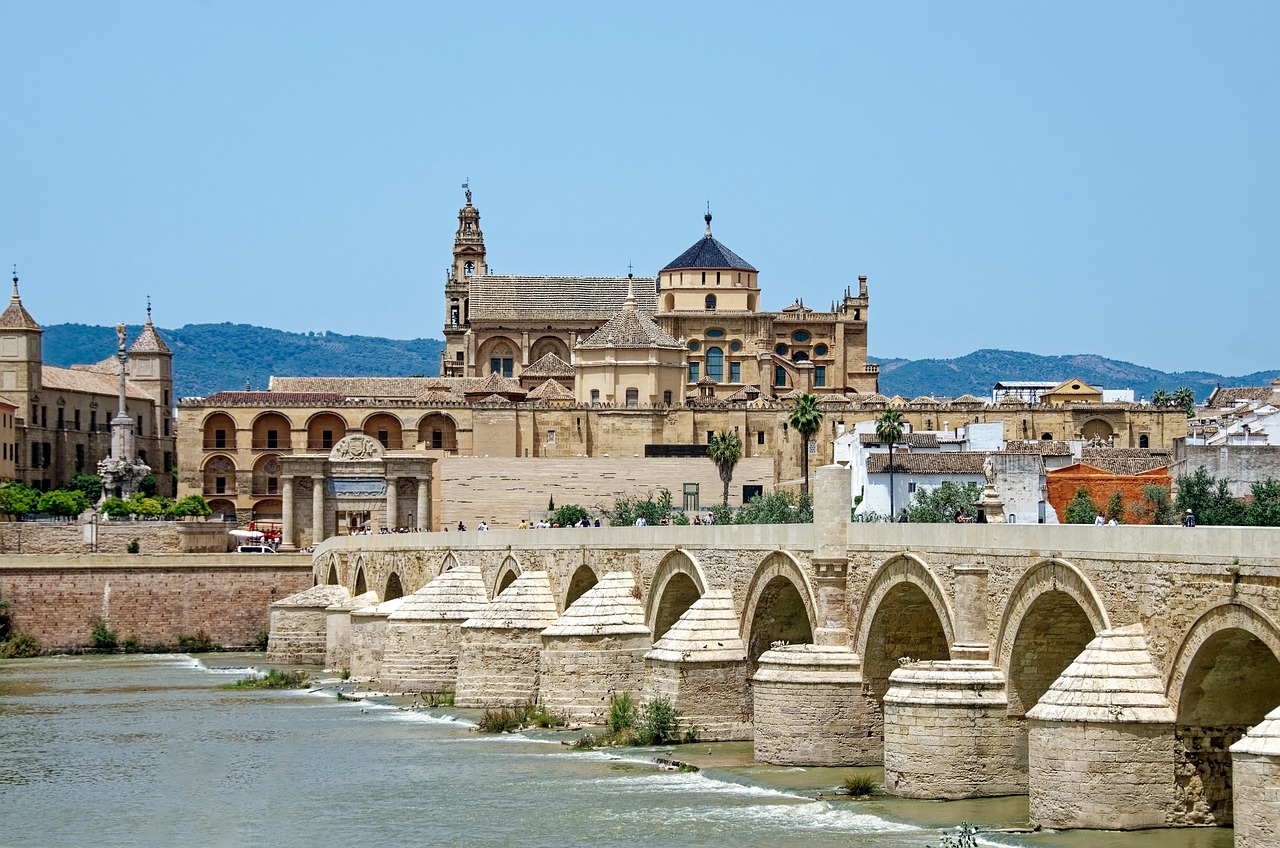
Just beyond the Mezquita’s southern wall, the ground falls away to the Guadalquivir River, crossed by the Puente Romano—the Roman Bridge. Originally built in the 1st century BCE, it has been rebuilt and restored many times, but it remains the city’s classic postcard view, especially at dusk when the Mezquita glows behind it.
On my last spring visit, I made it a ritual: every evening, after dinner, I’d stroll down to the bridge. One night it was busy with buskers and families pushing prams; the next, a chill wind emptied it of all but a few couples leaning on the stone parapet, sharing scarves and secrets.
Key sights:
- Puerta del Puente. The neoclassical gate at the bridge’s northern end acts as an architectural prologue to the Mezquita. You’ll usually pass through it if you approach from the modern center.
- St. Raphael’s statue. Midway along the bridge, a small shrine to the city’s patron archangel. Locals sometimes leave flowers here; I once watched an elderly woman whisper a quick prayer before turning back to the old town.
- Riverside paths. On the south bank, below the Calahorra tower, a path runs along the water. In cooler months, this makes a pleasant family-friendly stroll with space for kids to run.
Romantic tip: For couples, aim for late evening rather than peak sunset when everyone has the same idea. Around 11 p.m. in June, after most day-trippers have gone, the bridge is quiet and the reflection of the illuminated Mezquita shivers softly in the river.
6. Calahorra Tower & Guadalquivir Banks: Defensive Echoes & River Breezes
Anchoring the far end of the Roman Bridge is the Torre de la Calahorra, a sturdy defensive tower that has guarded Córdoba’s southern approach since Islamic times. Today it houses a small museum and, more importantly for many visitors, offers another vantage point over the Mezquita’s profile.
On a breezy evening in October 2024, I ducked in mostly to escape a sudden shower and ended up staying nearly an hour. The interior exhibits, which explore life in medieval Córdoba and the coexistence of Muslim, Jewish, and Christian communities, are more engaging than you might expect from the outside.
Why visit:
- Panoramic views back to the Mezquita. The tower frames the mosque-cathedral with the curve of the river and the long line of the bridge—an essential angle for photographers.
- Quieter atmosphere. Compared to the Mezquita itself, visitor numbers here are modest. I’ve often found myself almost alone on the battlements.
- Riverbank escape. After your visit, wander down the steps to the riverside path. In summer, this is one of the few places where you can count on a bit of a breeze.
Family note: The exhibits include models and multimedia displays that can hold school-age children’s attention for a short visit, especially when paired with the “castle-tower” climb.
7. The Jewish Quarter (Judería) & Córdoba Synagogue
To the north and west of the Mezquita, the streets tighten into a classic Andalusian maze: whitewashed walls, iron balconies, bursts of geraniums, and sudden little plazas. This is the Judería, the historic Jewish quarter, whose lanes still carry the names and echoes of a once-vital Sephardic community.
I love getting lost here. On a late-night wander last year, I followed the clink of cutlery to a tiny bar tucked down an alley no wider than outstretched arms, then emerged 10 minutes later into a square where a lone guitarist played softly beneath an orange tree. It felt staged, but it wasn’t.
Key stops:
- Córdoba Synagogue. One of only three medieval synagogues remaining in Spain. It’s small—almost startlingly so—but the plasterwork inscriptions and the women’s gallery evoke an intimate community life.
- Casa de Sefarad. A privately run cultural space that explores Sephardic history and music. I once lingered by a display of old songs and recipes longer than I expected; it’s a good antidote to the souvenir shops outside.
- Calleja de las Flores. A famous, and famously crowded, flower-lined alley with a carefully framed view of the Mezquita’s tower. Come early if you want photos without a crowd.
Shopping & souvenirs: The Judería has its share of tourist tat, but also some worthwhile shops selling ceramics, leather goods, and locally-made jewelry. I recommend wandering one or two streets off the main drag for slightly better quality and friendlier prices.
Food note: This is also where you’ll find a number of taverns and restaurants that stay open later than those closer to the Mezquita. More on specific recommendations in the food section below.
8. San Basilio & the Patios Quarter
Just a few minutes’ walk southwest from the Mezquita, past a stretch of the old city walls, lies San Basilio—a low-key residential quarter that bursts into global fame each May during Córdoba’s Fiesta de los Patios. Even outside festival dates, several courtyards here open to visitors, offering a more intimate encounter with the city’s patio culture.
On a hot May afternoon in 2023, I followed a hand-painted sign reading “Patio Visit” into what looked like an ordinary house. Inside: a riot of color. Blue flowerpots climbed the white walls, geraniums and jasmine perfumed the air, and an elderly couple sat in the shade, answering questions in patient, lilting Spanish.
Why San Basilio is worth your time:
- Authentic residential feel. This isn’t a polished museum quarter; it’s still very much lived-in, with laundry lines and the smell of cooking wafting from open windows.
- Patio visits year-round. Several patios operate on a small-fee, self-guided basis outside of festival weeks. Expect to pay a few euros per house; the money often helps maintain the flowers and structures.
- Proximity to the Mezquita. You can easily fold San Basilio into a Mezquita-focused day without feeling rushed.
Family & romantic angles: Children often enjoy the color and cats that inevitably occupy sunny corners; couples will appreciate the slightly secret-garden vibe. It’s a gentle contrast to the monumental scale of the Mezquita.
9. Alcázar de los Reyes Cristianos: Fortress, Gardens, and Royal Echoes
A short walk west from the Mezquita’s courtyard, the Alcázar de los Reyes Cristianos looms above the river: a solid, almost square fortress that once housed Christian monarchs, including Ferdinand and Isabella. Its interiors are modest compared to Seville’s Alcázar, but the gardens are the real draw.
On a spring morning in 2025, I climbed the battlements just as sprinklers were shutting off. The light caught the last droplets in the air, and the long pools reflected cypress trees like something from a meticulously arranged dream.
Highlights:
- Gardens & pools. Terraced gardens line up with long rectangular pools, punctuated by fountains. Benches and shaded areas make this a good mid-day respite in warm months.
- Towers & walls. Climb for views over the Mezquita’s roofscape and across to the river. The perspective is different from the bell tower and complements it nicely.
- Roman mosaics. Inside, look for the Roman mosaic floors, rescued from nearby sites and displayed here.
Practical tip: The Alcázar can be busy with tour groups in the morning. If you’re doing a 2 or 3 day itinerary, consider visiting around lunchtime, when many groups break for meals and the gardens feel quieter.
10. Plaza de la Corredera & Mercado: Everyday Córdoba
While the Mezquita area feels almost suspended in a historical bubble, Plaza de la Corredera reminds you that Córdoba is also a living, working city. This large rectangular square, lined with arcades and apartments painted in ochre and red, once hosted bullfights; today it’s home to cafes, weekend markets, and kids learning to ride bikes in wobbly circles.
I like to come here mid-morning, order a coffee at one of the slightly scruffy terrace bars, and watch the square fill. On Saturdays, you may find stalls selling secondhand books, antique bric-a-brac, or local craftwork.
Nearby:
- Mercado de la Corredera. A covered food market where you can browse stalls of fresh produce, meats, cheeses, and olives. It’s less touristic than some; I buy picnic supplies here when staying in an apartment.
- Side streets with tapas bars. A few streets leading off the square hide taverns where the menus aren’t translated. These are good spots to sample local food in a more “Córdoban” environment.
Family-friendly: Yes. Children can safely roam the pedestrianized square while adults linger over drinks. Just keep an eye on the occasional cyclist zipping through.
11. Palacio de Viana & Courtyards: Thirteen Patios in One Place
A bit farther from the Mezquita but still walkable (or a short bus/taxi ride), Palacio de Viana is a Renaissance palace wrapped around thirteen distinct courtyards. If your schedule doesn’t allow for extensive patio-hopping, Viana offers a concentrated taste of Córdoba’s courtyard culture.
On a drizzly afternoon in early 2026, I wandered from one patio to another under my umbrella: a mossy, shaded courtyard here, a bright, tiled one there, each with its own personality. The rain intensified the scent of damp earth and jasmine.
Why it’s worth the detour:
- Patio variety. From formal, symmetrical layouts to wilder, plant-filled spaces, you can see the range of what a patio can be in Córdoba.
- Historic interiors. Depending on ticket type, you can also visit the palace rooms, furnished across centuries, which give a sense of aristocratic life in the city.
- Crowd levels. It’s popular but rarely feels crushed; the multiple patios disperse visitors naturally.
Tip: Combine Palacio de Viana with Plaza de la Corredera and the nearby San Pedro churches for a half-day that balances monument-hopping with everyday neighborhoods.
12. Medina Azahara: The Shimmering “Lost City” Beyond the Mezquita
While not part of the Mezquita complex itself, Medina Azahara (Madinat al-Zahra) is essential context. Built in the 10th century by Caliph Abd al-Rahman III as a palatial city, it once dazzled visitors with marble halls and terraced gardens. Its stones and columns echo in the Mezquita’s architecture, and visiting both reveals how Córdoba looked at the height of its Islamic power.
In late 2024, I joined a small-group morning tour from near the Mezquita. We drove 8 km west into low hills, the city falling away behind us, and suddenly the ruins appeared: sun-bleached arcs of stone, partially reconstructed columns, and fragments of intricate carving.
Experience:
- Museum first. The modern visitor center at the base of the site is excellent, with models and timelines that help you imagine the vanished splendor.
- Shuttle up to the ruins. A dedicated shuttle bus runs from the museum to the archaeological site. From there, you walk through former audience halls, residential areas, and terraces overlooking the plain.
- Strong sun warning. There’s minimal shade. In summer, bring a hat, sunscreen, and plenty of water. I once underestimated this and regretted it halfway through the visit.
Connection to the Mezquita: Look for carved stone panels and arch motifs similar to those in the cathedral-mosque’s older sections. They’re cousins, separated by a short drive and a thousand years of history.
2–4 Day Itineraries for the Mezquita of Córdoba & Old Town
Whether you have 2, 3, or 4 days in Córdoba, the Mezquita area will anchor your stay. Below are personal, story-driven itineraries based on multiple recent visits, optimized for different lengths of time. You’ll see references to popular SEO questions—2 day itinerary for Mezquita of Córdoba, 3 day itinerary, 4 days in Mezquita of Córdoba—because these really are the rhythms that work best on the ground.
2 Day Itinerary for Mezquita of Córdoba – “The Essential Layers”
This 2 days in Mezquita of Córdoba plan is ideal for first-timers, couples on a romantic weekend, or families with limited vacation time. It focuses on the must-see attractions around the Mezquita, a handful of hidden gems, and enough downtime to actually enjoy being here.
Day 1: First Encounter – Mezquita, Patio de los Naranjos, Roman Bridge & Judería
I like to treat the first day as a wide-angle lens: you’ll see the Mezquita interior, explore the immediate surroundings, and get your bearings in the old town.
Morning: Entering the Forest of Arches
Start early. On my last 2-day blitz through Córdoba in spring, I set my alarm for 7:30 a.m., had a quick coffee at a bar just north of the Mezquita, and joined the small line forming for the morning free-entry period.
08:30–09:30 – Mezquita Interior (Quiet Hour)
- Enter via the Patio de los Naranjos, pausing briefly under the orange trees but resisting the urge to linger. The real magic is inside while it’s still quiet.
- Walk straight into the hypostyle hall and give yourself permission to simply wander for 20–30 minutes without a plan. Let your eyes adjust; notice how the columns recede into dimness.
- After your initial drift, make a slow approach to the mihrab (the richly decorated prayer niche) and the surrounding maqsura, where carved stone screens filter the light.
Even after multiple visits, this first hour always feels like stepping into a half-remembered dream. I find talking less and looking more is the way to go here; save the historical deep-dive for later in the day or for a guided tour.
Mid-Morning: Patio de los Naranjos & Coffee Break
Once the crowds begin to swell, slip back out into the Patio de los Naranjos. Now is the time to sit on a bench, look up at the bell tower, and let the experience settle.
- Grab a late breakfast—perhaps tostada con tomate and another coffee—at one of the cafes on the streets just north of the Mezquita, where locals still outnumber tourists earlier in the day.
- Walk a slow loop around the exterior walls of the Mezquita, noticing the different gates and architectural styles.
Late Morning: Bell Tower Climb
If you’ve pre-booked, time your bell tower slot for around 11:00 a.m. Climb at a comfortable pace, pausing at the intermediate landings to peek through small windows.
From the top, look down at the maze you’ll explore later: the Judería to your right (northwest), the Alcázar and San Basilio further west, and the Roman Bridge stretching south. I like to mentally map the rest of my day from this vantage.
Lunch: Local Food Near the Mezquita
For lunch, you have two options depending on your mood:
- Traditional tavern: Head a few streets away from the immediate Mezquita ring to a family-run taberna where you can order salmorejo (Córdoba’s thicker, creamier cousin to gazpacho), flamenquín (rolled pork loin with ham, breaded and fried), and a glass of local Montilla-Moriles wine.
- Lighter bite: If it’s hot, a simple salmorejo and a shared plate of boquerones en vinagre (marinated anchovies) might be plenty.
Afternoon: Judería & Synagogue
After lunch, drift into the Judería. In a 2 day itinerary for Mezquita of Córdoba, I recommend focusing on just a few key stops rather than trying to see every museum.
- Córdoba Synagogue. Spend 15–20 minutes here appreciating the plasterwork and imagining the community that once gathered within these small walls.
- Casa de Sefarad. If you’re curious about Jewish history and music, this is worth 30–45 minutes. Exhibits aren’t huge, but they’re thoughtfully arranged.
- Wander the lanes. Let yourself get a bit lost. Peek into artisan shops, and don’t be afraid to duck down quieter alleys—Córdoba’s center is very safe by European standards.
Late Afternoon: Roman Bridge & Calahorra Views
As the heat eases (or at least begins to think about it), make your way through the Puerta del Puente and onto the Roman Bridge. Take your time crossing; stop midpoint to turn back toward the Mezquita and appreciate how the building dominates the skyline without towering vertically.
If energy permits, continue to the Calahorra Tower for its small museum and rooftop lookout. If not, simply descend to the riverbank and walk a short stretch along the water.
Evening: Tapas & First Night Stroll
For your first evening, keep things simple:
- Dinner in the Judería or near Plaza del Potro. Choose a taberna that looks busy with Spanish voices. Order a mix of local dishes—salmorejo, berenjenas con miel (fried eggplant with honey), maybe some grilled pork or rabo de toro.
- Night walk. After dinner, walk back toward the Mezquita. The building is beautifully lit at night; circle around it, then cross the Roman Bridge again if you have the energy. The atmosphere is dramatically different from daytime—quieter, more intimate.
When I did this loop on a balmy June night, the hum of conversation from terrace bars mixed with the distant strum of a guitar. The Mezquita, illuminated against the sky, felt like a ship at anchor.
Day 2: Depth & Gardens – Alcázar, San Basilio & More Mezquita Time
Morning: Alcázar de los Reyes Cristianos
Begin Day 2 with a visit to the Alcázar. Try to arrive close to opening to enjoy the gardens in soft light before temperatures climb.
- Explore the gardens first. Walk slowly along the pools, pausing to sit in the shade. The sight of the Mezquita’s tower rising beyond the cypresses is one of my favorites in Córdoba.
- Climb the walls. Do the battlements circuit for fresh angles on the old town and river.
- Glance at the mosaics. Spend a few minutes with the Roman mosaics inside; they reward a close look.
Late Morning: San Basilio Patios
From the Alcázar, walk a short distance into San Basilio. Look for signage for open patios; a small entrance fee is typical. Visit one or two—no need to rush. This is about atmosphere: potted plants, trickling fountains, cats sunning themselves on stone steps.
On my last 2 day itinerary through Córdoba, I spent almost an hour in one particularly lush patio, chatting in broken Spanish with the owner about which flowers survived the previous summer’s heatwave.
Lunch: Traditional Cuisine in San Basilio or Near the Walls
Pop into a nearby tavern for a leisurely lunch. This area tends to be slightly less hectic than the streets immediately north of the Mezquita. If it’s still early in the season, you might luck into a table in a small inner courtyard.
Afternoon: Second Look at the Mezquita or Free Time
With only 2 days in Mezquita of Córdoba, you have a choice for your final afternoon:
- Return to the Mezquita with a guide. If Day 1’s self-guided wander left you hungry for context, book an afternoon tour. You’ll revisit key spaces (mihrab, cathedral choir, side chapels) with more understanding.
- Explore beyond: Plaza de la Corredera. Alternatively, head north to Plaza de la Corredera, stroll the square, and perhaps pick up picnic items from the market.
Evening: Flamenco or Quiet Farewell
For your last evening:
- Flamenco show: Book a performance in one of the small tablaos near the old town. Look for venues that emphasize traditional, intimate shows rather than flashy tourist spectacles.
- Quiet night walk: If you’re not in the mood for a show, simply revisit your favorite corner from Day 1—the Roman Bridge, the Patio de los Naranjos, or a particular alley in the Judería—and let the city say goodbye on its own terms.
A 2 day itinerary for Mezquita of Córdoba can’t cover everything, but if you follow this rhythm, you’ll leave with a solid sense of the building, its surroundings, and the city’s pulse.
3 Day Itinerary for Mezquita of Córdoba – “Beyond the Postcard”
With 3 days in Mezquita of Córdoba and its historic center, you can slow down, revisit the mosque-cathedral at different times of day, and weave in more local food, patios, and lesser-known churches.
Day 1: Similar to 2-Day Itinerary, Slower Pace
Follow the essential Day 1 from the 2 day itinerary—Mezquita interior, Patio de los Naranjos, bell tower, Roman Bridge, Judería—but stretch everything out. Linger longer under the arches. Add a leisurely mid-afternoon coffee in a shaded square. You’re not rushing to squeeze everything into 48 hours.
Day 2: Alcázar, San Basilio, and Evening Mezquita
Day 2 mirrors the second day of the 2 day itinerary, but with more breathing room and a special twist at the end.
Morning & Afternoon: As Above, With Extras
Enjoy the Alcázar, San Basilio patios, and a long lunch. In the afternoon, instead of deciding between a guided Mezquita visit or Plaza de la Corredera, you can do both in a more relaxed fashion.
Evening: Mezquita by Night (If Available)
Depending on the season, the cathedral chapter sometimes offers night visits with subtle lighting and an audio-guided route. I experienced this a few years ago and found it unexpectedly moving: the arches seem to float in semi-darkness, and the contrast between mosque and cathedral is even more dramatic.
Tip: Check current offerings well in advance; these night visits can sell out.
Day 3: Everyday Córdoba – Markets, Plaza de la Corredera & Palacio de Viana
Morning: Market & Coffee Ritual
Start your third day like a local:
- Head to Plaza de la Corredera, watch the city wake up, and have coffee and a pastry at a cafe under the arcades.
- Wander into the nearby market to buy fresh fruit, olives, or local cheese. Even if you’re not cooking, it’s a tactile way to experience daily life.
Late Morning to Afternoon: Palacio de Viana
Walk or take a short taxi ride to Palacio de Viana. Plan at least 2–3 hours here:
- Stroll through the thirteen patios, lingering in whichever ones speak to you most. I’m particularly fond of the more shaded, mossy courtyards, which feel like quiet green lungs.
- If you have the ticket that includes interior rooms, take the guided tour for an extra layer of history and anecdotes.
Afternoon: Optional Church-Hopping or Siesta
If your energy holds, you might:
- Visit one or two fernandine churches (medieval churches built after the Christian conquest) scattered around the center, each with its own character.
- Or simply retreat to your hotel or a cafe for a proper Andalusian siesta, saving energy for your last evening.
Evening: Return to the Mezquita Quarter
For your final night, gravitate back toward the Mezquita. Have dinner in a small courtyard restaurant, then take one last unhurried circuit around the building and across the bridge. With 3 days in Mezquita of Córdoba behind you, you’ll recognize corners and vistas like old acquaintances.
4 Day Itinerary for Mezquita of Córdoba – “Deep Dive & Medina Azahara”
A 4 day itinerary for Mezquita of Córdoba and surroundings gives you time to dive deeper into history, linger over meals, and take the unmissable side trip to Medina Azahara.
Days 1–3: As in the 3-Day Plan
Use the 3 day itinerary above as your base. By the end of Day 3, you’ll have experienced the Mezquita at multiple times of day, explored the Judería, Alcázar, San Basilio, Plaza de la Corredera, and Palacio de Viana.
Day 4: Medina Azahara & Slow Evening in the Old Town
Morning: Medina Azahara Excursion
Dedicate your final morning to Medina Azahara. There are three main ways to go:
- Organized minibus from near the Mezquita. Easiest option; you’ll get transport plus a guide at the site.
- Public bus + site shuttle. More independent and budget-friendly; check current timetables.
- Taxi or rental car. Offers flexibility but costs more; best if you’re traveling as a group.
Arrive at the visitor center as close to opening as you can, especially in hotter months. Do the museum first, then take the shuttle up to the ruins. Give yourself at least 2–3 hours total on site; anything less feels rushed.
Afternoon: Return & Rest
Come back to Córdoba by early afternoon. Depending on your energy, you could:
- Have a long, late lunch in a traditional tavern near the Mezquita.
- Take a proper rest in your room or in a quiet cafe; 4 days in Mezquita of Córdoba is plenty of sensory input, and a reset will help you appreciate your final evening.
Evening: Final Night – Choose Your Favorite View
For the last night of a 4 day itinerary, I suggest choosing one place you’ve loved most and revisiting it at a different time of day. For many, that’s:
- The Roman Bridge at twilight. Watch lights come on step by step.
- The Patio de los Naranjos at dusk. Fewer people, soft light filtering through leaves.
- A particular alley in the Judería. Walk it slowly, without a camera, just to etch it into memory.
Then have a last glass of fino or a final plate of salmorejo, and toast the building that has watched over this city through so many eras.
Traditional Cuisine & Local Food Around the Mezquita
Eating well within a few minutes’ walk of the Mezquita is almost too easy. The challenge is avoiding the most obvious tourist traps and finding those family-run restaurants and taverns that still feel genuinely Córdoban.
Signature Dishes Tied to Local History
- Salmorejo Cordobés. Thick, velvety cold soup of tomato, bread, olive oil, and garlic, usually topped with diced hard-boiled egg and jamón. It’s an evolution of ancient Roman-style bread porridges, adapted to Andalusia’s climate.
- Flamenquín. Pork loin rolled with cured ham, breaded, and fried. It’s hearty, unapologetically rich, and often served sliced to share.
- Rabo de toro. Oxtail stew, slow-cooked in red wine until the meat falls off the bone. Traditionally linked to bullfighting culture; whatever you think of that, the dish itself is superb when done well.
- Berenjenas con miel. Fried eggplant drizzled with honey or cane syrup; the sweet-savory combination likely nods to Moorish culinary traditions.
- Montilla-Moriles wines. Fortified (and unfortified) wines from nearby Montilla, cousins to Sherry but with their own identity. Try a chilled fino or a slightly sweeter amontillado.
Where to Eat Near the Mezquita (Without Feeling Herded)
Without naming specific establishments (which change ownership and quality over time), here’s how I approach food in this area:
- Step one or two streets back from the most obvious views of the Mezquita. Prices drop slightly, and menus are more likely to be written in Spanish first, English second.
- Look for “menu del día.” At lunch, a fixed-price menu with starter, main, drink, and dessert or coffee is great value and a window into everyday eating.
- Eat inside in summer. Air-conditioned interiors are your friend during July–August; don’t feel you must sit on the terrace if the sun is brutal.
- Trust the specials board. If a chalkboard lists a few seasonal dishes, ask about them. That’s how I discovered an outstanding artichoke dish one March, braised with ham and almonds.
Atmospheric Alleys for an Evening Meal
For pure atmosphere, I like the small streets:
- Just west of the Mezquita heading toward San Basilio, where quiet taverns hide behind plain facades.
- In the Judería but off the main tourist spine—if you turn into side alleys and find a place where locals are watching football on TV, you’re in the right zone.
- Near Plaza del Potro, a small square with a fountain and a handful of bars, slightly removed from the main flow.
Where to Stay: Inside the Old Quarter vs. Modern Town
I’ve stayed both steps from the Mezquita and in the newer districts north of the center; each has its pros and cons.
- Inside the old quarter (Judería/San Basilio/Mezquita area):
- Pros: Magical atmosphere, the ability to see the Mezquita early and late, no need for taxis at night.
- Cons: Narrow streets that can be tricky for taxis; occasional noise; slightly higher prices; some older buildings with thin walls.
- Modern town (around Ronda de los Tejares, Renfe station, etc.):
- Pros: More modern hotels with larger rooms; easier arrival/departure logistics; often better value.
- Cons: 15–25 minute walk to the Mezquita; you may miss out on the most atmospheric night and early-morning moments.
For a first visit focused on the Mezquita of Córdoba, I usually recommend staying in the old quarter, even if the room is smaller or older than what you’d get in the new town. Waking up and stepping into those lanes before the crowds arrive is worth it.
Evenings at the Mezquita: Night Atmosphere & Cultural Experiences
Evenings are when the Mezquita district loosens its collar. Day-trippers drift back toward buses, the heat softens, and locals emerge for their nightly paseo.
Lit-Up Monuments & Night Walks
- Mezquita exterior lighting. The stone glows warmly, emphasizing the arches and tower. I like to start at the north side, follow the walls clockwise, and end at the Roman Bridge.
- Roman Bridge & Calahorra silhouette. The bridge’s low lights and the tower at the far end create a cinematic composition, especially on still nights when the river reflects everything.
- Quiet late-night loops. After 11 p.m., especially outside high season, the streets can become surprisingly still. A late walk through the Judería then feels like time travel.
Evening Tours & Sound-and-Light Shows
Offerings change year to year, but typically you’ll find:
- Night visits inside the Mezquita. Often with limited numbers and careful lighting. These are more contemplative than didactic; the audio guide sets the mood rather than overwhelming you with facts.
- Theatrical or themed walks. Some guides lead small groups through the old town at night, focusing on legends, ghost stories, or specific historical periods.
Music, Flamenco & Cultural Events
Córdoba has a vibrant, if sometimes understated, cultural scene. Around the Mezquita you might encounter:
- Intimate flamenco shows. Look for venues emphasizing cante jondo (deep song) rather than flashy costumes. The best performances I’ve seen here were almost austere: one singer, one guitarist, one dancer on a small wooden stage.
- Classical or sacred music concerts. Occasionally held in nearby churches or even within the Mezquita itself during festivals.
- Street musicians. Especially on weekends near the Roman Bridge and main squares.
Difference Between Busy Hours & Quiet Moments
Walking through the Mezquita quarter at noon in May and at midnight in January feels like visiting two different cities:
- Busy tourist hours (10:00–16:00): Expect crowds, guided groups, and full terraces. Good for people-watching, less so for introspection.
- Early morning (before 9:30): Delivery vans, locals heading to work, shutters going up. The Mezquita’s walls stand almost alone.
- Late night (after 23:00): In warm months, still lively but more local; in cooler seasons, borderline deserted in some alleys—peaceful, even slightly eerie.
Cultural Etiquette & Local Customs in Mezquita of Córdoba
Córdoba is friendly and relaxed, but the Mezquita’s dual identity as a historic monument and active cathedral means a few extra etiquette considerations.
Inside the Mezquita
- Dress code. Shoulders and knees covered is a good rule of thumb. Sleeveless tops are sometimes tolerated but may draw disapproving looks. Avoid beachwear, very short shorts, or anything overtly revealing.
- Behavior. Speak quietly, especially near the choir and during any visible services. Don’t climb on structures or lean over barriers to get “the shot.”
- Photography. Allowed without flash. Tripods and selfie sticks are generally not permitted. Respect signs in specific chapels where photography is prohibited.
- Prayer & religious gestures. The building is officially a Catholic cathedral; Muslim prayer inside has been a point of tension in recent years and is not allowed by the authorities. Be discreet and respectful with any personal rituals or meditative moments.
In the Streets & Restaurants
- Greetings. A simple “Hola” when entering a small shop or bar, and “Gracias, hasta luego” when leaving, goes a long way.
- Meal times. Lunch is typically 14:00–15:30; dinner often starts around 21:00. Some places near the Mezquita cater to earlier diners, but you’ll see more locals at traditional hours.
- Ordering. In taverns, it’s common to share plates. Don’t be shy about asking the server to recommend a portion size for your group.
- Tipping. Not obligatory, but rounding up or leaving 5–10% for good service is appreciated.
Local Rhythm & Siesta
Afternoons (roughly 14:00–17:00) can be sleepy, especially outside high season. Many small shops close. The Mezquita and main monuments remain open, but neighborhoods like San Basilio may feel quiet. Embrace this: plan indoor visits or rest during peak heat, then re-emerge in the early evening.
Events, Festivals & What’s New in 2026–2027
Córdoba’s annual calendar weaves around its historic core, with several events spilling right up to the Mezquita’s doorstep. For 2026–2027, here are key happenings to keep in mind (always confirm dates closer to travel):
Major Annual Events
- Holy Week (Semana Santa, March/April). Processions pass through the old town day and night, some with the Mezquita as a dramatic backdrop. Crowds are intense; book accommodation early.
- Fiesta de los Patios (early–mid May). Houses in San Basilio and other quarters open their patios. Expect queues but also extraordinary floral displays. The Mezquita area is decorated but less the patio focal point.
- Feria de Córdoba (late May). A fairground across the river hosts casetas (tents), rides, and music. It’s more of a local party than a tourist event.
- Noche Blanca del Flamenco (usually June). All-night flamenco performances scattered around the city, including near major monuments.
2026–2027 Trends & Changes Around the Mezquita
- Visitor management tweaks. Expect continued refinement of timed entry slots and capacity limits inside the Mezquita during peak hours, aiming to preserve the contemplative atmosphere.
- Accessibility improvements. Incremental upgrades to ramps and signage in and around the monument complex, especially in the Patio de los Naranjos and entrance routes.
- Sustainability focus. More emphasis on water-saving in patios and gardens, plus campaigns to encourage off-peak and shoulder-season visits.
Day Trips & Nearby Attractions from Mezquita of Córdoba
While the Mezquita and old town can easily fill 2–4 days, if you’re staying longer or returning, consider these nearby escapes.
Medina Azahara (Primary Day Trip)
Already covered above, but to reiterate: it’s the top day trip for anyone interested in the broader story behind the Mezquita.
Montilla-Moriles Wine Country
South of Córdoba, rolling hills host vineyards producing Montilla-Moriles wines. Many bodegas offer tours and tastings.
- Getting there: Car is easiest; some organized excursions run from Córdoba.
- What to do: Tour cellars, learn about solera aging, and sample fino and other styles. Pair with local tapas.
Subbética Villages (Zuheros, Priego de Córdoba)
A bit farther afield, but rewarding if you have a car and an extra day: white villages clinging to hillsides, olive groves as far as the eye can see.
Seville or Granada as Longer Side Trips
By high-speed train, Seville and Madrid are feasible as onward destinations; Granada is a longer connection. I wouldn’t do them as true “day trips” from Córdoba, but they pair beautifully for multi-city itineraries.
Practical Travel Tips & Logistics for Mezquita of Córdoba
Getting Around the Historic Area
- On foot: The old town is compact; walking is by far the best way to move between the Mezquita, Judería, Alcázar, and nearby neighborhoods.
- Cobbles & steps: Many streets are uneven; wear comfortable shoes. Wheelchair users will find main routes manageable but some shortcuts tricky.
- Taxis: Can’t always enter the narrowest lanes. Expect to be dropped at nearby squares or main streets, then walk a short distance.
Tickets & Money-Saving Strategies
- Mezquita free hours. Use the early-morning free-entry window if traveling on a budget, but remember it doesn’t include full access to some areas or guided explanations.
- Combined visits. Consider pairing the Mezquita with the bell tower, and the Alcázar with other municipal monuments; ask at ticket offices about combo deals, which change periodically.
- Card vs. cash: Cards are widely accepted, but small bars and patio visits may prefer cash. Keep some euros on hand.
SIM Cards & Connectivity
- eSIMs: Easy option if your phone supports them; purchase online before arrival for seamless activation.
- Local SIMs: Available from major providers (Movistar, Orange, Vodafone) in the modern center and at transport hubs. You’ll need ID (passport).
- Wi-Fi: Most hotels and many cafes offer free Wi-Fi; speeds are usually adequate for video calls.
Public Transport & Car Rental
- Train. High-speed AVE/AVLO trains link Córdoba with Madrid, Seville, Málaga. From the station, it’s a 20–25 minute walk or short taxi ride to the Mezquita.
- Buses. Local buses connect the modern city with edges of the old town, but you’ll still walk the last part.
- Car rental. Not recommended for use within the old town itself. If you rent a car for day trips, choose accommodation with parking outside the historic core and walk in.
Visa Requirements & Driver’s Licenses
- Visas. Spain is in the Schengen Area. Many travelers (including from the EU, UK, US, Canada, Australia, and others) can enter visa-free for short stays; always check current rules based on your nationality.
- Driver’s licenses. EU licenses are valid. For others, an International Driving Permit (IDP) alongside your home license is often recommended and sometimes required by rental agencies.
Seasons & Weather: When to Visit for Different Experiences
- Spring (March–May): Ideal temperatures, patios in bloom, major festivals. Also busier and pricier; book early.
- Summer (June–August): Very hot, often above 35–40°C. The Mezquita remains cool inside, but midday sightseeing can be challenging. Early morning and late night become prime hours.
- Autumn (September–November): Pleasant weather, fewer crowds. A sweet spot for many travelers.
- Winter (December–February): Mild but can be damp and chilly, especially indoors in older buildings. Quiet, atmospheric, and great for those who prefer fewer people.
Historic-Area Etiquette & Accessibility
- Avoid blocking narrow lanes. If you stop for photos, step to one side so residents and delivery vehicles can pass.
- Noise. Sound carries in small courtyards and alleys; keep voices down late at night.
- Archaeological sites. Don’t climb on ruins or sit on fragile walls, especially at Medina Azahara.
- Accessibility. The Mezquita itself is relatively accessible inside, but some chapels and the bell tower are not. The old town’s cobbles can be fatiguing; plan shorter walking segments with rest stops.
Summary & Final Recommendations – When and How to Visit the Mezquita of Córdoba
Across repeated visits over the last decade, including the most recent in early 2026, the Mezquita of Córdoba has never lost its pull. Each time I step beneath those arches, I notice something new: a capital I’d missed, a shaft of light I’d never seen at that angle, a quiet corner where someone sits, eyes closed, simply being there.
If you’re planning a trip now, here are the distilled takeaways from this long travel guide for Mezquita of Córdoba:
- Give it time. Even a focused 2 day itinerary for Mezquita of Córdoba deserves slow moments. Don’t try to cram it into a single rushed afternoon.
- See it at different hours. Early morning, midday, and night all reveal different aspects of the building and its surroundings.
- Balance big sights with small corners. Pair the Mezquita, Alcázar, and Roman Bridge with patios in San Basilio, a drink in Plaza de la Corredera, and unplanned detours down quiet alleys.
- Eat locally, seasonally. Salmorejo in warm months, hearty stews in cooler ones; look for taverns where locals linger.
- Respect the space. Remember this is both a monument and a living place of worship—a layered site that has meant different things to different communities over more than a millennium.
Best seasons? For most travelers, April–May and late September–October strike the perfect balance between weather, festivals, and manageable crowds. Winter offers contemplative quiet; summer offers long evenings and a certain languid charm if you can handle the heat by adopting local rhythms.
However you structure your 2, 3, or 4 days in Mezquita of Córdoba, leave a little blank space in your itinerary—for the unplanned conversation with a patio owner, the extra half-hour on the Roman Bridge at sunset, or one last slow lap around the orange trees before you go. Those unscripted moments are often what stay with you longest.