Why Visit Park Güell in 2026
Park Güell is the moment Barcelona takes a deep breath. After the tight Gothic alleyways and the roar of La Rambla, you step into a hillside of tiled dreams, pine-scented air, and those impossible Gaudí curves that look like they grew here by accident. It is both one of the most famous landmarks on the planet and, in the right corners and at the right times, surprisingly intimate.
As a local, I’ve come here on first dates, with jet‑lagged friends on their first morning in Europe, with kids racing up the steps to the El Drac dragon, and alone at sunrise when the city is just a watercolor below. Park Güell holds up to every version of Barcelona you’re looking for: a one‑day highlight, a 2–3 day deep dive into Catalan modernism, or simply a quiet hillside walk with bird song and city views.
In 2026, the park is in one of its best phases in years: the monumental zone is well maintained, timed tickets keep crowds more manageable, accessibility paths have been improved, and there’s a growing ecosystem of good, honest neighborhood restaurants in the surrounding streets instead of the old tourist traps. There are also new evening cultural programs rolling out through 2026–2027 that make dusk and after-dark visits more magical than ever.
Table of Contents
- Why Visit Park Güell
- Park Güell Overview & How It Works
- Main Areas & Viewpoints (8 Essential Sections)
- 1. Monumental Zone & Main Entrance
- 2. Dragon Stairway & El Drac
- 3. Hypostyle Room (Hall of 100 Columns)
- 4. Plaça de la Natura (Nature Square / Greek Theatre)
- 5. Gaudí House Museum
- 6. Viaducts & Portico of the Washerwoman
- 7. Turó de les Tres Creus (Calvary Hill Viewpoint)
- 8. Upper Gardens, Forest Paths & Quiet Corners
- 1–3 Day Itineraries Around Park Güell
- Where to Eat & Drink Near Park Güell
- Where to Stay Nearby
- Park Güell by Time of Day: Sunrise, Sunset & After Dark
- Culture, Etiquette & Local Customs
- Events & What’s New in 2026–2027
- Nearby Attractions & Easy Day Trips
- Tickets, Opening Hours & Practical Logistics
- Getting Around Barcelona from Park Güell
- Money-Saving & Connectivity Tips
- Best Time & Season to Visit Park Güell
- Summary & Final Recommendations
Park Güell Overview & How It Works
Park Güell sits on Carmel Hill in the Gràcia district, a 20–30 minute ride from the city center. Conceived between 1900 and 1914 as a garden city for Barcelona’s elite, it never fully took off as a housing development; instead, it evolved into the fantastical public park we know today.
The site is divided into two main zones:
- Monumental Zone (ticketed) – The famous Gaudí core: the mosaic lizard, the columned hall, the undulating bench, and the gingerbread gatehouses. Access is controlled by timed tickets.
- Free Access Zone – Forested slopes, viewpoints, and paths surrounding the monumental core. These feel more like a traditional park and are open 24 hours, though services are limited outside official hours.
To really understand Park Güell, you should walk it the way your feet naturally want to: starting at the main entrance, climbing through Gaudí’s dreamscape, then drifting into the pines and up towards the rocky cross at Turó de les Tres Creus.
Across multiple visits – misty winter mornings, scorching August afternoons, and an unforgettable blue-hour evening in May 2026 – I’ve settled on a rhythm: enter low, climb slow, and linger long. The park is vertical; you’ll feel the hill. But every level rewards you with a different reading of the city and of Gaudí’s imagination.
The 8 Essential Sections & Viewpoints of Park Güell
1. Monumental Zone & Main Entrance
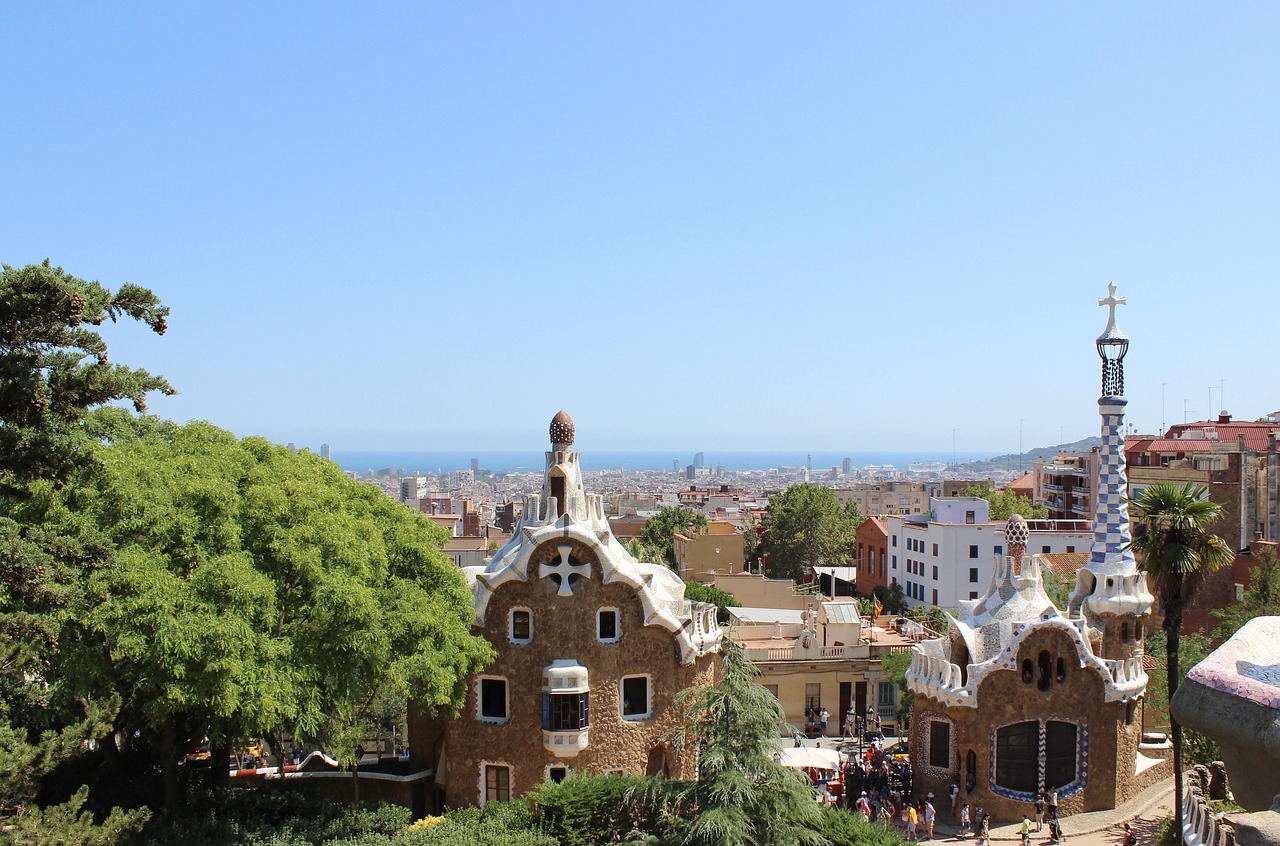
The main entrance on Carrer d’Olot is where Park Güell performs its grand reveal. You step off a fairly ordinary Barcelona street and suddenly there’s a pair of storybook gatehouses, a sweeping staircase, and the promise of color everywhere. It still makes me smile, even after dozens of entries.
Historically, these gatehouses were the concierge lodges of Eusebi Güell’s failed garden city experiment. Today, they set the tone: organic forms, ceramic mosaics, and a kind of architectural playfulness that feels almost subversive compared to the more solemn European monuments.
On my last autumn morning visit in 2026, I arrived 15 minutes before my 8:30 am entry time. The light was low and warm, the ticket scanners were just being fired up, and a small line of half-asleep visitors shuffled forward clutching coffees from the café across the street. This is, in my opinion, the single best time slot if you like your masterpieces with a side of relative quiet.
What to look for at the entrance:
- The gingerbread-like gatehouses – One now houses a small shop and exhibition; note the expressive rooflines and the ceramic-tiled spires that look like frosted cakes.
- The wrought-iron gates – Reused from Güell’s private estate, they’re a reminder that Gaudí saw nothing wrong with recycling materials artistically.
- The first glimpse of the Dragon Stairway – rising above you like a tiled river.
How long to spend: 15–20 minutes is enough to take photos, absorb the composition, and let your eyes adjust to the riot of detail before climbing the stairs.
Tip: If you love photography, step back across the street to capture the entire façade in one frame. The morning establishing shot of Park Güell that fills Instagram every summer? That’s taken from here, with the gatehouses in the foreground and the columns peeking above.
2. Dragon Stairway & El Drac
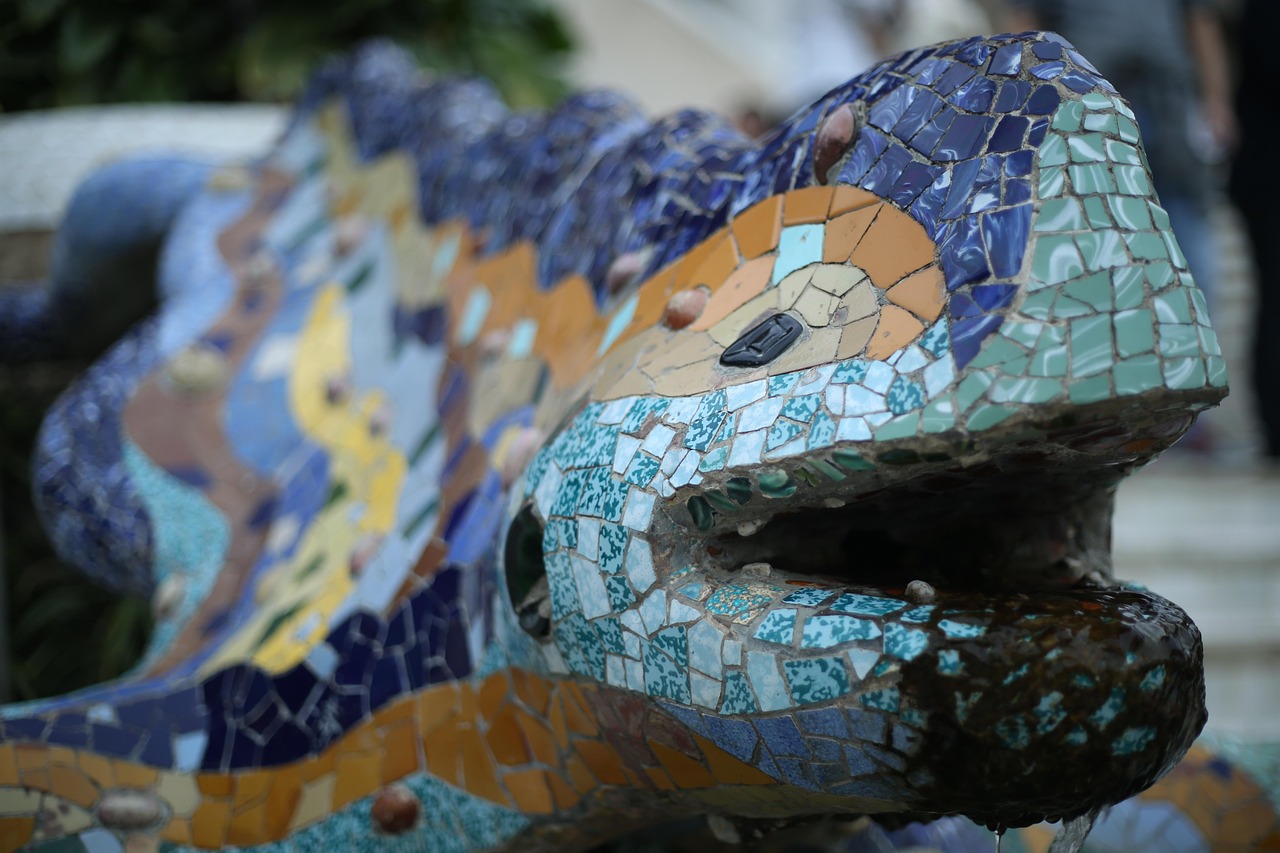
The Dragon Stairway is a double staircase that splits and rejoins like a stone waterfall, carrying you from the entrance up to the Hypostyle Room. In its center sits the park’s most beloved creature: El Drac, the mosaic “dragon” (technically more of a salamander) that has become a symbol of Barcelona itself.
Every visit, I tell myself I won’t stop here for long – and every visit I end up lingering. There’s something irresistible about watching families stage their photos: toddlers patting the dragon’s nose, grandparents leaning on canes, couples trying to get a lizard selfie without strangers in the background. It’s joyful chaos.
History & significance: The stairway was designed as a ceremonial approach, with water as a guiding theme. The dragon is part of a complex water collection system: rain filters down through the square above and is stored in a cistern beneath the stairs, with the dragon’s mouth acting as an overflow spout. It’s not just pretty; it’s clever urban infrastructure disguised as art.
What to look for:
- The three landings – Each has symbolic motifs, including Catalan emblems and religious references.
- The mosaic medallions – Look closely at the broken tile technique, known as trencadís. Many pieces were repurposed from local ceramic factories.
- The dragon’s scales – They shimmer differently in sun and shade; on a damp winter morning they glisten as if actually wet.
Photography tip: For a less crowded shot, walk up to the second or third landing and shoot back down towards the dragon with a longer lens. Early morning or late afternoon side-light brings out the texture of the tiles beautifully.
How long to spend: 20–30 minutes, more if you’re corralling kids or waiting for a lull in the crowds to get your photo.
3. Hypostyle Room (Hall of 100 Columns)
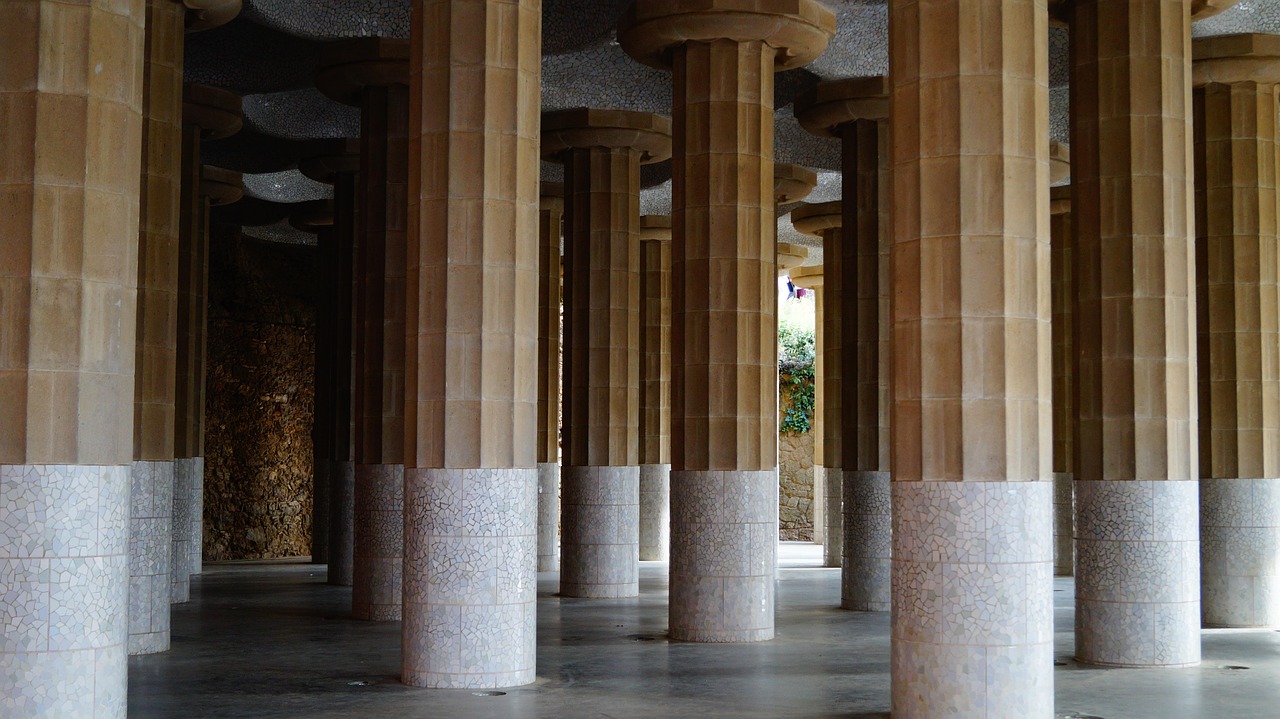
At the top of the Dragon Stairway you enter the Hypostyle Room, a forest of fluted Doric columns supporting the plaza above. Intended originally as a marketplace for the planned residential estate, it feels more like a temple stripped of its gods and left open to sea breezes.
It’s here that Park Güell becomes almost abstract. The columns are not perfectly aligned; some tilt slightly, some cluster. The ceiling is a white mosaic studded with four large, colorful medallions and countless small broken tiles that catch light in unexpected ways.
On a quiet January visit, I stood in the center and listened to a busker play a soft classical guitar piece. The acoustics here are extraordinary; sound travels but remains gentle. I watched a little girl spin in circles, her red coat blurring between the columns, and realized that while the market never opened, the space fulfilled its destiny as a gathering place.
History & structure: Built between 1908 and 1909, the Hypostyle Room’s 86 columns (not 100, despite the nickname) channel water from the plaza above into that same cistern feeding the dragon fountain. It’s another example of Gaudí’s eco-functional design a century before “sustainable architecture” became a buzzword.
What to look for:
- The four main medallions in the ceiling – Representing the seasons and possibly solar motifs; each is a swirl of color and mythic imagery.
- The edge details – Where the ceiling meets the outside, the curves echo sea waves, an homage to Barcelona’s Mediterranean identity.
- The water spouts – Subtle outlets along the ceiling perimeter that hint at the water collection system.
How long to spend: 20–40 minutes. Wander in zigzags between columns, pause to look straight up, and if you’re lucky enough to catch a musician, just sit and let the sound fill the space.
Tip: This is a pleasant shady refuge in summer. When the upper plaza is blazing, retreat here for a cool break.
4. Plaça de la Natura (Nature Square / Greek Theatre)
Climb a short flight of stairs from the Hypostyle Room and you emerge into the heart of the park: Plaça de la Natura, a broad, open terrace ringed by the famous sinuous bench. This is the “postcard view” of Park Güell – and one of my favorite places in Barcelona, bar none.
On clear days you see a full cinematic sweep: the gingerbread gatehouses below, the sea shimmering beyond the city, and the organic white tower of the gatehouse piercing the skyline like something from a fairytale. On hazy summer afternoons, the city blurs into a soft blue band and the plaza becomes all about people-watching.
Gaudí conceived this as a Greek Theatre, a place where residents could gather for open-air performances with the city as a backdrop. In 2026, it’s more likely to host selfie sessions and sunning lizards (the human kind), but occasionally cultural events bring the original intention back to life.
What to look for:
- The undulating bench – Designed by Gaudí’s collaborator Josep Maria Jujol, this is arguably the most comfortable stone bench you’ll ever sit on. The curve supports your back, and the angled seat keeps you in place.
- The trencadís mosaics on the bench – A chaotic yet somehow harmonious patchwork of broken ceramics. Look for hidden words, faces, and playful shapes.
- The drainage system – Slight slopes and discreet holes manage rainwater, again feeding into the park’s cisterns.
On a late May evening in 2026, I came up here with a visiting friend just before golden hour. We found a free section of bench (not always easy – be patient and a spot will open) and watched as the light slid across the city, turning brick orange and sea silver. A street musician played soft jazz, a couple quietly shared a bottle of cava from plastic cups, and a group of teenagers filmed a TikTok dance routine a few meters away. It was chaotic, but wonderfully so; this is living urban theatre.
How long to spend: 30–60 minutes; longer if you have the time. This is a natural pause point – drink water, snack, reapply sunscreen, and simply watch the show.
Photography tip: For the classic “Park Güell bench + city + sea” shot, walk to the right-hand side of the plaza (facing the sea) where the curve of the bench guides the eye towards the Sagrada Família in the distance.
5. Gaudí House Museum
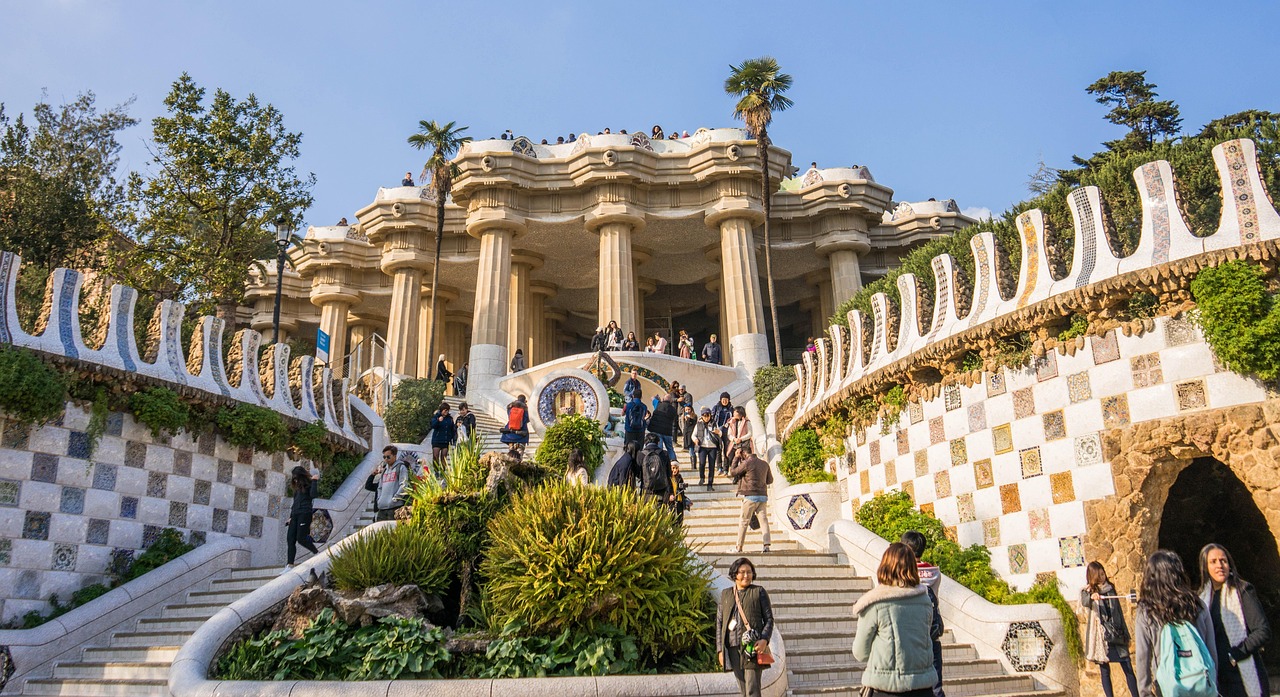
Tucked just above the monumental core, the Gaudí House Museum is easy to skip – but if you’re even mildly interested in the man behind the myth, it’s worth your time. This was Gaudí’s actual home from 1906 to 1925, and stepping inside feels like stepping into his quieter, more domestic world.
The building itself was designed by Gaudí’s collaborator Francesc Berenguer as a show house for the planned residential estate. When the project failed commercially, Gaudí bought the house and moved in with his father and niece. Today, it’s a small but evocative museum.
On a rainy February afternoon in 2026, I ducked in here partly to escape the drizzle. The soft pink façade looked almost luminous against the grey sky, and the garden smelled of wet earth and pine. Inside, the creak of the floorboards and the slightly uneven walls made the space feel more human than monumental.
What to see inside:
- Original furniture designed by Gaudí – Chairs, desks, and doors with his characteristic ergonomic curves.
- Personal objects – Photographs, religious items, and drawings that paint a picture of an intensely devout and focused man.
- Views from the upper windows – A different, more intimate framing of Park Güell’s gardens.
How long to spend: 30–45 minutes. It’s compact, but don’t rush – the details reward slow looking.
Ticket note: The Gaudí House Museum has a separate ticket from the main Park Güell monumental zone. In 2026, you can buy a combo online that slightly reduces the total cost and helps you secure a timed entry slot. It’s easiest to visit after touring the main monumental area.
Tip: The garden around the house is a surprisingly peaceful spot to sit for a few minutes, especially in late afternoon when the day-trip groups have thinned out.
6. Viaducts & Portico of the Washerwoman
Leaving the monumental core, the park softens into a network of viaducts and porticoes that feel more grown than built. These raised walkways and stone arcades were designed to carry horse-drawn carriages and pedestrians through the hillside without scarring the landscape.
The most famous of these is the Portico of the Washerwoman, a colonnaded path that curves dramatically like a breaking wave. One of the columns morphs into a figure of a woman carrying a basket on her head – a tribute to Catalan peasant life hiding in plain sight.
The first time I walked this path was on a blazing August afternoon. Down in the city, the heat was oppressive, but here in the shade of the portico, it was several degrees cooler. Kids clambered on the stone ledges, couples posed for photos, and I remember thinking how alive the architecture felt: it’s not just something you look at; it’s something you inhabit.
What to look for:
- The tilted columns – Many lean at dynamic angles, giving the impression of movement.
- The rough stone texture – Sourced from the hill itself, it blurs the line between built and natural.
- The Washerwoman figure – About halfway along the portico; look for the column with a subtle human silhouette.
How long to spend: 30–45 minutes walking the main viaducts and pausing for photos. They make a great transition zone between the busy monumental core and the calmer upper gardens.
Photography tip: Late afternoon side-lighting creates dramatic shadows along the Portico of the Washerwoman. A wide-angle lens captures the sweeping curve best.
7. Turó de les Tres Creus (Calvary Hill Viewpoint)
Climb high enough into Park Güell and you’ll reach Turó de les Tres Creus, a rocky knoll crowned by three stone crosses. This is the park’s wildest corner and, in my opinion, the best panorama in the entire complex.
The path up is a modest but steady climb, winding through pines and agaves. On a breezy March morning in 2026, I hiked up here with a coffee from a kiosk in hand, the smell of resin in the air. At the top, the city unfurled below like a map: the grid of Eixample, the spike of the Sagrada Família, the bulk of Montjuïc, and the bright band of the Mediterranean beyond.
History & symbolism: Gaudí originally considered placing a chapel here, but the plan never materialized. Instead, the three crosses (Calvary) mark the spot, one of them serving as a compass pointing to the cardinal directions. The roughness of the stone contrasts sharply with the polished mosaics of the lower park, a reminder that this is still, at heart, a hillside.
What to look for:
- The orientation cross – One cross has arrows indicating the cardinal points; it’s fun to align yourself with the geography of the city.
- The 360º views – On a clear winter day you may even glimpse the Montseny mountains to the north.
- The vegetation – Hardy Mediterranean plants clinging to the rocks; in spring, wildflowers add pops of color.
How long to spend: 30–40 minutes including the climb (15–20 minutes up from the main paths, depending on your pace) and time at the top.
Tip: The summit is exposed; bring a hat in summer and a jacket in winter. There’s no railing at some edges, so keep a close eye on kids.
8. Upper Gardens, Forest Paths & Quiet Corners
Beyond the crowds and cameras, Park Güell has a quieter self – the upper gardens and forested paths that locals use as a jogging route, a dog-walking loop, or simply a place to escape the city’s noise for an hour.
Here the design is subtler: terraced slopes, stone retaining walls, and clusters of pines and carob trees. Benches are scattered at viewpoints; unpaved paths branch off in inviting directions. I’ve spent many Sunday afternoons here with a book, sometimes forgetting for long stretches that one of the world’s most visited monuments is just below.
What to look for:
- Quiet viewpoints – Small clearings where you can see the sea framed by trees.
- Local life – Elderly neighbors out for a walk, teens practicing skateboard tricks, occasional yoga groups in hidden corners.
- Native plants – Mediterranean flora that Gaudí integrated intentionally, mirroring the natural landscape.
How long to spend: As long as you like. Even 30 minutes wandering up here gives you a different, more relaxed sense of Park Güell.
Tip: If you’re building a 2 or 3 day itinerary around Park Güell and Gràcia, plan one early morning or late afternoon just to walk these upper paths. It’s free, open 24/7, and feels like the locals’ version of the park.
1–3 Day Itineraries for Park Güell & Surroundings (2026 Edition)
Most visitors treat Park Güell as a quick stop on a frantic Barcelona checklist. That’s fine if time is short – there is such a thing as a solid 1 day itinerary for Park Güell. But if you can stretch to 2 days in Park Güell and its neighborhoods or even 3 days in Park Güell combined with other Gaudí sites, the experience deepens dramatically.
Below, I’ve laid out three personal itineraries based on actual visits in 2025–2026, tailored to different trip lengths. Each day mixes must-see attractions with quieter corners and local experiences, and is flexible enough to adapt to weather and energy levels.
One Perfect Day in Park Güell
If you only have 1 day in Park Güell, you’ll want an efficient but unhurried route through the park’s highlights, with time for views, photos, and at least one good meal in a local restaurant just outside the tourist funnel.
Morning: Early Entry & The Monumental Zone
On my ideal one-day visit, I’m at the main entrance 15–20 minutes before the earliest ticket slot (usually 8:30 am). The air is cooler, the light is softer, and you’ll share the park with far fewer tour groups.
Route:
- Enter via Carrer d’Olot main gate.
- Spend a few quiet minutes with the gatehouses and overall composition.
- Climb the Dragon Stairway, pausing on each landing for photos of El Drac and the mosaics.
- Drift into the Hypostyle Room, moving across the columns in a slow zigzag.
- Ascend to Plaça de la Natura and claim a spot on the bench.
By about 10:00–10:30 am, the plaza becomes noticeably busier. This is your cue to finish up your photos and begin exploring the park’s secondary layers.
Practical tips for a 1 day itinerary for Park Güell (morning):
- Tickets: Book online at least several days ahead in high season (May–September). Choose the earliest slot you can manage.
- Breakfast: Grab a coffee and simple pastry near Lesseps or Vallcarca metro before heading uphill; food inside the park is limited and pricey.
- What to bring: Refillable water bottle, hat, sunglasses, and a light layer in winter/spring (mornings can be cool).
Late Morning: Viaducts & Gaudí House Museum
From Plaça de la Natura, I usually wander towards the viaducts. The crowds thin out as you move away from the central core, and the shady stone paths feel like a balm after the bright terrace.
Walk the Portico of the Washerwoman, take photos along the curved colonnades, then loop up towards the Gaudí House Museum. If you’ve booked a combo ticket, this is the perfect time to duck inside.
Inside the museum, let yourself slow down. Look not just at the objects but at the proportions of the rooms, the views from the windows, the way the light falls. This was a working home, not a showpiece, and that intimacy is rare among Gaudí’s surviving works.
Lunch: Escape the Tourist Ring
By early afternoon, your stomach (and maybe your feet) will be sending you clear messages. Resist the temptation to sit at the first place you see outside the park gates; prices are high and quality often low.
Instead, walk 10–15 minutes downhill into Vallcarca or over towards the edge of Gràcia. I often take the Baixada de la Glòria escalators down to the lower streets, then wander until a place feels right: locals at tables, a handwritten menu in Catalan or Spanish, and no aggressive touts out front.
Typical lunch on my one-day Park Güell routine: a menu del dia (fixed-price lunch, usually 12–18€) with a starter like esqueixada (salt cod salad), a main of grilled fish or meat, dessert, and a glass of wine or water. You’ll eat better and pay less than in the hyper-touristy ring around the park.
Afternoon: Upper Gardens & Turó de les Tres Creus
After lunch, I like to re-enter the free access zone of the park from a side entrance and make a slow ascent through the upper gardens. The light is harsher now, but the trees provide shade, and the crowds have usually shifted back towards the monumental zone entrances.
Follow the signs toward Turó de les Tres Creus. Take your time; this is about the walk as much as the viewpoint. Once on top, you’ll see the entire morning’s route laid out below you in miniature.
On one particularly clear November day in 2025, I watched a storm front roll in from the sea while standing up here. The city remained in sun for several minutes while dark clouds stacked over the water, and the result was a dramatic, cinematic contrast I still think about.
Late Afternoon: Gràcia Stroll & Early Dinner
To round off your 1 day itinerary for Park Güell, drift downhill into Gràcia, one of Barcelona’s most characterful neighborhoods. From the northern edge of the park, aim for Plaça de la Vila de Gràcia or Plaça del Sol; both are about a 20–30 minute walk, mostly downhill.
Reward yourself with an early dinner or substantial tapas: patates braves, grilled vegetables with romesco sauce, a plate of padrón peppers, and maybe a slice of Basque cheesecake or mel i mató (fresh cheese with honey) to finish.
By the time you head back to your hotel, you’ll have seen Park Güell from bottom to top, day to dusk, and tasted a little of the local life that orbits this famous hill.
Two Days in and Around Park Güell
With 2 days in Park Güell and the surrounding neighborhoods, you can slow the pace, revisit favorite spots at different times of day, and weave in more cultural context and local flavor.
Day 1: Classic Park Güell, Done Slowly
Use the 1 day itinerary for Park Güell as your base, but stretch it out:
- Book a mid-morning timed ticket if you’re not an early riser.
- Spend more time in the Hypostyle Room and on the bench at Plaça de la Natura, maybe journaling or sketching.
- Build in a leisurely coffee break at one of the small kiosks or in nearby streets.
In the late afternoon, when the park is busiest, retreat fully into the upper gardens with a book or just your thoughts. Let the day drain out of you among the pines, then head into Gràcia for dinner as above.
Day 2: Gaudí Context, Local Life & Sunset Return
On my favorite two-day Park Güell plan, the second day is about context and contrast.
Morning:
- Visit another Gaudí site in the city – ideally Sagrada Família or Casa Batlló – to see how his style evolved in more urban settings.
- Have a long lunch back in Gràcia, perhaps at a traditional Catalan restaurant or a contemporary tapas bar.
Afternoon & Sunset:
- Walk or bus back up to Park Güell’s free access zone for a late afternoon stroll.
- Time your arrival at Plaça de la Natura or Turó de les Tres Creus for golden hour (roughly 1 hour before sunset).
- Watch as the city transitions from day to dusk; the bench and upper viewpoints are spectacular at this time.
On a spring trip in 2026, I did exactly this with my sister. We’d toured Casa Batlló in the morning, lingered over a late lunch in Gràcia, then climbed back to Park Güell just as the sky was turning peach. Sitting on the undulating bench with a small group of other sunset-watchers, we compared the way Gaudí treated color in stone houses versus mosaics. It felt less like sightseeing and more like a conversation with the city.
Three Days in Park Güell & Gaudí’s Barcelona
With 3 days in Park Güell and its orbit, you can build an immersive modernism and neighborhood experience. Think: slow mornings, deep dives into architecture, and multiple passes through the park at different moods and lights.
Day 1: First Encounter & Orientation
Follow a slightly shortened version of the 1 day itinerary for Park Güell, but don’t push to see everything. Focus on:
- Main entrance, Dragon Stairway, Hypostyle Room.
- Plaça de la Natura with a long bench sit.
- Short wander along the Portico of the Washerwoman.
Think of this as your “first date” with Park Güell. You’re getting acquainted, not trying to learn every detail.
Day 2: Details, Museum & Neighborhoods
On your second day, go back in with intention:
- Revisit one or two favorite spots from day 1 (I often choose the Hypostyle Room and bench) and look for details you missed: tile fragments, column angles, hidden motifs.
- Visit the Gaudí House Museum if you haven’t yet, spending more time than you think you need.
- Leave the park by a different exit and spend the afternoon exploring Gràcia’s squares, boutiques, and galleries.
On a 2025 research trip, I spent nearly an hour just photographing bench mosaics on day 2. Up close, they’re wilder than they look from afar: broken cups, floral tiles, even fragments of what were once bathroom fixtures. It’s recycling turned into poetry.
Day 3: Sunrise, Forest & Offbeat Gaudí
Dedicate your third day to off-peak times and offbeat angles:
- Sunrise walk in the free access upper gardens. The monumental zone opens later, but you can access the surrounding paths and viewpoints early. Bring a thermos of coffee.
- Climb to Turó de les Tres Creus for first light over the city. In winter, sunrise is late enough that this doesn’t require heroic wake-ups.
- Later in the day, visit a lesser-known Gaudí or modernist site – for example, Torre Bellesguard or Casa Vicens, both of which offer quieter, more contemplative experiences than the big hitters.
That sunrise walk is one of my favorite Park Güell memories. I went in early February 2026, when the air had a bite and the city was still half-asleep. From the upper paths, I watched the sky change from inky blue to pale pink, with only a few joggers and dog walkers for company. Down below, the monumental zone waited behind its gates, but up here the park belonged entirely to the neighborhood.
Eating & Drinking Around Park Güell
Food immediately around Park Güell has historically been a minefield of limp sandwiches and overpriced paella. Things are improving, but my rule remains: walk at least 8–10 minutes away from the main entrances before you sit down.
What to Bring Into the Park
- Water: There are a few fountains, but not always where you need them. A refillable bottle is essential in summer.
- Light snacks: Nuts, fruit, a small sandwich. Picnicking is allowed in designated areas in the free zone; be respectful and pack out your trash.
- Coffee: You can bring takeaway coffee, but secure the lid – paths are uneven.
Where Locals Actually Eat
Without naming specific businesses (which change more quickly than guidebooks), here’s how I choose:
- Head down towards Lesseps or Vallcarca for traditional menu del dia spots.
- Walk into Gràcia (towards Plaça de la Vila or Plaça del Sol) for creative tapas, vermouth bars, and bakeries.
- Avoid places with photographed menus, servers shouting in multiple languages, and “paella for two” signs plastered everywhere.
My usual pattern after a morning in Park Güell is to descend into Gràcia, find a square, and choose any place where I hear more Catalan than English at the tables. I’ve had memorable lunches of roasted vegetables, grilled butifarra sausage, and crisp salads that cost less than a coffee and croissant at some central tourist cafés.
Where to Stay Near Park Güell
Most visitors stay closer to the center (Gothic Quarter, Eixample, El Born) and commute to Park Güell. That’s perfectly workable – the park is only 20–30 minutes away by metro and bus. But if you want quieter nights and a more local feel, consider staying in:
- Gràcia: My top choice. Village-like atmosphere, great food, easy access to Park Güell on foot or by bus, and well-connected to the rest of the city.
- Lesseps / Vallcarca: Slightly more residential, with simple hotels and apartments. Very convenient for early Park Güell visits.
On a research stay in autumn 2025, I rented a small apartment at the bottom of the Baixada de la Glòria. Every morning, I’d ride the escalators up toward Park Güell before the main tourist wave, and every evening I’d descend into Gràcia for dinner and a drink. It struck a perfect balance between access and atmosphere.
Park Güell by Time of Day: Sunrise, Golden Hour & After Dark
Sunrise (Dawn)
The free access zone of Park Güell is open 24 hours, so you can roam the upper paths and viewpoints at sunrise. The monumental zone opens later, typically in tandem with official opening hours.
At dawn, the city is a hushed silhouette, and you’ll mostly encounter local joggers and dog walkers. It’s a wonderful time for contemplative photography and quiet thinking.
Daytime
From late morning to mid-afternoon, especially in high season, the park is busy. This is when timed entry tickets earn their keep, managing – if not eliminating – congestion in the monumental zone. Aim to be in the shadier lower areas during the midday heat.
Golden Hour & Sunset
Golden hour (roughly one hour before sunset) is the most beautiful time to see the mosaics glow and the city soften. The bench at Plaça de la Natura and Turó de les Tres Creus are prime spots.
On several evenings in 2025–2026, I watched as street performers drifted away, day-trippers filed out, and the park’s energy mellowed into something almost local again. If your schedule allows, plan at least one golden hour visit.
After Dark
The monumental zone typically closes around dusk, with seasonal variations. However, the surrounding park remains open. After dark, the upper paths feel secluded; the city glitters below, but the park itself is only minimally lit.
For safety, stick to main paths, avoid walking alone very late at night, and be mindful of footing. There is no regular sound-and-light show in 2026, but occasional special evening events (see next section) bring temporary lighting and performances.
Cultural Etiquette & Local Customs in and Around Park Güell
Park Güell may be a global landmark, but it sits within a very real, very lived-in Catalan neighborhood. A few cultural notes will help your visit feel respectful and smooth.
Language
- Locals speak Catalan and Spanish. Either is appreciated; English is widely understood in tourism contexts.
- Simple Catalan phrases like bon dia (good day) or si us plau (please) go a long way.
Behavior in the Park
- No climbing on mosaics, walls, or restricted areas. Damage is expensive and sometimes irreversible.
- Keep noise moderate, especially in early morning and late evening when nearby residents are resting.
- Picnicking: Fine in the free zone, but not on the mosaicked benches or stairways. Always clean up.
Local Rhythms
- Lunch is typically 1:30–3:30 pm; many restaurants don’t serve full meals at 12:00.
- Dinner starts later than in many countries: 8:00–10:30 pm is normal.
- Sunday afternoons, you’ll see families strolling the upper paths; join in, but remember the park is part of their weekly routine, not just a tourist attraction.
Events & What’s New for Park Güell in 2026–2027
While Park Güell doesn’t host massive festivals like the city center, 2026–2027 brings a few notable developments:
- Enhanced Evening Cultural Programs (Pilot 2026–2027): Occasional guided twilight walks and small-scale musical performances are being tested in shoulder seasons (spring and autumn). Check official channels closer to your visit.
- Accessibility Improvements (2026): Ongoing upgrades to ramps and paths in select areas of the monumental zone and free access paths to better accommodate wheelchairs and strollers.
- Gaudí Anniversary Exhibitions: Rotating exhibitions across the city’s Gaudí sites (including Park Güell’s information center and the Gaudí House Museum) exploring his ecological ideas – a fascinating lens for repeat visitors.
Additionally, the nearby neighborhood of Gràcia continues to host its spectacular Festa Major every August, with street decorations and concerts that are easily combined with Park Güell visits if you’re in town then.
Nearby Attractions & Easy Day Trips from Park Güell
Within Barcelona
- Gràcia Neighborhood: A natural pairing with Park Güell. Squares, indie shops, and a strong local identity.
- Casa Vicens: Gaudí’s early residential work, about a 20-minute walk downhill. Less crowded, richly detailed, and an excellent complement to Park Güell’s garden-city concept.
- Bunkers del Carmel: A short but steep walk or bus ride from Park Güell’s upper side. Offers expansive city views from an old anti-aircraft battery; go at sunset, bring layers and water.
Day Trips Beyond Barcelona
While not directly “from Park Güell” in transport terms, once you’re up here and in a Gaudí frame of mind, you may be inspired to explore further:
- Colònia Güell: A former industrial village with a stunning, lesser-known Gaudí crypt. Reachable by commuter train from Plaça d’Espanya.
- Montserrat: A dramatic mountain monastery about an hour away by train and cable car. Great for hikers and those wanting a spiritual or nature-focused day.
Both can be combined with a Park Güell-centric trip if you have 3–4 days in Barcelona and want varied landscapes and experiences.
Tickets, Opening Hours & Practical Logistics (2026)
Ticket Types
- General Ticket – Monumental Zone: Timed entry, includes access to the main Gaudí core (stairway, Hypostyle Room, Plaça de la Natura, gatehouses).
- Combo Ticket: Monumental zone plus Gaudí House Museum, usually at a slight discount versus buying separately.
- Guided Tour Tickets: Small-group tours with an official guide; more expensive, but invaluable if you want structured context.
- Free Zone: The rest of the park (upper gardens, many paths) remains free and open 24/7.
Timed Entry & Reservations
For most of 2026, advance online booking is strongly recommended, especially for morning and late afternoon slots. In high season (May–September, Easter, and Christmas/New Year), popular time slots may sell out several days in advance.
Arrive at the gate 10–15 minutes before your time slot. If you’re late, staff may let you in within a short grace period, but this isn’t guaranteed when the park is at capacity.
Opening Hours (Subject to Seasonal Changes)
- Monumental Zone: Roughly 9:00 am to 7:30–9:30 pm depending on season (earlier closing in winter, later in summer).
- Free Zone: Open 24 hours, but lighting is limited outside main paths.
Always verify current hours on the official site close to your visit; 2026 may see minor adjustments with new evening programs.
Rules & Restrictions
- Photography: Allowed for personal use throughout, but no tripods or professional equipment without permits.
- Drones: Not permitted.
- Smoking: Officially discouraged, and often prohibited in key areas; follow local signage.
- Dress Code: Casual is fine; just dress for the weather and hill walking. Comfortable shoes are essential.
Accessibility
Park Güell is on a hill, and not all areas are fully accessible, but 2026 improvements have made more of the monumental zone reachable by:
- Accessible routes with ramps and smoother paths in key sections.
- Dedicated entrance options for visitors with reduced mobility – check the official map and signage.
If you use a wheelchair or have mobility challenges, I recommend:
- Entering from the main gate on Carrer d’Olot, where surfaces are more manageable.
- Allowing extra time and consulting the latest accessibility map online before arrival.
Getting To & Around Park Güell
Public Transport
Barcelona’s public transit is efficient and the best way to reach Park Güell without stress.
- Metro + Walk/Bus:
- L3 (Green Line) – Lesseps or Vallcarca: From either station, it’s a 15–20 minute uphill walk or a short bus ride on local lines (signposted at the metro exits).
- Bus: Several lines stop near different park entrances; check real-time apps (TMB, Google Maps) for the best option from your location.
- Taxi / Ride-hail: Convenient for early-morning or late-evening visits; ask to be dropped at the Carrer d’Olot main entrance or the nearest side entrance depending on your plan.
Car Rental & Parking
Driving to Park Güell is generally more trouble than it’s worth:
- Parking is limited and streets are narrow and steep.
- Barcelona’s public transit is excellent; you don’t need a car to visit Park Güell.
If you do have a car for a broader road trip, park further away and use public transport or walk for the final approach.
Foreign Driving Licenses & Visas
- Driving: Most non-EU licenses are accepted for short stays; an International Driving Permit (IDP) is recommended and sometimes required by rental agencies. Check current Spanish regulations before arrival.
- Visas: Spain is part of the Schengen Area. Many travelers (e.g., from the EU, UK, US, Canada, Australia, New Zealand) can enter visa-free for short stays, but always verify current rules as they may evolve by late 2026–2027.
Money-Saving, SIM Cards & Connectivity Tips
Saving Money at Park Güell
- Buy tickets online: Avoids on-site surcharges and last-minute “sold out” headaches.
- Use the free zone: Even if monumental zone tickets are gone or out of budget, the upper gardens and viewpoints are free and beautiful.
- Eat like a local: Seek menu del dia lunches in Gràcia or Lesseps instead of grabbing food right outside the park.
- Public transport passes: Multi-day travel cards can reduce per-ride costs and simplify moving between sites.
SIM Cards & Connectivity
For 2026 visitors, connectivity is straightforward:
- eSIMs: Many travelers opt for eSIM data packages purchased before arrival; these work well across Spain.
- Local SIM Cards: Available from major providers (Movistar, Vodafone, Orange) at airports, city shops, and some supermarkets. Bring your passport.
- Wi-Fi: Most hotels and many cafés offer reliable Wi-Fi. Coverage in Park Güell itself is patchier; don’t rely on it for navigation.
As a local, I keep maps for Park Güell and its surrounding streets downloaded offline in a mapping app – it makes getting turned around on hillside paths much less stressful.
Best Time & Season to Visit Park Güell
Seasons
- Spring (March–May): My personal favorite. Mild temperatures, blooming plants, and longer days. Great for photography and comfortable hill walking.
- Summer (June–August): Hot, especially midday; crowds are at their peak. Visit early morning or late afternoon, wear sun protection, and take advantage of shade in the Hypostyle Room and viaducts.
- Autumn (September–November): Still warm in September; comfortable and less crowded in October–November. Light can be spectacular, especially around sunset.
- Winter (December–February): Cooler, with some crisp days and fewer crowds. Shorter opening hours and a chill at higher viewpoints, but excellent visibility on clear days.
Best Time of Day
- Early Morning: Best for avoiding crowds and capturing soft light; highly recommended for a 1 day itinerary for Park Güell.
- Late Afternoon / Golden Hour: Best for romantic visits, photographers, and those wanting to see the city glow below.
- Midday: Manageable in winter; best avoided in high summer unless you stick to shaded areas.
Summary & Final Recommendations
Park Güell in 2026 is more than a quick photo stop. It’s a layered experience: a failed garden city turned world icon, an open-air gallery of mosaics and columns, a neighborhood park for Gràcia’s residents, and a hillside stage where the whole of Barcelona plays out below you.
If you’re planning 1 day in Park Güell, book an early ticket, start at the main entrance, climb steadily through the Dragon Stairway and Hypostyle Room to Plaça de la Natura, walk a viaduct or two, and finish in the upper gardens or Gràcia for a meal. For 2 days in Park Güell, add a sunset return, the Gaudí House Museum, and more neighborhood time. With 3 days in Park Güell and Gaudí’s Barcelona, weave in sunrise walks, lesser-known modernist gems, and slower, more reflective passes through the park.
Respect the mosaics, pace yourself on the hills, detour into Gràcia for honest food, and give yourself at least one unstructured hour just to sit – on a bench, under the pines, or atop Turó de les Tres Creus – and let the city tell you its story from a little distance. That, more than any checklist, is how to visit Park Güell well.