Why Visit Plaza de España Seville in 2026
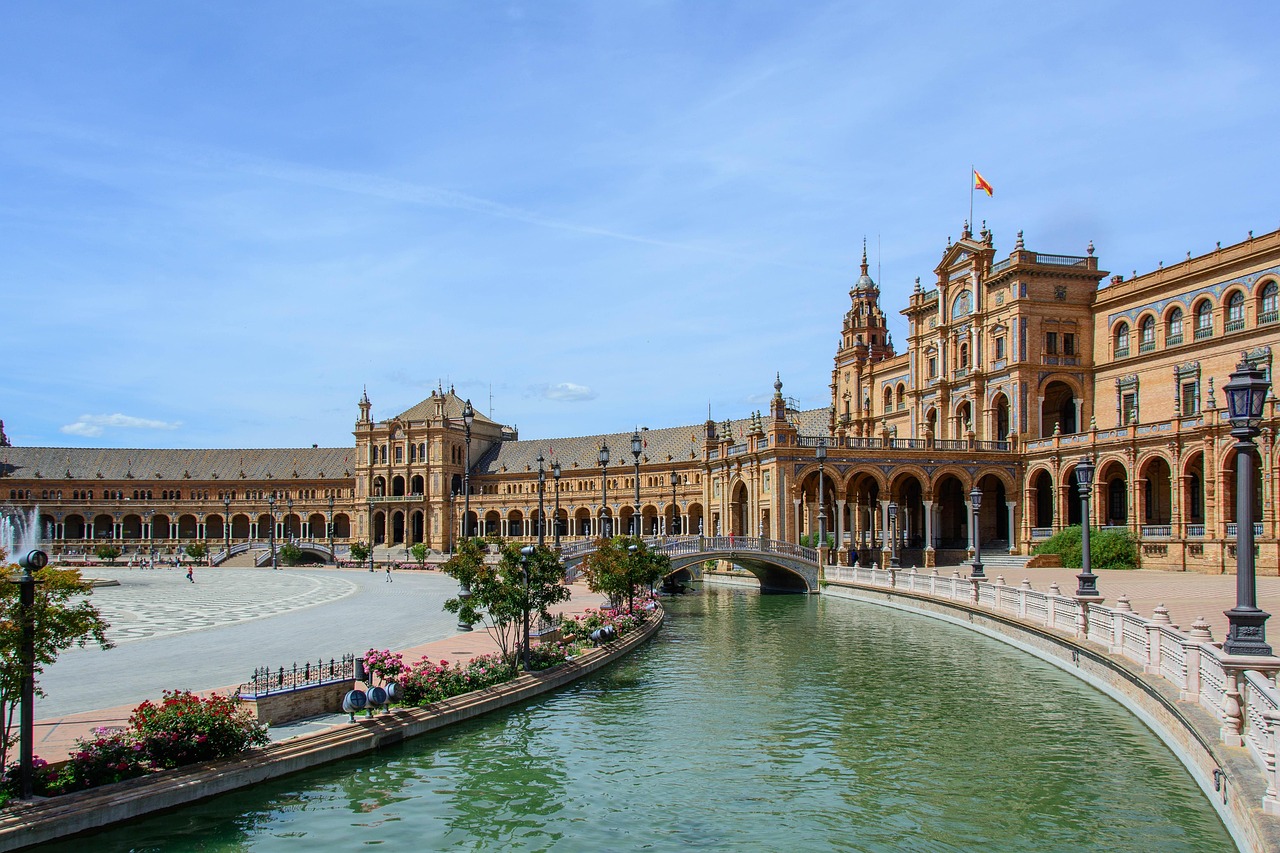
Plaza de España in Seville is one of those rare places that manages to be both cinematic and deeply human at the same time. Built for the Ibero-American Exposition of 1929, it’s an enormous semi-circular palace of brick, marble, and azulejo tiles, wrapped around a canal where rowboats drift lazily under ornate bridges. You’ve seen it in Lawrence of Arabia and Star Wars, but on the ground it feels less like a movie set and more like a grand living room for the city.
I live about a fifteen-minute walk away, and Plaza de España has become my default answer to almost everything: where to take visiting friends, where to go for a thinking walk, where to watch the sunset without paying for a rooftop bar. Over the years I’ve learned when the light is best on the ceramic balustrades, which benches are actually comfortable, which buskers are worth lingering for, and where to escape when the crowds roll in.
This 2026 travel guide for Plaza de España Seville is designed to be both poetic and practical. Whether you just have a 1 day itinerary for Plaza de España Seville or you’re planning a deeper 3 days in Plaza de España Seville with the park and nearby neighborhoods, I’ll walk you through the plazas, viewpoints, hidden corners, and surrounding streets as if we were wandering together.
You’ll find detailed itineraries (1–3 days), must-see attractions in Plaza de España Seville, cultural experiences and local customs, and straightforward travel tips for Plaza de España Seville covering everything from tickets and logistics to when the tiles glow at golden hour.
Table of Contents
- Why Plaza de España Seville Belongs on Your Itinerary
- Plaza de España at a Glance (History, Layout, What to Expect)
- Main Sections & Viewpoints of Plaza de España
- 1. The Semi-Circular Palace & Central Fountain
- 2. The Canal and Iconic Bridges
- 3. Provincial Alcoves & Azulejo Benches
- 4. Upper Galleries & Best Panoramic Views
- 5. Parque de María Luisa: The Green Heart Next Door
- 6. The Museums on the Plaza’s Edge
- 7. Adjacent Neighborhoods (El Prado, El Porvenir & More)
- 8. Hidden Corners & Lesser-Known Spots
- Suggested Itineraries: 1, 2 & 3 Days Around Plaza de España
- Where to Eat & Drink Around Plaza de España
- Plaza de España After Dark & Off-Hours Magic
- Events, Festivals & What’s New in 2026–2027
- Nearby Attractions & Easy Day Trips
- Cultural Etiquette & Local Customs
- Logistics: Tickets, Hours, Accessibility & Safety
- Practical Travel Advice: Money, SIM Cards, Transport & Seasons
- Summary & Final Recommendations
Plaza de España at a Glance: History, Layout & What to Expect
Plaza de España sits at the edge of Parque de María Luisa, about a 15–20 minute walk south from Seville’s cathedral. It’s technically a public space, not a paid monument, which means there’s no entry fee for the plaza itself. That’s a pleasant surprise if you’ve been tallying up ticket prices around Spain.
Designed by architect Aníbal González and inaugurated in 1929 for the Ibero-American Exposition, the plaza was a statement piece: Spain opening its arms to the Spanish-speaking world. The semi-circular form symbolizes an embrace; the buildings face west toward the Americas. A wide moat-like canal arcs around the plaza, crossed by four bridges representing the ancient kingdoms of Spain.
You’ll navigate four main elements as you walk:
- The central square & fountain – the open heart of the plaza, framed by the building’s arcades.
- The canal & bridges – where rowboats, reflections, and endless photos happen.
- The provincial alcoves – tiled benches and maps for each Spanish province, each an artwork.
- The upper galleries – broad balconies and corridors with the best views over the whole scene.
On a typical day in 2026 you’ll see wedding shoots, buskers playing Spanish guitar, kids chasing bubbles, couples renting boats, and locals using the shaded corridors as their running track at dawn. The plaza is both theatrical and lived-in, which is the essence of Seville itself.
Main Sections, Viewpoints & Adjacent Sites
Below are the eight areas you’re most likely to explore on a deep visit, each with history, details, and some hard-earned local tips.
1. The Semi-Circular Palace & Central Fountain
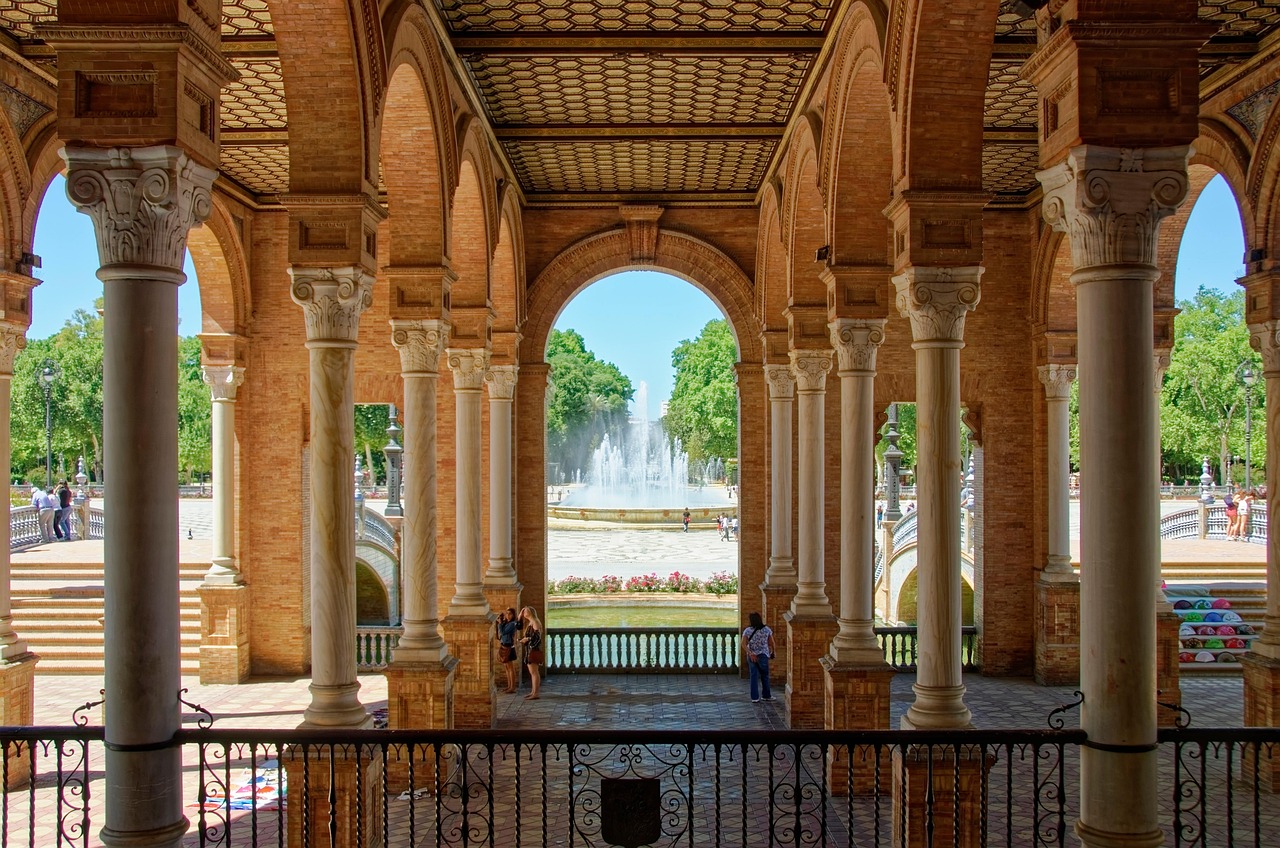
My first memory of Plaza de España was stepping from the shaded corridor into the blazing open square one October afternoon, the central fountain throwing up arcs of water that caught the light like glass. The semi-circular palace curves around you, tower to tower, like a stage set waiting for the actors to step on.
The style is a hybrid: Regionalist architecture that borrows from Renaissance, Baroque, and Mudéjar traditions, layered with brick, marble, and river-blue tiles. Walk slowly along the inner perimeter of the square and pay attention to the changing patterns in the balustrades and lamp posts; they’re not as repetitive as they first appear.
What to look for:
- The central fountain: Best photographed early in the morning when the mist is visible in the first light, or during golden hour when the water glows. On windy days, be careful where you stand if you’d prefer to stay dry.
- The twin towers (torres norte y sur): They anchor each end of the semi-circle. Neither is open for climbing as of 2026, but use them as orientation points when you’re moving around.
- The floor details: Look down. The stonework patterns radiate outward, subtly guiding you toward the canal bridges.
Best time to be here: For photos with fewer people, arrive right around sunrise. Locals out running will weave around you, but the big tour groups won’t appear until 9:30–10:00. For atmosphere, I love just before sunset, when families come out and buskers set up around the fountain.
How long to spend: Even on a tight schedule, give yourself at least 30–45 minutes circling the fountain and walking a full lap of the semi-circle.
2. The Canal & Iconic Bridges
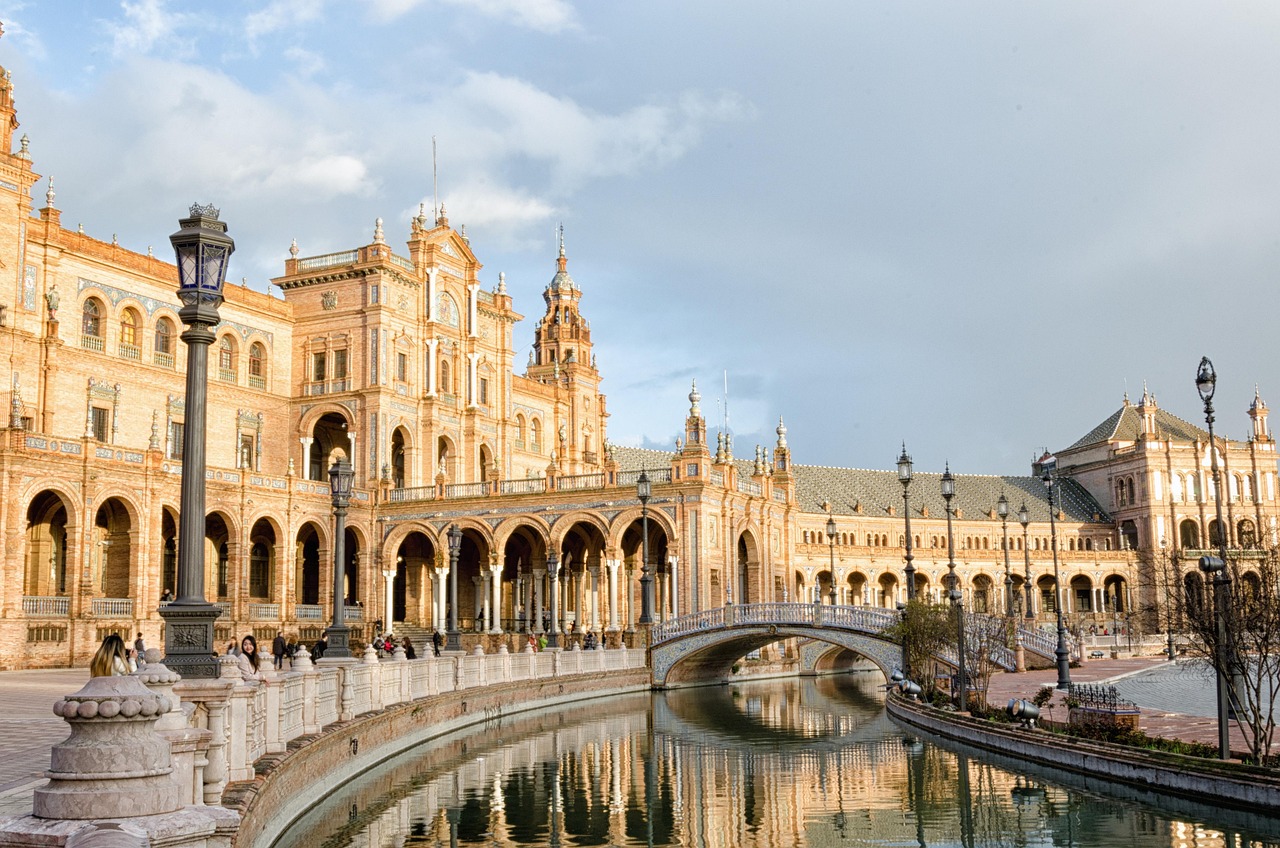
If the semi-circular palace is the face of Plaza de España, the canal is its smile. It curves gently along the base of the building, crossed by four ceramic-laden bridges that might be the most photographed railings in Andalusia.
Each bridge has balustrades of blue-and-white azulejos, each column slightly different, each lamp post topped with delicate ceramic finials. On my last visit in early 2026, I stood on the second bridge watching a rowing couple argue amiably about who was steering badly. That’s the mood here: half romance, half comedy.
Rowboat rentals:
- Where: The small boat rental kiosk sits on the right-hand side of the plaza (if you’re facing the palace), beside the canal.
- Cost (2026): Typically around €10–€12 for 35–45 minutes per boat (up to four people). Card accepted most of the time, but carry cash just in case.
- When: Open daily roughly 10:00–21:00 in high season, shorter hours in winter and rainy days.
- Tip: For couples, go near sunset on a weekday; you avoid school groups and the light is perfect. For families, late morning is easier with kids — less glare and heat than midday.
Photography tips:
- Stand on the bridges and shoot toward the towers for classic postcard views.
- For a sense of scale, frame a boat just under the bridge arch from the central square side.
- In blue hour (just after sunset), the canal reflects the lamps beautifully; a tripod or steady hand is useful here.
How long to spend: Allow 45–60 minutes if you want to both walk the bridges and rent a boat; otherwise, 20–30 minutes for photos and people-watching.
3. Provincial Alcoves & Azulejo Benches
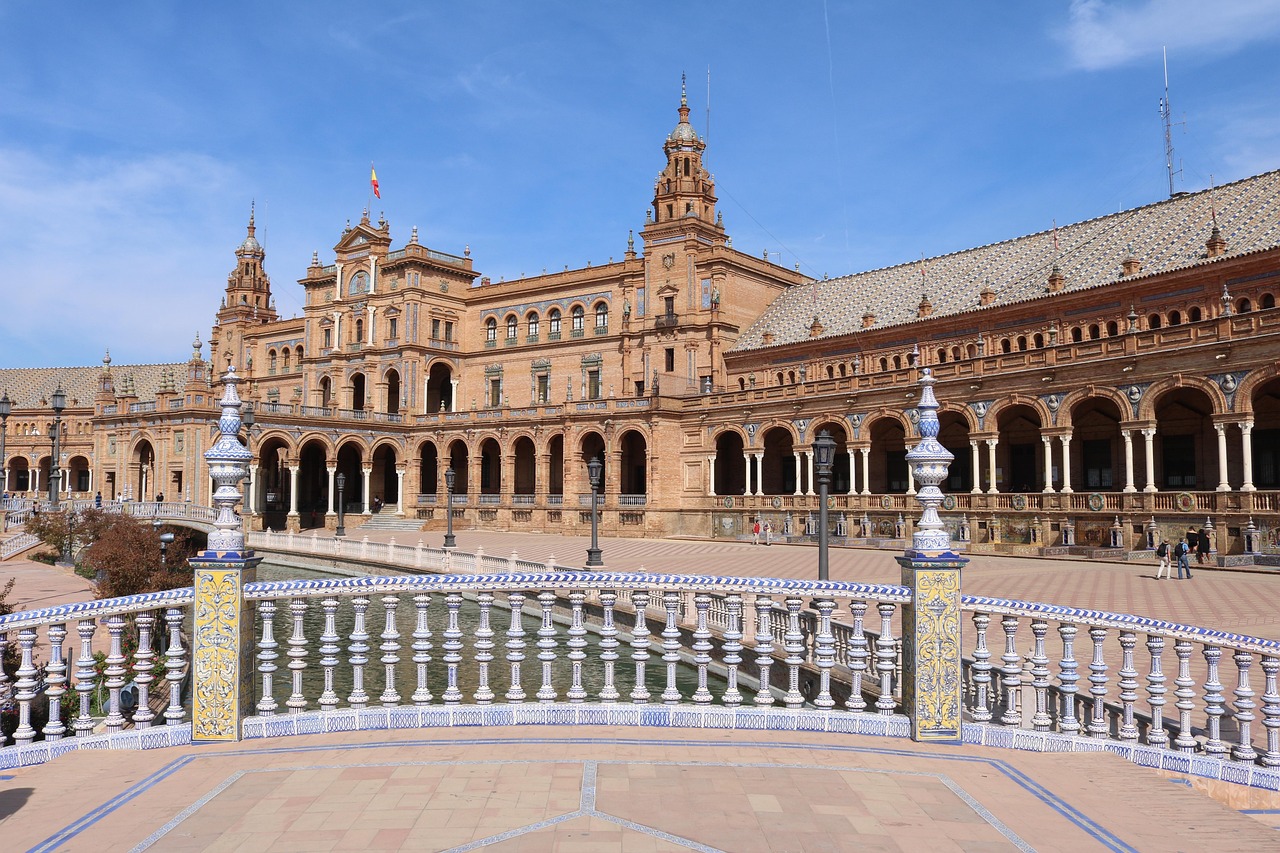
The provincial alcoves are my favorite part of Plaza de España. Set into the lower section of the building, they’re tiled micro-scenes for each of Spain’s provinces, arranged alphabetically. If you’re visiting with Spanish friends, this is where they instinctively head to take a picture with their home province. I’ve lost track of how many times I’ve sat on the Cádiz bench listening to people talk about summers on the Costa de la Luz.
What they represent: Each alcove has a central tile mural depicting a historic scene or map from that province, flanked by benches and smaller decorative panels. It’s essentially an outdoor open-air geography lesson wrapped in ceramics.
How to explore them:
- Start at one end (Andalucía’s provinces are especially beloved) and stroll slowly; you’ll notice different color palettes and artistic styles.
- If you’re traveling with kids, make a game: find your favorite tile, spot the coats of arms, or look for the province you’ll visit next.
- For language learners, read the place names aloud; Sevillanos will happily correct your pronunciation with a smile.
Hidden detail: Look at the small tiled maps under each main mural. They show train lines and cities from the late 1920s, a snapshot of Spain’s geography and infrastructure at that moment in history.
Best times: Mid-morning or late afternoon, when the sunlight rakes across the tiles. Midday sun can be harsh and hot on the benches.
How long to spend: A full lap of the alcoves can easily take 45–90 minutes if you’re an art or history lover; at least 20 minutes even on a quick visit.
4. Upper Galleries & Best Panoramic Views
The upper galleries are where the plaza reveals its full grandeur. Broad corridors run along the inner curve of the building, with tall arches framing the canal, bridges, and fountain below. This is where I usually bring visitors once they’ve had their fill of close-ups at ground level.
How to get up there: There are several staircases along the semi-circle, tucked behind the provincial alcoves. Look for open stairwells; as of 2026 the upper level is freely accessible during daytime hours, though some doors may be closed for maintenance or small exhibitions.
What to look for:
- Viewpoints over each bridge: Stand directly above the bridges and look down through the balustrades for layered compositions.
- Ceiling details: The coffered wooden ceilings and painted beams often get overlooked; stop and look up.
- Acoustic pockets: In some archways, you’ll hear street musicians playing below; the galleries act as a natural echo chamber.
On a breezy spring evening last year, I watched a couple practicing a quiet sevillanas dance step in one of the upper arches, their music coming from a phone speaker. Down below, hundreds of people milled around; up here, it felt like a private balcony.
Safety & etiquette:
- Don’t sit on or lean heavily over the balustrades; they’re strong but old.
- Tripods are allowed informally, but don’t block the passage during busy hours.
- Keep voices low; sound carries to the plaza below more than you expect.
How long to spend: At least 30–45 minutes strolling the full semi-circle, longer if you’re into photography.
5. Parque de María Luisa: The Green Heart Next Door
Step through the back of Plaza de España and you’re suddenly in Parque de María Luisa, Seville’s lush, romantic parkland. Whenever I feel the plaza getting too busy, I escape into the park’s shaded paths. It’s the perfect complement: if Plaza de España is architectural drama, María Luisa is dappled light and birdsong.
History & layout: Once the gardens of the San Telmo Palace, the park was redesigned for the 1929 Exposition. Expect winding paths, tiled fountains, duck ponds, and a generous scattering of palm trees, orange trees, and jacarandas (which explode into purple blossom in late April–May).
Family-friendly highlights:
- Duck ponds & doves: Kids love feeding (though ideally, don’t overdo bread) and watching the birds.
- Bikes & pedal carts: Rentals are often available near main entrances; great for covering more ground.
- Playgrounds: Simple but handy if you need a break while kids burn off energy.
Romantic spots: The Isleta de los Pájaros (Bird Island) and the quieter fountains deep inside the park are lovely places for couples. Bring a takeaway coffee from a café on Avenida de la Borbolla or Felipe II and wander until you find “your” bench.
How long to spend: You could cross the park in 20 minutes, but it deserves 1–2 hours wrapped into any serious visit to Plaza de España. In summer, this is where you’ll want to linger in the shade.
6. The Museums on the Plaza’s Edge
Several of Seville’s most interesting (and underrated) museums sit just beyond Plaza de España within Parque de María Luisa’s footprint. They’re ideal for adding depth to your visit while escaping midday heat.
Museo de Artes y Costumbres Populares (Museum of Arts and Popular Traditions):
- Focus: Andalusian crafts, folk traditions, textiles, ceramics, and domestic life.
- Why go: If you’re fascinated by the tiles at Plaza de España, this museum gives context to the artisanship behind them.
- Time needed: 60–90 minutes.
Museo Arqueológico de Sevilla (Seville Archaeological Museum):
- Focus: Roman and pre-Roman artifacts from the region, including pieces from nearby Itálica.
- Why go: To understand Seville’s deeper layers beneath the 1920s grandeur.
- Time needed: 60–90 minutes.
On a personal level, I often duck into the Arts and Traditions museum when the sun is punishing. I’ll emerge an hour later with a notebook full of patterns I want to sketch, then return to Plaza de España seeing its ceramics anew.
Tip: Check current opening hours online; they can shift slightly seasonally and on holidays. As of 2026, many state museums in Andalusia remain free or very inexpensive for EU citizens, with modest fees for others.
7. Adjacent Neighborhoods: El Prado, El Porvenir & Beyond
Most visitors arrive at Plaza de España, snap photos, and then boomerang straight back to the historic center. That’s a shame, because the surrounding neighborhoods – especially El Porvenir and the streets around Prado de San Sebastián – are where Seville feels lived-in and pleasantly local.
El Porvenir:
- A residential area just south-east of the plaza.
- Low-rise houses, tree-lined streets, and a handful of excellent tapas bars where you’ll mostly hear Spanish.
- Perfect for a post-plaza lunch or evening drink.
Prado de San Sebastián area:
- Transport hub with tram, metro, and bus connections.
- Gateway between the historic center and Plaza de España/María Luisa.
- Good spot for picking up a SIM card, grabbing a simple breakfast, or catching a tram toward San Bernardo.
On many evenings I walk home through El Porvenir after sunset at Plaza de España, stopping for a glass of manzanilla and a tapa of espinacas con garbanzos. It’s a simple pleasure, but it’s exactly where the monumental and the everyday overlap.
8. Hidden Corners & Lesser-Known Spots
Even in such a well-known landmark, there are pockets that most people miss.
Behind-the-arcade corners: Walk behind the provincial alcoves toward the outer side of the building. Small courtyards and quieter staircases hide here, where you can catch your breath away from the selfie sticks.
Far ends of the canal: The stretches near the towers are often calmer, with better reflections and fewer vendors.
Tile hunting: Bring a telephoto lens or just a curious eye and search for small discrepancies and repairs in the tiles. You can see the passage of decades in the slightly mismatched glazes.
One drizzly January day in 2025, I spent nearly an hour tucked into a dry corner under an archway, just watching the plaza in the rain. The tiles became mirrors, and the usually crisp edges blurred. If you happen to catch a rainy day, don’t bail on your visit; come anyway and let Plaza de España show you a mood most tourists never see.
Suggested Itineraries: 1, 2 & 3 Days Around Plaza de España
Below you’ll find tailored itineraries that weave Plaza de España into a broader exploration of its surroundings. They’re designed to help you decide how to visit Plaza de España Seville depending on your time and interests.
1 Day Itinerary for Plaza de España Seville
If you only have 1 day in Plaza de España Seville and its immediate surroundings, you can still experience the essential magic without rushing too much. This is roughly the route I take when friends land in Seville for just a weekend and we dedicate a single day to the plaza and park.
Morning: Plaza de España in Soft Light
Start as close to sunrise as you can manage, especially in spring or autumn. I like to arrive by 8:00–8:30, walking down from the cathedral via Avenida de la Constitución and the tram line, then cutting across Prado de San Sebastián.
As you step into the square, you’ll likely share it with joggers, dog walkers, and the maintenance crew hosing down tiles. The central fountain often isn’t on yet, which gives you a different view: the emptiness emphasizes the geometry.
- Walk a full circle of the central square.
- Cross each bridge slowly, pausing in the middle for different angles.
- Climb up to the upper galleries via the first accessible staircase you see.
From the upper galleries, look east as the sun comes up behind the towers; the arches frame the glowing sky. I like to carry a takeaway coffee (in a reusable cup) and sip it from one of the quieter archways.
Late Morning: Provincial Alcoves & Canal Boat
By 10:00, the first tour groups begin to arrive. This is a good time to descend and wander the provincial benches. Pick your favorites, take photos, and notice how people naturally gravitate to “their” province.
Around 11:00, head for the boat rental kiosk. You’ll avoid the heaviest afternoon queues, and the sun won’t yet be at full power. If you’re traveling with kids, let them take turns rowing; if you’re a couple, you may end up with the classic “you’re rowing in circles” argument — consider it part of the experience.
Lunch: Escape the Tourist Ring
By now you’ll be hungry, and the food carts near the plaza aren’t where you want your main meal. Walk south-east into El Porvenir (8–10 minutes). Your options include:
- Neighborhood tapas bars – classic Andalusian dishes at local prices.
- Simple menú del día spots – a set lunch menu with starter, main, dessert, and drink; great value.
This is also a good time to duck into a supermarket for water and fruit if you’re traveling on a budget.
Afternoon: Parque de María Luisa & One Museum
Return via a different entrance into Parque de María Luisa. Spend a couple of hours meandering: find the Bird Island, sit by a pond, let the kids run. When the sun is highest, consider heading into either the Museo de Artes y Costumbres Populares or the Archaeological Museum for an hour of cool, shaded culture.
If you’re short on energy, simply pick one: I’d choose the Arts and Traditions museum if you loved the tilework at Plaza de España; the Archaeological Museum if Roman history intrigues you.
Late Afternoon & Sunset: Back to the Plaza
As the heat softens, drift back toward Plaza de España. By now it will be busier, but the mood is festive. Street musicians often set up under the arches around 18:00–19:00.
- Revisit your favorite viewpoints from the morning, this time in warmer light.
- Find a spot on the balustrade or benches to watch the sky change; I like the area near the southern tower.
When the last light hits the upper brickwork, the entire palace glows a deep, rusty gold. It’s the kind of sight that stays with you long after your trip ends.
Evening: Tapas & Stroll Back to the Center
Head back toward the historic center via Prado de San Sebastián, stopping for tapas either in El Porvenir or closer to the cathedral. You’ve just completed a focused but rich 1 day itinerary for Plaza de España Seville that balances iconic moments with quiet corners.
2 Day Itinerary for Plaza de España Seville
With 2 days in Plaza de España Seville and its surroundings, you can slow down and layer on more experiences: museums, local bars, and more time in the park.
Day 1: Architecture, Tiles & First Impressions
Follow the 1 day itinerary for Plaza de España Seville above, but without rushing. The difference is in the pacing: linger longer at the alcoves, spend more time in the upper galleries, and perhaps skip the museum on day one to save your indoor time for day two.
In the evening, consider walking north along the river from Torre del Oro for a sunset drink; it gives you a satisfying sense of how Plaza de España connects to the rest of the city.
Day 2 Morning: Deep Dive into the Park & Museums
On your second morning, start in Parque de María Luisa. Enter from a different gate – perhaps from the river side – and let yourself get a little lost. Notice the shifting garden styles, the small pavilions, the secluded benches mostly occupied by locals.
Late morning, head to your chosen museum. If you’re traveling as a family, the Archaeological Museum can be surprisingly engaging for kids if you turn it into a treasure hunt for specific motifs (lions, horses, mythological creatures).
Day 2 Afternoon: Local Life in El Porvenir
After lunch in El Porvenir, explore the neighborhood more deliberately:
- Look for modernist and early 20th-century residential architecture – echoes of the 1929 Exposition era.
- Stop at a bakery for something sweet; pestiños or torrijas if you’re here around Semana Santa.
- Find a small bar where the TV is showing a Betis or Sevilla FC game; the atmosphere is part of the cultural experience.
Day 2 Evening: Plaza de España After Dark
On your second evening, time your return to Plaza de España so you’re there just before sunset and can stay into blue hour. As the lamps flicker on and the sky deepens to navy, the reflections in the canal change completely.
In winter, you might find the plaza almost eerily quiet at night; in spring and autumn, groups linger, musicians play, and couples stroll hand in hand. It’s one of the most romantic free “evening programs” in Seville.
3 Day Itinerary for Plaza de España Seville
With 3 days in Plaza de España Seville and its immediate orbit, you can treat the plaza as an anchor point for a richer exploration of the city and even a nearby day trip.
Day 1: The Classic Plaza Experience
Use the same structure as the 1 day itinerary for Plaza de España Seville, but give yourself permission to wander and sit more. Let day one be about pure first impressions, photographs, and a sense of place.
Day 2: Culture & Neighborhoods
Dedicate day two to the museums, deeper exploration of Parque de María Luisa, and time in El Porvenir and the streets around Prado de San Sebastián. This is also a good day to handle practicalities: buying a local SIM, familiarizing yourself with the tram and metro, and sampling non-touristy restaurants.
Day 3: Day Trip + Return to the Plaza
On day three, take a short day trip (more options in the section below) and return to Plaza de España for a final walk.
Two favorites that pair well with Plaza de España:
- Itálica: Roman ruins just outside Seville; visit in the morning, then come back and see Plaza de España with fresh eyes about how Spain reinterprets its past.
- Triana & Ceramics: Spend the day across the river in Triana visiting ceramic workshops, then finish at Plaza de España comparing the modern tiles you’ve just seen with the 1920s azulejos here.
On your last evening, walk one last slow lap of the semi-circle, pick your favorite provincial bench, and sit for ten minutes. Let the place imprint itself on your memory before you go.
Eating & Drinking Around Plaza de España
The immediate surroundings of Plaza de España skew touristy: snack carts, ice cream, and basic terrace cafés with views but middling food. For a proper meal, you’ll want to walk 8–15 minutes into nearby neighborhoods.
General Food Strategy
- Avoid sitting down for a full lunch right on the plaza; fine for coffee or a drink, not for serious tapas.
- Head to El Porvenir or the streets around Felipe II and Avenida de la Borbolla for better value and more locals.
- For budget travelers, pick up picnic supplies (bread, cheese, fruit, olives) at a supermarket and eat in Parque de María Luisa.
What to Eat in the Area
Classic Andalusian dishes to look for on menus nearby:
- Salmorejo – thicker, creamier cousin of gazpacho, often topped with jamón and egg.
- Tortilla de patatas – potato omelet; judge a bar by this.
- Espinacas con garbanzos – spinach and chickpeas; a Sevillian staple.
- Pescado frito – fried fish, especially in bars that look busy with locals.
- Churros con chocolate – especially in cooler months, ideal pre- or post-plaza treat.
What to Bring Onto the Site
- Water: Always carry a bottle, especially April–October; refill at park fountains where marked potable.
- Light snacks: Nuts, fruit, or a small bocadillo can save you from overpriced stands.
- Sun gear: Hat, sunglasses, sunscreen; there’s a lot of open, reflective stone.
Plaza de España After Dark & Off-Hours
Plaza de España is magical at any time, but certain windows transform it completely.
Sunrise & Early Morning
Best time for photographers and anyone who likes quiet. The light comes from behind the palace, casting long shadows and bathing the bricks in pastel tones. Runners and dog-walkers give the place a lived-in feel, but you can usually frame shots without crowds.
Golden Hour & Sunset
The hour before sunset is my favorite. The sun moves behind the park, the heat eases, and the plaza fills with a gentle buzz. Musicians often play Spanish guitar or flamenco under the arches or near the fountain.
Blue Hour & Night
When the lamps flick on and the sky turns deep blue, the reflections in the canal and the way the towers are illuminated can feel almost surreal. In 2026 there are occasional special lighting displays and projection events tied to city festivals (Feria de Abril, Navidad); check local listings or your hotel’s noticeboard for any scheduled light shows.
Safety: The plaza is generally safe at night, especially in spring and autumn when many people are about. As always, keep an eye on your belongings and avoid very late solitary walks through the darkest parts of the park.
Events, Festivals & What’s New in 2026–2027
Seville’s big events shape the rhythm of life at Plaza de España.
Annual Highlights
- Semana Santa (Holy Week, March/April): While the processions focus in the historic center, Plaza de España sees more visitors, and spring blooms in Parque de María Luisa are spectacular.
- Feria de Abril (April Fair): Held at Los Remedios fairgrounds; Plaza de España is a lovely daytime escape from Feria intensity.
- Summer Cultural Nights: Concerts and performances sometimes take place in or near the park on summer evenings.
- Navidad (Christmas Season): December brings lights across the city; while Plaza de España doesn’t host major markets, it’s beautifully quiet and atmospheric.
What’s New for 2026–2027
- Ongoing restoration and maintenance of ceramic elements continues; you may find small sections scaffolded but the overall experience remains intact.
- City plans include more integrated guided walking routes linking Plaza de España, María Luisa, and Triana’s ceramic workshops, making it easier to connect the dots between tiles and their makers.
Nearby Attractions & Easy Day Trips from Plaza de España
While Plaza de España is a destination in itself, it’s also a convenient starting point for several nearby attractions.
Within Walking Distance
- Seville Cathedral & Giralda: About 15–20 minutes’ walk north; combine with Plaza de España over 1–2 days.
- Torre del Oro & Guadalquivir River: 15 minutes’ walk, nice for a sunset stroll along the water.
- Triana: Cross the river from the center; ceramic shops and tapas bars await.
Short Trips
- Itálica: Take a bus or organized tour to this Roman site. Plan 3–4 hours door-to-door.
- Carmona: Hilltop town with Roman and medieval history; reachable by bus.
For all these, start or end your route at Prado de San Sebastián, which connects Plaza de España to buses, trams, and metro lines.
Cultural Etiquette & Local Customs in Plaza de España Seville
Sevillanos are used to visitors, but a little cultural awareness goes a long way.
General Behavior
- Respect shared space: Don’t block stairs or narrow parts of the galleries for long photo shoots.
- Noise: It’s fine to be lively, but avoid shouting or loud music, especially in the early morning or late at night.
- Dress: Casual is fine; just remember that Seville is sunny and conservative-ish. Beachwear is out of place in the city center.
Photos & People
- Ask before taking close-up photos of strangers, especially children or buskers.
- If you photograph street performers, tipping is appreciated.
Romance & Public Displays of Affection
Plaza de España is undeniably romantic, and you’ll see couples holding hands, hugging, or sharing a kiss. Modest affection is normal; overtly sexual behavior is not appreciated.
Logistics: Tickets, Hours, Accessibility & Safety
One of the joys of Plaza de España is how low-stress it is compared to ticketed monuments.
Tickets & Entry
- Plaza de España itself: Free public space, no ticket required.
- Opening hours: The plaza is generally accessible daily, though gates to Parque de María Luisa may be closed late at night. Exact times can vary slightly by season but approximate daylight hours.
- Museums: Separate tickets and specific hours; check ahead if you’re visiting on Mondays or holidays.
Peak Hours & Best Time to Visit
- Peak: 10:30–16:00, especially March–June and September–October.
- Best for quiet: Early morning (sunrise–9:00) and late evening (after 20:00 in summer).
- Best for photos: Golden hour before sunset and early morning for soft light.
Accessibility
- Ground level: Largely accessible with smooth surfaces; some cobblestones but manageable.
- Upper galleries: Currently accessible mainly via stairs; limited access for those with mobility impairments.
- Benches & shade: Plenty of seating under the arches and in the park.
Security & Safety
- Pickpocketing is not rampant but can happen in any tourist area; keep valuables close.
- At night, stick to lit paths and avoid the deepest, unlit parts of the park alone.
- Police patrols are common in high season and during events.
Photography Restrictions
- Personal photography is freely allowed.
- For professional shoots (weddings, fashion, commercial), local regulations may require permits; check with city authorities.
- Drones are generally not permitted without specific authorization.
Practical Travel Advice for Visiting Plaza de España Seville
Beyond the plaza itself, a few practicalities will smooth your visit.
Getting There Without Wasting Time
- On foot: 15–20 minutes from Seville Cathedral; a pleasant walk.
- Tram: Take the T1 tram to Prado de San Sebastián, then walk 8–10 minutes.
- Metro: Line 1 to Prado de San Sebastián or San Bernardo, then walk.
- Bus: Several lines stop nearby; check current routes at your accommodation.
- Taxi / Ride-hailing: Easy and relatively affordable; useful in summer heat.
Where to Stay Nearby
For easy access to Plaza de España while still enjoying Seville’s main sights, aim for:
- Historic center: Cathedral / Santa Cruz area – 15–25 minutes’ walk to the plaza, ideal if it’s your first time in Seville.
- Prado / San Bernardo: Quieter, more residential; excellent transport links and quick access to both the plaza and the center.
- El Porvenir: Very local feel, great if you prefer residential streets and being near the park.
Saving Money
- Remember that Plaza de España is free; allocate your ticket budget to the cathedral, Alcázar, and selected museums.
- Eat your main meal at lunchtime with a menú del día rather than at dinner.
- Use public transport or walk rather than relying solely on taxis.
SIM Cards & Connectivity
- Prepaid SIMs from major Spanish providers (Movistar, Orange, Vodafone) and low-cost brands (Lowi, Pepephone) are widely available in phone shops and some supermarkets.
- EU roaming rules mean EU residents can often use their home plans without extra fees.
- Free Wi-Fi is available in many cafés and some public spaces, but don’t rely on the plaza itself for strong coverage.
Public Transport vs. Car Rental
- Within Seville: You don’t need a car; walking, trams, buses, and taxis are enough.
- Car rental: Useful only if you’re exploring rural Andalusia or multiple towns; parking near Plaza de España can be tricky and/or paid.
Visa & Driving License Considerations
- Visa: Spain is in the Schengen Area. Many nationalities can enter visa-free for short stays (up to 90 days). Check current requirements before traveling.
- Driving licenses: EU licenses are valid as-is. Non-EU visitors may need an International Driving Permit (IDP) alongside their home license if renting a car.
Best Time of Year to Visit Plaza de España Seville
- Spring (March–May): Ideal. Orange blossoms, mild temperatures, jacarandas blooming. Also the busiest due to Semana Santa and Feria.
- Summer (June–August): Very hot (often 35–40°C). Visit Plaza de España early morning or late evening, retreat indoors midday.
- Autumn (September–November): Lovely balance of warmth and fewer crowds; my personal favorite for long park walks.
- Winter (December–February): Mild, quieter, occasionally rainy; beautiful low light and far fewer visitors.
Summary & Final Recommendations
Plaza de España is more than a pretty backdrop; it’s a living, breathing part of Seville’s daily rhythm. Whether you have a tight 1 day itinerary for Plaza de España Seville or a leisurely 3 day itinerary for Plaza de España Seville, the key is to experience it at different times of day and from different angles.
Walk the semi-circle at dawn. Trace the provincial benches with your fingertips. Drift under the ceramic bridges in a rowboat. Escape into the shade of Parque de María Luisa when the sun bites. Come back at sunset and again after dark, when the lamps and reflections give the plaza an entirely new personality.
For most travelers, the best time to visit Plaza de España Seville is spring or autumn, but winter offers quiet charm and summer rewards early risers and night owls. However and whenever you come, give the plaza more than just a quick photo stop; let it be a place where you linger, observe, and, for a little while, feel like part of Seville’s ongoing story.