Why Visit Bayeux?
Bayeux is one of those rare places where history, beauty, and everyday French life blend so seamlessly that you almost forget how important it is. This small town in Normandy survived World War II largely intact, which means you get cobbled streets, timbered houses, a magnificent Gothic cathedral, and centuries of stories layered on top of each other—without the crowds you’ll find in bigger French cities.
I’ve been coming to Bayeux on and off for over a decade—sometimes for a long weekend with friends, sometimes as a base for exploring the D-Day beaches, sometimes just to slow down with good food and walks along the River Aure. Every time I return, I find another corner café, another small chapel, another story from a local who still remembers the liberation. It’s a place that feels intimate, yet globally significant.
Whether you’re planning a 3 day itinerary for Bayeux, stretching it to 4 days in Bayeux, or lingering with a 5 day itinerary for Bayeux, this guide will help you build a trip that balances must-see history with relaxed, local experiences.
- For history lovers: The Bayeux Tapestry, D-Day sites, medieval streets, and a cathedral that has seen nearly a millennium of change.
- For families: Gentle walks, clear storytelling museums, easy day trips, and small-town safety.
- For couples: Candlelit dinners, quiet riverside strolls, and a romantic old town that glows at night.
- For curious travelers: Local markets, Norman cheeses and cider, hidden chapels, and conversations with proud locals.
Bayeux is also a fantastic base for exploring Normandy—Mont-Saint-Michel, Caen, the D-Day beaches, and the cider route are all within reach. Yet at night, you return to a calm town where the cathedral bells are usually the loudest sound.
Table of Contents
- Why Visit Bayeux?
- Overview of Bayeux in 2026
- Recommended 3–5 Day Itineraries
- Top 20+ Must-See Attractions in Bayeux
- Neighborhoods & Areas to Explore
- Local Food in Bayeux & Where to Eat
- Nightlife, Entertainment & Cultural Experiences
- Best Day Trips from Bayeux
- Local Customs & Cultural Etiquette
- Practical Travel Tips for Bayeux
- Summary & Best Time to Visit Bayeux
Overview of Bayeux in 2026
In 2026, Bayeux feels both timeless and subtly refreshed. The stone houses and narrow lanes are unchanged, but there’s a quiet revival in food, small galleries, and cultural events. Tourism is strong but not overwhelming, and the town remains walkable and friendly.
Location & Vibe
Bayeux is in Normandy’s Calvados department, about 30 minutes from Caen by train and roughly 2.5 hours from Paris Saint-Lazare. It’s compact enough that you can cross the center in 15 minutes on foot, but rich enough that you can easily spend several days exploring.
Major Events 2026–2027
- Bayeux Calvados-Normandy Award for War Correspondents (October 2026 & 2027): A powerful annual event with exhibitions, talks, and photojournalism displays across the city.
- D-Day Anniversary (6 June 2026 & 2027): Commemorations along the nearby beaches, often with ceremonies, re-enactments, and flyovers.
- Cathedral Light Show (summer evenings, 2026–2027): A sound-and-light projection on the cathedral façade (dates announced each spring; ask at the tourist office).
- Normandy Food & Cider Weekends (various weekends, 2026–2027): Pop-up markets and tastings celebrating Calvados, cider, and Norman cheeses, often spilling into Bayeux.
Recommended 3–5 Day Itineraries for Bayeux
Below are flexible itineraries for 3 days in Bayeux, 4 days in Bayeux, and a leisurely 5 day itinerary for Bayeux. I’ve woven in my own experiences and some hidden gems. Use them as a base; you can mix and match according to your interests.
3 Day Itinerary for Bayeux
Day 1: Old Town, Cathedral & Bayeux Tapestry
When I arrive in Bayeux, I always start by dropping my bags at my guesthouse and walking straight toward the cathedral. It’s the anchor of the town and the perfect orientation point.
Morning: Bayeux Cathedral & Old Town Stroll
Begin at Bayeux Cathedral (Cathédrale Notre-Dame de Bayeux). Even if you’re tired from travel, step inside: the cool air and soaring arches wake you up better than coffee. I like to walk the perimeter of the nave slowly, noticing the carved stone faces and the mix of Romanesque and Gothic styles.
- Best time: Around 9–10am, when tour groups are few and light filters through the stained glass.
- Tip: Check if the crypt is open—its faded frescoes are easy to miss but worth a look.
After the cathedral, wander the streets radiating out around it. Follow the little bronze “Bayeux” markers embedded in the pavement—these form a walking route past key sights. I usually duck into the small bookshops and artisan stores: there’s a ceramics atelier on a side street where I once spent half an hour chatting with the owner about glazes and Normandy weather.
Lunch: Traditional Norman Fare
For lunch, choose a brasserie with outdoor seating within sight of the cathedral. Order something quintessentially Norman: galette complète (savory buckwheat crêpe with ham, cheese, and egg) or moules-frites in cider cream when in season. Pair it with a glass of local cider. This is your first encounter with local food in Bayeux—simple, rich, and comforting.
Afternoon: Bayeux Tapestry Museum
Next, head to the Musée de la Tapisserie de Bayeux (Bayeux Tapestry Museum). Even if you’re not a “museum person,” this is different. The tapestry—actually an embroidered linen strip nearly 70 meters long—tells the story of William the Conqueror and the 1066 Battle of Hastings.
The museum provides an excellent audio guide that walks you scene by scene. I like to do one slow pass with the audio, then another faster walk just soaking in the details: the little dogs underfoot, the ships, the strange mythical creatures in the borders.
- Allow: 1.5–2 hours.
- Family tip: Older kids usually love the vivid battle scenes; the audio guide keeps them engaged.
- Practical: Go mid-afternoon; it’s often quieter then than late morning.
Late Afternoon: River Aure Walk
As the day softens, walk along the River Aure. Start near the old mill wheel (one of my favorite photo spots in the city) and follow the river as it curves behind stone houses and under low bridges. This is where Bayeux feels particularly romantic.
Evening: First Night in Bayeux
For dinner, choose a cozy bistro in the old town. I often go for fish—Normandy does it well—or a rich poulet à la crème. If it’s summer, linger for a post-dinner stroll; if you’re here during the cathedral light show season, time your walk to watch the façade come alive after dark.
Day 2: D-Day Beaches & World War II History
A travel guide for Bayeux isn’t complete without WWII history. I’ve done the D-Day circuit many times, and it still hits me every visit. Bayeux makes an ideal base: you can visit the sites by organized tour, rental car, or even a combination of bus and walks.
Morning: Arromanches-les-Bains & Mulberry Harbour
Start early and head to Arromanches-les-Bains, about 15 minutes by car. I like to begin at the clifftop viewpoint above town where you can see the remains of the artificial “Mulberry Harbour” out at sea. In the morning light, the concrete blocks look strangely peaceful, but the scale reminds you of the massive operation behind D-Day.
- How to get there: Rental car, taxi, or D-Day tour from Bayeux. In summer, limited buses run; check schedules at the tourist office.
- Tip: If driving, combine Arromanches with other key sites to make a loop.
Visit the Arromanches 360° circular cinema to see archival footage projected around you. It’s intense but extremely well done. Then stroll down into town, walk the beach, and if the tide is low, get closer to the hulks of the old harbor.
Lunch: Seaside Lunch in Arromanches
Grab a simple lunch along the seafront—mussels in season, or a seafood platter. I usually sit on a terrace facing the water, letting the wind and salt air clear my head after the museum.
Afternoon: American Cemetery & Omaha Beach
Continue to the Normandy American Cemetery and Memorial above Omaha Beach. No matter how many times I visit, the sight of the white crosses lined up against the green grass gets me. Take your time. There’s a small visitor center with moving exhibits and personal stories; then walk among the graves and, if you can, down to the beach itself.
- Allow: 2–3 hours, more if you like to walk.
- Respect: This is a place of remembrance. Keep voices low, dress modestly, and avoid loud phone calls or music.
Evening: Quiet Return to Bayeux
On days like this, I keep the evening simple. Back in Bayeux, I like a relaxed dinner and maybe a Calvados (apple brandy) nightcap. Many visitors say this is the day that stays with them the longest.
Day 3: Museums, Market & Hidden Corners
Your third day in Bayeux is about filling in the gaps: smaller museums, local markets, and those side streets that caught your eye.
Morning: Market (If Saturday) & Bayeux Museum Cluster
If it’s a Saturday, start at the Bayeux weekly market (around Place Saint-Patrice and nearby streets). It’s my favorite weekly ritual here: locals catching up, vendors shouting out specials, the smell of roasted chicken and cheese. Buy picnic supplies—cheese, bread, fruit, maybe a slice of apple tart.
Then choose one or two of Bayeux’s smaller museums:
- Musée d’Art et d’Histoire Baron Gérard (MAHB): A lovely mix of art, local history, lace, and porcelain in the former episcopal palace.
- Memorial Museum of the Battle of Normandy: Good for those who want more context on the events around D-Day, with vehicles, maps, and displays.
Afternoon: Hidden Lanes & Riverside Picnic
Use your market haul for a picnic by the River Aure. One of my favorite spots is a small bench under a tree just off the main path, where you can watch ducks drift by and hear the cathedral bells in the distance.
After lunch, wander into residential streets south of the cathedral and east toward the train station. You’ll find stone houses with overflowing flower boxes, quiet squares, and the kind of small-town details that never make it into guidebooks.
Evening: Last Night Treat
For your final evening of a 3 day itinerary for Bayeux, consider a slightly nicer restaurant—one of the town’s bistros focusing on seasonal Norman cuisine. I like to end with a dessert featuring apples or salted butter caramel; both taste like Normandy in a spoonful.
4 Day Itinerary for Bayeux
If you have 4 days in Bayeux, you can slow down and add one more substantial experience—either more WWII history, a food-focused day, or a countryside escape.
Day 4 Option A: Deeper WWII & British/Canadian Sectors
For history buffs, day four can focus on the British and Canadian landing beaches: Gold, Juno, Sword. I’ve done this day with a local guide and alone; both work, but a guide helps bring small details to life.
- Juno Beach Centre (Courseulles-sur-Mer): Excellent Canadian museum with personal stories and exhibits.
- Gold Beach & British Normandy Memorial: A newer memorial that’s particularly moving; combine with a walk along the bluffs.
- Small village stops: Places like Ver-sur-Mer or Langrune-sur-Mer, where everyday life goes on around memorials and plaques.
End the day with a quiet dinner back in Bayeux; this is a mentally full day.
Day 4 Option B: Food, Cider & Countryside
If you’d rather lean into regional flavors, design day four around Normandy’s farms and cider houses.
- Visit a cider farm (cidrerie) within 30–40 minutes of Bayeux for tastings of cider, Pommeau, and Calvados.
- Stop at a fromagerie (cheese farm) to sample Camembert, Pont-l’Évêque, and Livarot.
- Have a long countryside lunch at a ferme-auberge (farm inn) with rustic dishes and a slow pace.
This makes for a great romantic or foodie-focused day, contrasting well with the heavier war history.
5 Day Itinerary for Bayeux
A 5 day itinerary for Bayeux lets you combine all of the above with a proper day trip a bit farther afield.
Day 5: Day Trip to Mont-Saint-Michel or Caen
Two excellent options:
- Mont-Saint-Michel: Iconic island abbey about 1.5–2 hours away. It’s busy and touristy, but the first sight of it floating above the tidal flats is unforgettable.
- Caen: Larger city 30 minutes away with the Caen Memorial Museum, ducal castle, and a more urban feel than Bayeux.
If it’s your first time in Normandy and the logistics work, Mont-Saint-Michel is hard to beat. Otherwise, Caen makes for a lower-stress but very rewarding day trip with fewer crowds.
Top 20+ Must-See Attractions in Bayeux
Here are the best places to visit in Bayeux, with deeper dives into each one: history, significance, and how they’ve felt to me over multiple visits. These are the core of your “things to do in Bayeux” list, from the famous to the more hidden gems.
1. Bayeux Cathedral (Cathédrale Notre-Dame)
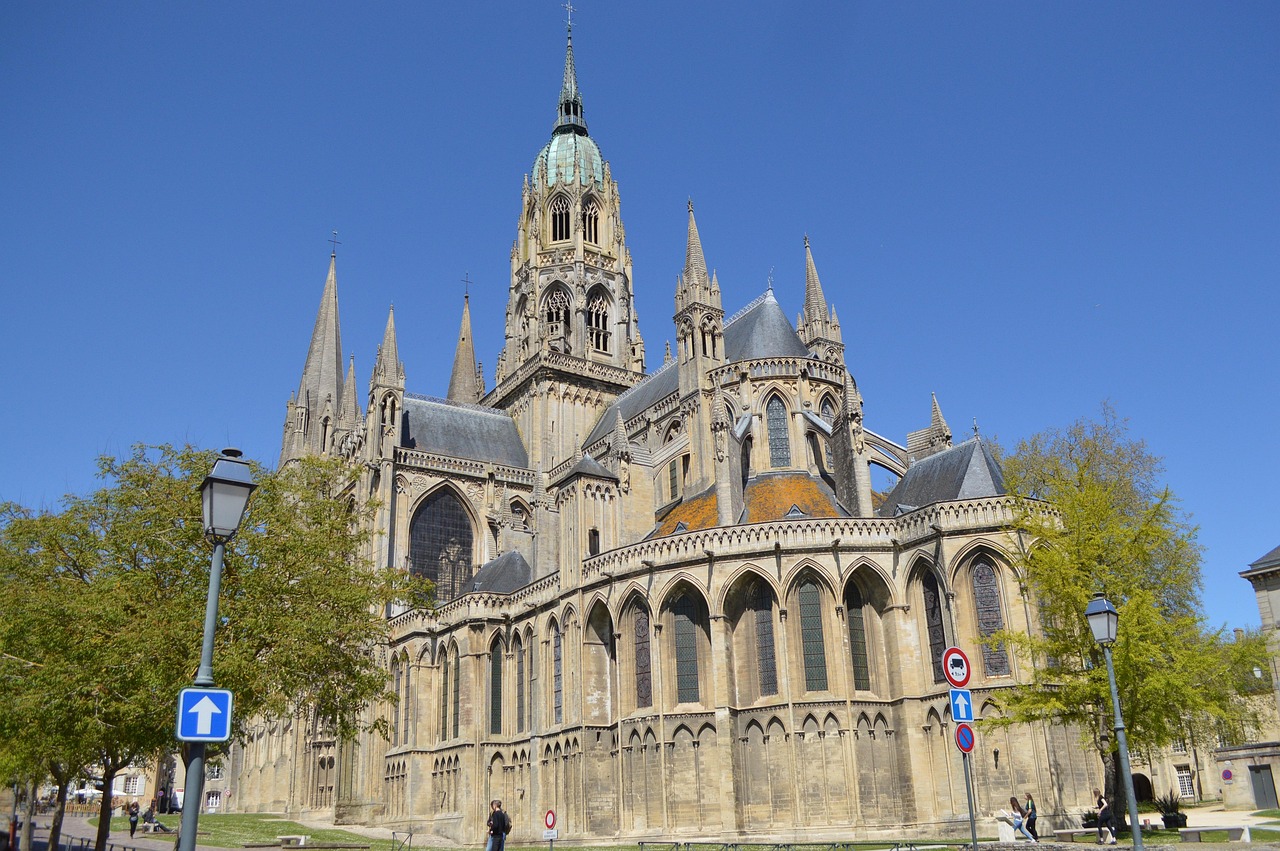
The Bayeux Cathedral dominates the skyline, its twin towers visible from almost anywhere in town. Consecrated in 1077 in the presence of William the Conqueror, it’s deeply entwined with the story of the Bayeux Tapestry and the Norman conquest of England.
Inside, the nave soars in light stone and delicate Gothic arches; step closer to the pillars and you’ll see tiny carvings and worn details from centuries of hands. The crypt below, older and more intimate, holds faded frescoes that survived revolution and war.
I like visiting at different times of day: morning for quiet contemplation, midday when shafts of light turn dust motes into glitter, and evening when the exterior glows golden. In summer 2026–2027, the cathedral light show transforms the façade into a moving canvas of color and history—a family-friendly, magical way to end a day.
- Family friendly: Kids enjoy climbing the external steps and spotting gargoyles.
- Romantic: Evening strolls around the lit-up exterior are unforgettable.
- Tip: Dress modestly (covered shoulders) and keep voices low inside.
2. Bayeux Tapestry Museum
The Bayeux Tapestry is probably the main reason people first hear of Bayeux. Seeing it in person is nothing like looking at photos: it’s longer, more vivid, and somehow more human than you expect.
The museum cleverly keeps the main tapestry gallery dark and cool, with the embroidery lit along a curved display. You walk alongside it, audio guide in hand, travelling from Harold’s oath to the clash at Hastings. The commentary is clear and engaging without being childish.
On my first visit, I rushed it. On later visits, I slowed down, noticing the small details: soldiers with mustaches, tiny ships, animals in the margins that have nothing to do with the story but everything to do with the medieval imagination.
- Allow: 1.5–2 hours including upper-level exhibits on the context and making of the tapestry.
- Family tip: The linear story makes it accessible to school-age children.
- Practical: Go earlier in the day in high season to avoid queues.
3. Memorial Museum of the Battle of Normandy
This museum sits just outside the historic center but is an easy walk. It focuses on the period from June to August 1944, when the Battle of Normandy unfolded after D-Day.
Inside, you’ll find tanks, vehicles, uniforms, maps, and detailed timelines. What I appreciate here is the balance: it’s factual and comprehensive without being overwhelming. Large dioramas explain how the battle moved across the region, and the exhibits cover the experiences of soldiers and civilians alike.
I once visited with a British friend whose grandfather landed on Gold Beach; he found his unit mentioned in a wall display. Moments like that remind you this isn’t just history—it’s personal to many visitors.
- Best for: Those wanting deeper WWII context beyond the beaches.
- Allow: 2 hours.
- Tip: Combine with the British military cemetery nearby for a powerful half-day.
4. Baron Gérard Art & History Museum (MAHB)
Housed in the former bishop’s palace, the Musée d’Art et d’Histoire Baron Gérard is one of Bayeux’s more underrated attractions. It traces local history from prehistoric times through the 20th century and includes an elegant collection of paintings, lace, and porcelain.
What I love here is how “Bayeux” it feels: you see how the town evolved, from Roman fragments to medieval manuscripts to fine 18th-century ceramics once used in local homes. There’s a room on Bayeux lace where you can get up close to work so delicate it looks like it might dissolve if you breathe on it.
On a rainy afternoon, I once had an entire floor nearly to myself; sitting on a bench in a quiet gallery, you feel as if the building is whispering stories from each era.
- Good for: Art lovers, history buffs, anyone needing a slower-paced museum.
- Allow: 1.5–2 hours.
5. Bayeux Old Town & Medieval Streets
The old town itself is an attraction. Half-timbered houses lean over narrow lanes, stone façades sport carved doorways, and small courtyards appear where you least expect them. I’ve spent entire mornings here doing nothing more than wandering.
Follow the historic walking trail marked by bronze plaques in the pavement. You’ll pass ancient houses, old convents, and small squares where locals sit with their groceries at their feet, catching up on news.
One of my favorite corners is a tiny square where ivy climbs a weathered wall and a single bench sits in the shade. I’ve watched school kids on field trips, elderly couples with baguettes under their arms, and visitors quietly reading guidebooks here—it’s the everyday life of Bayeux on display.
6. River Aure & Old Mill
The River Aure slices through Bayeux like a slow-moving ribbon, reflecting stone houses and the cathedral spire. The old mill wheel is the star: a classic postcard view you’ll probably photograph more than once.
There’s a riverside path you can follow, especially lovely in late afternoon when light softens. I like to walk it with an ice cream in hand in summer, or a takeaway coffee in spring and autumn. Look back often—the views change with every few steps.
- Romantic: Perfect for an after-dinner stroll.
- Family friendly: Flat, easy walking; kids enjoy watching ducks and the waterwheel.
7. Bayeux War Cemetery (Commonwealth Cemetery)
The Bayeux War Cemetery is the largest Commonwealth cemetery in France, with almost 4,000 graves of British and other Allied soldiers. It’s impeccably maintained: rows of pale headstones, bright flowers, and a central memorial.
I usually walk slowly along the rows, reading names, ages, and sometimes personal inscriptions from families. The mix of nationalities and regiments hints at the scale and diversity of the forces that passed through here.
Across the road, the Bayeux Memorial bears the names of over 1,800 Commonwealth soldiers who have no known grave. It’s a sobering but important stop for anyone exploring Normandy’s WWII legacy.
- Respect: Maintain silence or very low voices, avoid intrusive photography.
- Allow: 45–60 minutes, more if you want to sit and reflect.
8. Bayeux Lace & Linen Shops
Bayeux has a long tradition of lace-making and fine linens. While industrialization and changing fashions shrank the trade, echoes remain in small family-run shops and museum displays.
I like to step into these boutiques not just to browse but to chat. Older shopkeepers sometimes share stories about mothers or grandmothers who made lace at home for extra income. You’ll find tablecloths, napkins, delicate doilies, and modern interpretations of traditional patterns.
Prices vary widely, but even a small handkerchief makes a meaningful souvenir—lighter than cider bottles and easier to pack than cheese.
9. Église Saint-Patrice & Upper Town
Up toward the northern side of town, the Église Saint-Patrice and surrounding streets offer a quieter slice of Bayeux. Fewer tourists wander up here; it feels more like a neighborhood parish than a major attraction.
The church itself is worth a peek for its stained glass and calm interior. Around it, you’ll find residential streets, small bakeries, and on Saturdays, part of the market scene. I once ducked into Saint-Patrice during a sudden rainstorm and watched as a few locals came in just to sit silently for a minute; it felt like stepping into the town’s private rhythm.
10. Bayeux Weekly Market
The Saturday market is one of my favorite cultural experiences in Bayeux. It’s both practical and festive: locals actually shop here for the week, but there’s also a pleasure in browsing, tasting, and chatting.
Expect stalls piled with apples, artichokes, and seasonal vegetables; fishmongers with shining seafood from the coast; cheese stalls with endless rounds of Camembert and Pont-l’Évêque; and vendors selling rotisserie chickens with potatoes roasting in the dripping fat underneath.
Grab a coffee from a nearby café and just watch the flow of people. It’s a fantastic window into local life and a budget-friendly way to eat if you assemble a picnic.
11. Old Mill & Tanners’ Quarter
Near the river and old mill, you’ll find a cluster of streets that once housed tanners and other craftspeople. The architecture here is especially photogenic: timbered houses, stone bridges, small courtyards.
Information panels (in French and often English) explain how the river was used to power mills and wash hides. Today, the only smell in the air is more likely to be coffee or crêpes from nearby cafés, but the sense of continuity is strong.
On a sunny late afternoon, this is one of my favorite areas for a slow meander and photos—even after multiple trips, I still discover new angles.
12. Bayeux Liberation Route & WWII Plaques
Bayeux was the first major town in mainland France to be liberated after D-Day. Scattered through the town are plaques and small memorials marking where key events took place in June 1944.
I like to turn this into a self-guided walk: follow a map from the tourist office that points out sites like the town hall where General de Gaulle spoke, or buildings hit during bombing raids. It’s a quiet, reflective way to understand how the war touched everyday streets.
13. War Correspondents’ Memorial & Exhibition Spaces
Just outside Bayeux is the Memorial to Reporters, a landscaped area with stelae bearing the names of journalists killed while reporting wars around the world. It’s linked to the annual Bayeux Calvados-Normandy Award for War Correspondents, held each October.
During the award period, photojournalism exhibitions appear in public spaces around the city—on fences, in squares, inside temporary galleries. I’ve stumbled upon some of the most gripping war photography I’ve ever seen on quiet Bayeux streets in autumn. It’s a poignant reminder that conflict reporting didn’t end in 1944.
14. Fromageries & Cider Bars
While not “attractions” in the traditional sense, Bayeux’s cheese shops and cider bars are central to understanding the region. Popping into a fromagerie to ask about the difference between two types of Camembert can lead to a mini-lesson in terroir and aging.
There are also a few wine and cider bars where you can sample local bottles by the glass. I often come here in the late afternoon, order a small tasting flight, and let the staff suggest pairings. It’s informal, approachable, and a wonderful way to taste the region without leaving town.
15. Public Gardens & Park Walks
Bayeux has several small parks and gardens that rarely make “must-see” lists but are perfect for a breather. One near the river has big lawns where kids run and locals sun themselves on warm days.
I like to pick up a pastry and take a short detour through these green spaces when I need a break from museums. In spring, cherry blossoms and tulips brighten the lawns; in autumn, fallen leaves crunch underfoot and the air smells faintly of woodsmoke from nearby houses.
16. Bayeux Train Station Area & Everyday Life
The area around Bayeux Gare might not be conventionally beautiful, but I always enjoy a short wander here to see the town beyond the postcard core. Small apartment blocks, modest cafés, and a couple of supermarkets reveal where and how locals actually live.
If you’re staying for several days, you’ll likely pass through here anyway for day trips. Grab a coffee at the station café and watch trains to Caen and Paris glide in and out—it’s a reminder of how connected this quiet town is to the wider world.
17. Artisan Workshops & Galleries
Bayeux has a small but growing community of artists and craftspeople: potters, painters, textile artists. Their workshops and galleries are scattered through backstreets, often marked by small signs or open doors.
On one trip, I spent half an afternoon in a ceramics studio chatting in franglais with the potter about glazes and firing techniques. Another time, I discovered a tiny gallery with moody seascapes of the Normandy coast that perfectly captured the area’s changeable light.
These spots are great for unique, locally made souvenirs and a sense of Bayeux’s creative side beyond history.
18. Cooking Classes & Food Experiences
In recent years, a few small-scale cooking classes and food experiences have sprung up in and around Bayeux. Think market tours followed by a home-style cooking session, or farm visits where you help make butter or cheese.
I joined a half-day class once where we cooked chicken in cider cream, a potato gratin, and an apple tart, all with ingredients mostly sourced from the Saturday market. We ate together at a long table, swapping travel stories and recipe tips. It remains one of my favorite Bayeux memories.
19. Night Illuminations & Cathedral Light Show
In summer, Bayeux often runs a nocturnal lights trail, illuminating key monuments in soft colors. The most spectacular part is the cathedral show: images projected onto the stone façade, accompanied by music.
Standing in the square as the façade comes alive is a family-friendly, almost fairy-tale experience. Kids sit on the cobbles, couples lean close, and locals turn up with ice creams or folding chairs. It’s one of the town’s most joyful communal experiences.
Neighborhoods & Areas to Explore in Bayeux
Cathedral Quarter (Historic Center)
This is the heart of Bayeux: cobbled lanes, stone houses, and the cathedral rising above it all. You’ll spend a lot of your time here, whether visiting attractions, eating, or simply wandering.
- Character: Historic, lively but not frantic.
- Best for: First-time visitors, photography, evening strolls.
Riverside & Old Mill Area
Following the River Aure, this area feels particularly romantic: low bridges, waterwheels, and views of houses reflected in the water.
- Character: Picturesque, tranquil.
- Best for: Couples, quiet walks, picnics.
Upper Town & Saint-Patrice
North of the center, this residential area around Église Saint-Patrice has more of a local feel: small bakeries, schools, and a chunk of the Saturday market.
- Character: Everyday, unpretentious.
- Best for: Seeing local life, quieter accommodation.
Station Quarter (Gare)
The area around the train station is less charming architecturally but useful: budget hotels, small eateries, and services like car rentals.
- Character: Functional, more modern.
- Best for: Practical stays for early trains or late arrivals.
Outskirts & Surrounding Countryside
Within a short drive or bike ride from the center, you’re in rolling Norman countryside: hedgerows, apple orchards, and small farms. Staying in a countryside B&B gives you the best of both worlds—a rural feel, with easy access to Bayeux’s restaurants and museums.
Local Food in Bayeux: What to Eat & Where
Normandy is one of France’s great food regions, and Bayeux is an ideal place to taste it all. Think cream, butter, apples, seafood, and cheese—lots of cheese.
Must-Try Norman Specialties
- Camembert, Pont-l’Évêque, Livarot: Normandy’s famous cheeses; try them on a cheese board with bread and cider.
- Crêpes & Galettes: Sweet crêpes and savory buckwheat galettes filled with ham, cheese, egg, or more elaborate combos.
- Moules marinières or à la crème: Mussels cooked with wine or cream, often served with fries.
- Coquilles Saint-Jacques: Scallops, especially in season (autumn–spring).
- Poulet Vallée d’Auge: Chicken in cream and cider with apples—classic comfort food.
- Tarte aux pommes: Apple tart, often with a Calvados-scented cream.
- Cider, Pommeau, Calvados: Apple-based drinks from light sparkling cider to strong brandy.
Where I Like to Eat in Bayeux
Names and specific places can shift, but here’s the kind of spots I gravitate to:
- Crêperies near the cathedral: Great for a filling, budget-friendly meal with both savory and sweet options.
- Traditional bistros in the old town: For multi-course dinners featuring local seafood and meat dishes.
- Market stalls: Rotisserie chicken, fresh bread, and pastries for picnics.
- Wine & cider bars: For tastings and light bites in the late afternoon or evening.
Saving Money on Food
- Prix fixe lunch menus: Many restaurants offer a set lunch cheaper than dinner.
- Picnics: Use the Saturday market or supermarkets for picnic supplies.
- Bakeries: A baguette sandwich and pastry make a satisfying, low-cost lunch.
Nightlife, Entertainment & Cultural Experiences in Bayeux
Bayeux is not a late-night party town, and that’s part of its charm. Evenings here are about slow dinners, drinks on terraces, and cultural events.
Evening Activities
- Dinner & dessert: Linger over a multi-course meal, then stroll for ice cream or a crêpe.
- Cathedral light show (summer): Family-friendly and free; check dates each year.
- Bars & cafés: A handful stay open late, especially on weekends, for cider, wine, or Calvados.
- Cinema: The local cinema sometimes screens films in VO (original language) with French subtitles.
- Concerts & events: Church concerts, small festivals, and war correspondents’ events in autumn—ask at the tourist office for a current schedule.
Cultural Experiences
- Local festivals: Food festivals, commemorative events, and seasonal markets.
- War correspondents’ week (October): Talks, exhibitions, and film screenings related to conflict journalism.
- Cooking classes: Join a half-day workshop to cook with Norman ingredients.
Best Day Trips from Bayeux
D-Day Beaches Circuit
From Bayeux, you can reach Utah, Omaha, Gold, Juno, and Sword beaches plus multiple museums and cemeteries. Organized tours are convenient if you don’t have a car; self-driving offers more flexibility.
- Travel time: 15–60 minutes depending on the site.
- Tip: Focus on 2–3 key sites rather than trying to see everything in one day.
Mont-Saint-Michel
The abbey rising out of the tidal flats is one of France’s icons. It’s busy, yes, but still magical if you time your visit well.
- Getting there: Car (about 1.5–2 hours) or organized day tour from Bayeux or Caen.
- Tip: Aim for early morning or late afternoon to avoid peak crowds and to see changing tides.
Caen
Caen offers a more urban Normandy experience: the impressive Caen Memorial Museum, a medieval castle, and a livelier nightlife scene.
- Getting there: 30 minutes by frequent train.
- Best for: Museum lovers, those wanting a taste of a larger Norman city.
Normandy Cider Route
Drive or join a tour through villages and farms producing cider, Pommeau, and Calvados. Many offer tastings and direct sales.
- Best for: Couples, friends, and foodies; not ideal for designated drivers unless tastings are limited.
- Tip: Call ahead to confirm opening hours of smaller producers.
Local Customs & Cultural Etiquette in Bayeux
Normandy is relaxed, but a few customs will make your stay smoother and more pleasant.
Greetings & Politeness
- Always say “Bonjour” or “Bonsoir” when entering a shop, café, or speaking to staff. Not doing so is considered rude.
- Use “Madame/Monsieur” when addressing people—“Bonjour, Monsieur.”
- “Merci, au revoir” on leaving is appreciated.
Dining Etiquette
- Reservations: For popular restaurants, especially on weekends, reserve in advance or early in the day.
- Table time: Once seated, the table is yours for the night; you won’t be rushed out.
- Tipping: Service is included; rounding up or leaving a few euros for good service is customary but not required.
Religious & Memorial Sites
- Dress modestly in churches and cemeteries (no beachwear, cover shoulders).
- Keep voices low and avoid phone calls inside.
- Photography: Allowed in many places but avoid flash in churches and be discreet at cemeteries.
Language
- Many people speak some English, especially in tourism, but a few French phrases go a long way.
- Starting in French (“Bonjour, parlez-vous anglais ?”) is more polite than launching straight into English.
Practical Travel Advice for Bayeux
Getting To & Around Bayeux
Arriving
- By train: Direct or one-change trains from Paris Saint-Lazare (about 2–2.5 hours). From Caen, it’s about 30 minutes.
- By car: About 2.5–3 hours from Paris; highways are good and well-signposted.
Getting Around Town
- On foot: The historic center is compact and easily walkable.
- Bike: Some hotels rent bikes; good for countryside rides.
- Car: Handy for D-Day beaches and rural explorations but unnecessary inside town.
- Local buses & taxis: Limited but useful for nearby sights; ask at the tourist office.
Car Rental & Foreign Driver’s Licenses
- Car rental: Best arranged in Caen or at major airports; some options near Bayeux station.
- Licenses: Most foreign licenses are accepted; non-EU visitors may be asked for an International Driving Permit (IDP), so bring one if you can.
- Driving tips: Drive on the right, seatbelts mandatory, strict drink-driving laws.
Money-Saving Tips
- Stay slightly outside the center: Rooms can be cheaper while still within walking distance.
- Self-catering: Choose a place with a small kitchen to take advantage of markets and supermarkets.
- Combination tickets: Check if museums offer joint tickets or passes.
- Shoulder season travel: Late April–May and September–October are often cheaper and less crowded.
SIM Cards & Connectivity
- Airport kiosks & phone shops: Easiest place to buy a local or EU-wide SIM on arrival in France.
- eSIMs: Many travelers now use eSIM data packages (e.g., regional Europe plans) activated before arrival.
- Wi-Fi: Most hotels and many cafés in Bayeux offer free Wi-Fi.
Visa Requirements
- Bayeux is in France, part of the Schengen Area.
- Citizens of many countries (including most of Europe, North America, parts of Asia-Pacific, and Latin America) can enter visa-free for short stays; others require a Schengen visa.
- From 2025–2026, some visa-exempt travelers may need to complete an ETIAS travel authorization—check official EU sources before travel.
Best Seasons for Different Activities
- Spring (April–June): Mild weather, blooming countryside, fewer crowds. Great for walking, markets, and sightseeing.
- Summer (July–August): Warmest weather, longest days, busy season. Ideal for beaches and evening events like the cathedral light show.
- Autumn (September–October): Cooler air, beautiful foliage, food festivals, and harvest season for apples and cider. Excellent for foodies and WWII sites with fewer crowds.
- Winter (November–March): Quiet, some attractions have shorter hours, but accommodation is cheaper and the town feels very local. Cozy for those who don’t mind grey skies.
Hidden Tips from Experience
- Start your days early: You’ll have streets and major sights almost to yourself before 10am.
- Book D-Day tours early in peak season: The best small-group tours fill up fast for June and July.
- Carry a light layer: Normandy weather shifts quickly; even summer evenings can be cool.
- Ask locals for bakery and cheese recommendations: People are proud of their food and usually happy to share favorites.
- Use the tourist office: It’s excellent—maps, current events, bus timetables, and last-minute tour info.
Summary: Planning Your Trip to Bayeux in 2026–2027
Bayeux is small enough to feel intimate yet rich enough to fill several days with meaningful experiences. It’s the perfect base for D-Day history, a charming stop on a Normandy road trip, or even a slow, food-focused escape.
Key Takeaways
- 3 days in Bayeux lets you see the cathedral, Bayeux Tapestry, key WWII sites, and the old town at a relaxed pace.
- 4 days in Bayeux adds either deeper WWII exploration or a countryside food-and-cider day.
- 5 days in Bayeux gives time for a major day trip to Mont-Saint-Michel or Caen plus more hidden corners.
- Bayeux is extremely walkable, family-friendly, and well-placed for day trips across Normandy.
Best Time to Visit Bayeux
- Best overall: Late April–June and September–early October for pleasant weather and manageable crowds.
- For D-Day commemorations: Early June (book early and expect higher prices and more people).
- For food & harvest: September–October for apples, cider, and autumn festivals.
Whether you’re following a detailed 3 day itinerary for Bayeux or letting yourself drift through lanes and along the river, this town rewards both planners and wanderers. Come for the tapestry or the D-Day beaches; stay for the gentle pace, the clink of café cups, the smell of apples and butter, and the feeling of walking through a place where history is not just in museums, but in every stone.