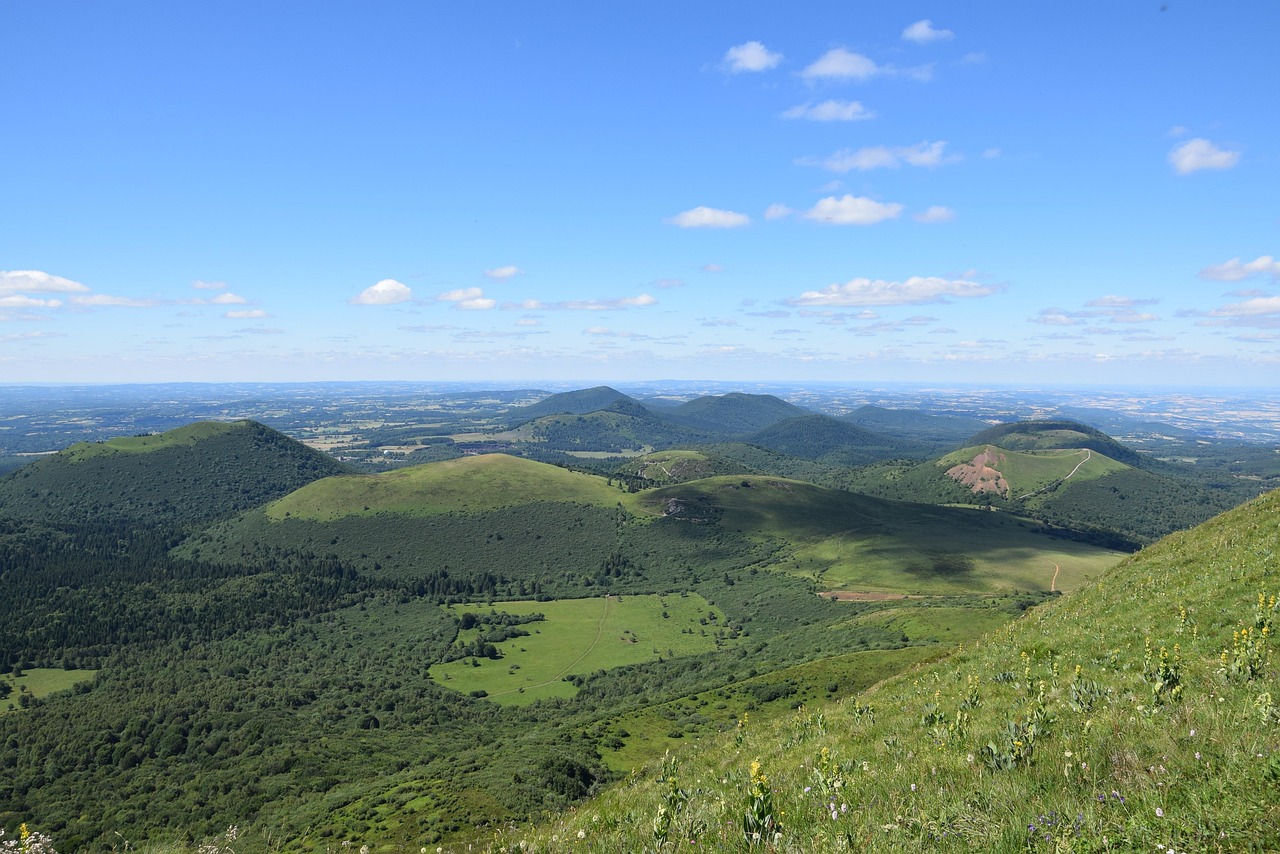
Why Visit the Chaîne des Puys in 2026
The Chaîne des Puys is a north–south line of about 80 volcanic domes, cones, and maars stretching just west of Clermont-Ferrand, in central France’s Auvergne region. In 2018, the area (together with the Limagne Fault) was inscribed as a UNESCO World Heritage Site, and 2026 marks eight years of carefully managed tourism: better waymarking, restored paths, and new interpretive centers, without sacrificing the wild, open feel.
What makes it special, and why you should consider at least a 4 day itinerary for Chaîne des Puys:
- Accessible volcanoes: You can hike the rim of a crater in under an hour, or stitch several cones into a full-day ridge traverse.
- Family friendly: Gentle gradients, short loops, farm visits, and the kid-pleasing Vulcania park.
- Romantic escapes: Sunset on Puy de Dôme, thermal spas in Royat or La Bourboule, candlelit dinners in village auberges.
- Adventure: Long-distance GR routes, paragliding off Puy de Dôme, trail running, winter snowshoeing on the higher puys.
- Local food in Chaîne des Puys: Four famous AOP cheeses (Saint-Nectaire, Cantal, Salers, Bleu d’Auvergne), volcanic wines, lentils, charcuterie, and unapologetically hearty mountain fare.
- Authentic rural France: Quiet stone villages, weekly markets, and a pace of life that invites you to slow down.
In 2026–2027, several new interpretive trails and small-scale festivals are planned (details in the events section below), making this an excellent time to visit before the crowds that have transformed other mountain regions arrive in force.
Practical Overview of the Chaîne des Puys
The Chaîne des Puys sits just west of Clermont-Ferrand, the regional capital and your likely gateway. The range’s highest point, Puy de Dôme, tops out at 1,465 m – modest compared to the Alps, but high enough for snow in winter and sweeping views of the Massif Central.
This is not a ski resort region in the classic sense; it’s about hiking, trail running, paragliding, and contemplative walks. Elevations range from about 800 m in the valleys to 1,500 m on the highest puys. That means altitude sickness is essentially a non-issue, yet you still get that crisp mountain feeling and, on clear nights, astonishing stars.
The best bases, depending on season and style:
- Clermont-Ferrand: Year-round base with trains, car rentals, and urban comforts; ideal for a 4 days in Chaîne des Puys city-and-nature combo.
- Orcines: Quiet village under Puy de Dôme; great for hikers and families.
- Royat & Chamalières: Spa towns with thermal baths; romantic short stays.
- Saint-Nectaire & Murol: Perfect for food lovers and those wanting a more “deep countryside” feel, especially in summer and autumn.
- La Bourboule & Le Mont-Dore: Higher, cooler bases closer to the Sancy massif – ideal if you plan to combine Chaîne des Puys with higher alpine-style hiking or snowshoeing.
15 Signature Peaks, Valleys, Passes & Villages – Deep Dive
Below are fifteen of the best places to visit in Chaîne des Puys – the volcanoes, valleys, passes, and villages that shape any good 4–7 day itinerary for Chaîne des Puys. I’ve hiked, eaten, and occasionally gotten lost around each of these, most recently in spring and autumn 2026.
1. Puy de Dôme (1,465 m) – The Iconic Summit
If you only climb one volcano here, make it Puy de Dôme. On my last visit in May 2026, I arrived early, catching the first Panoramique des Dômes train from Orcines. The summit was strangely quiet – just a handful of hikers and a couple of paragliders unrolling their canopies in the morning light.
Puy de Dôme is a trachytic dome, the tallest in the chain. The Romans built a temple to Mercury up here, and the remains are still visible. The views stretch across the entire necklace of puys to the south and east to Clermont-Ferrand’s black lava-stone cathedral.
- Altitude: 1,465 m
- Best for: Panoramic views, paragliding, short family hikes, sunrise/sunset, historical ruins.
- Access: Rack railway from Orcines (year-round, weather permitting) or a steep 1–1.5 hour hike via the Chemin des Muletiers from the Col de Ceyssat.
- Best base: Orcines, Royat, or Clermont-Ferrand.
I like to hike up and take the train down; it keeps the climb honest but spares your knees. For families, the train both ways is perfect – the summit loop path is stroller-friendly in good weather. In 2026, new interpretive panels (in French and English) explain the geology and Roman history in more detail than ever.
Tip: On clear evenings outside peak summer, stay for sunset. I’ve watched the entire chain turn gold from up here, followed by a slow, chilly descent as paragliders swooped silently below me.
2. Puy de Pariou (1,209 m) – The Perfect Crater
Puy de Pariou is the volcano you’ve probably seen on water bottles and postcards: a perfectly shaped green cone with a neat, circular crater. It’s also one of the must-see attractions in Chaîne des Puys if you like that “walking-into-a-volcano” feeling.
- Altitude: 1,209 m
- Best for: Family hikes, photography, walking inside a crater, wildflowers in late spring.
- Access: Well-marked trails from the Col de Ceyssat or from the parking near Orcines; expect a 2–3 hour round-trip hike.
- Best base: Orcines or Clermont-Ferrand.
I last walked up in early June 2026, just as the slopes were dotted with orchids and gentians. The path climbs gently through forest before emerging onto an open ridge, with Puy de Dôme looming behind you. The final stretch into the crater is always a little surreal; the acoustics change, and conversations bounce oddly off the slopes.
Tip: Take a picnic but leave no trace. The crater is fragile, and rangers are increasingly strict about off-trail wandering in 2026, due to erosion.
3. Puy de Sancy (1,885 m) – The High Point of the Massif Central
Strictly speaking, Puy de Sancy is just south of the core Chaîne des Puys, in the Monts Dore, but for many travelers it’s part of the same trip. At 1,885 m, it’s the highest peak in the Massif Central and delivers a more “alpine” feel: sharper ridges, lingering snowfields, and ski lifts in winter.
- Altitude: 1,885 m
- Best for: More challenging hikes, late spring snow, winter snowshoeing and modest skiing, dramatic views.
- Access: Cable car from Le Mont-Dore up to the upper slopes, then stairs; or full hiking routes from several valleys.
- Best base: Le Mont-Dore or La Bourboule.
In February 2026 I snowshoed a loop on Sancy’s flanks in crisp, -5°C air. The wind was brutal on the ridge, but the view of the entire Auvergne plateau under snow was worth it. Summer brings a completely different atmosphere: grassy slopes, marmots, and families in sneakers eyeing the final stair climb with mixed enthusiasm.
Tip: Weather turns fast here. I’ve twice been caught in sudden fog on Sancy, even in June. Layers, a map app, and checking the forecast are non-negotiable.
4. Puy de Cliersou (1,197 m) – Quiet Ridge Between Giants
Just north of Puy de Dôme, Puy de Cliersou tends to be overlooked. That’s precisely why I like it. On a cloudless September afternoon in 2025, I wandered its grassy ridge and saw maybe three other hikers in two hours.
- Altitude: 1,197 m
- Best for: Quiet walks, ridge views of multiple puys, trail running.
- Access: Footpaths from the Orcines area; best explored as part of a multi-puy loop.
- Best base: Orcines.
The ridge lets you see how the whole chain aligns, like a string of emerald beads. In late afternoon light, the shadows of the puys stretch across the pastures, and the bells of grazing cows serve as soundtrack.
5. Puy de Côme & Puy de Corcou (1,253 m & 1,151 m) – Twin Volcano Adventure
Puy de Côme and nearby Puy de Corcou form an impressive double crater system. Their flanks are mostly forested, and the hike feels wilder than some of the more manicured routes.
- Altitude: 1,253 m (Côme), 1,151 m (Corcou)
- Best for: Half-day hikes, feeling “deep” in the chain, birdwatching.
- Access: Trails from the D941 road; not as clearly signed as Dôme/Pariou, so bring a map.
- Best base: Orcines or Pontgibaud.
I spent a foggy October morning here in 2024, the kind where every spiderweb sparkles and the cones loom like shadows in the mist. It’s a place for people who enjoy atmosphere over vistas. On clear days, the crest views are still satisfying, but the real magic is in the silence of the beech and fir forest.
6. Puy de la Vache & Puy de Lassolas (1,167 m & 1,190 m) – Red Cinder Sisters
These two are my favorite for “wow” factor with minimal effort. Their slopes are streaked with red and black volcanic scoria, giving them an almost Martian profile. Kids love them; photographers love them; my calves slightly less so after sprinting up to catch a sunset in 2023.
- Altitude: 1,167 m (Vache), 1,190 m (Lassolas)
- Best for: Short, dramatic hikes, sunrise or sunset, geology buffs.
- Access: Signposted trails from the parking area near the D5 road (between Saint-Genès-Champanelle and Aydat).
- Best base: Saint-Genès-Champanelle, Aydat, or Clermont-Ferrand.
The climb is short but steep in places, with loose stones – good shoes are essential. Once on the rim, you’re walking a fiery palette of reds and blacks, with views towards Lake Aydat and the rest of the chain.
Tip: In 2026, these puys are part of several guided “geology walks” (mostly in French) that sell out quickly in summer. Book ahead if you want a deeper dive into the volcanic story.
7. Puy des Gouttes & Puy de la Vache Valley – A Quiet Green Corridor
The valley between Puy de la Vache, Puy de Lassolas, and Puy des Gouttes is a textbook example of how lava flows and cones shape the land. It’s also one of my favorite places for an easy, contemplative loop, especially in late May when the meadows are overflowing with buttercups.
- Altitude: Around 1,100–1,200 m on the valley rims.
- Best for: Gentle walking, family outings, learning geology, spring wildflowers.
- Access: Same parking as Puy de la Vache; several loop trails are clearly mapped on local boards.
- Best base: Saint-Genès-Champanelle.
I’ve walked here with friends’ kids more than once; the gentle ups and downs keep smaller hikers entertained, and there are enough volcanic shapes to spark imagination. Bring binoculars: raptors often cruise overhead, riding the thermals.
8. Lac d’Aydat – Volcanic Lake Life
Formed by ancient lava flows damming a valley, Lac d’Aydat is the largest natural lake in the region and the closest thing the Chaîne des Puys has to a beach resort – albeit a low-key, family-friendly one.
- Altitude: ~825 m
- Best for: Swimming in summer, paddleboarding, lakeside walks, relaxed family days.
- Access: 20–25 minutes’ drive from Clermont-Ferrand; limited buses in high season.
- Best base: Aydat or Saint-Genès-Champanelle.
On a hot July afternoon in 2022, I finished a dusty hike on Puy de la Vache and dove straight into Aydat’s cool water. There are lifeguarded swimming areas in summer, pedal boats for hire, and grassy banks shaded by trees. Cafés around the shore serve ice cream, crêpes, and the ubiquitous truffade (potato-and-cheese comfort food).
Tip: The circular lakeside path is a flat, easy walk – ideal for strollers and older travelers. Go early or late in the day in July–August to avoid peak crowds.
9. Orcines – Village at the Foot of the Volcano
Orcines is not a picture-perfect old-town kind of place, but it has what matters for a volcano-focused trip: proximity. The Panoramique des Dômes train station is right here, trailheads are minutes away, and there’s just enough infrastructure to be comfortable without losing the country feel.
- Altitude: ~850 m
- Best for: Hikers, paragliders, those wanting to be on the first train up Puy de Dôme.
- Access: 15 minutes’ drive or bus from Clermont-Ferrand.
I like waking up here on clear mornings and seeing Puy de Dôme already catching pink light. There are a couple of solid bakeries – I usually grab a still-warm pain aux raisins and coffee before heading up the mountain – and a growing number of guesthouses that understand hikers’ needs (early breakfasts, drying rooms, local maps).
10. Pontgibaud & the Sioule Valley – Castles and Rivers
North of the main chain, Pontgibaud sits on the Sioule River and offers a different palette: stone bridges, a small medieval château, and wooded riverbanks. It’s a good base for people who want both volcanoes and water.
- Altitude: ~700 m
- Best for: Mixed hiking and river activities, quieter stays, historical ambience.
- Access: 30–35 minutes’ drive from Clermont-Ferrand.
I spent a rainy November weekend here once, huddled in a tiny wine bar tasting local reds and watching mist hang in the Sioule valley. When the weather cleared, we walked a stretch of the river, the water high and fast after days of rain, and spotted kingfishers darting between overhanging branches.
11. Royat & Chamalières – Thermal Spa Towns at the Edge of the Chain
Technically suburbs of Clermont-Ferrand, Royat and Chamalières feel like separate towns – leafy, hilly, and famous for hot springs since Roman times. They’re where I go when my legs have had enough puys for the week.
- Altitude: ~400–500 m
- Best for: Romantic weekends, spa days, gentle walks, evenings out.
- Access: Local buses and trams from Clermont-Ferrand.
In March 2026, after three muddy hiking days, I spent an afternoon at the Royatonic spa: hot pools, outdoor baths with views of wooded hills, and that delicious post-sauna sleepiness. You’re only 20–30 minutes by car from major trailheads, making this a clever base if one half of a couple is more hiking-obsessed than the other.
12. Saint-Nectaire – Cheese, Church, and Hot Springs
The name Saint-Nectaire is synonymous with one of Auvergne’s best cheeses, but the village itself deserves attention: a Romanesque church perched on a hill, small hot springs, and farm visits that count among my favorite cultural experiences in Chaîne des Puys.
- Altitude: ~700–800 m
- Best for: Food lovers, church architecture, farm visits, scenic drives.
- Access: 40–45 minutes’ drive south of Clermont-Ferrand; best with a car.
One crisp October morning in 2025, I joined a small group visit to a local farm. We walked through the cool, earthy cheese caves, tasting slices at different stages of aging. Later, from the church terrace, the view over rolling hills dotted with cows felt like the label on a cheese wheel come to life.
Tip: Many farms welcome visitors but appreciate a call ahead, especially outside July–August. In 2026, some are starting to offer simple farmhouse lunches by reservation.
13. Murol & Lac Chambon – Castle Above a Volcanic Lake
South of the chain proper, Murol and Lac Chambon make a superb base for families. The ruined castle of Murol sits on a lava mound, watching over the lake and surrounding fields like something from a storybook.
- Altitude: ~870 m (Murol), ~875 m (Lac Chambon)
- Best for: Family-friendly swimming, castle visits, easy walks, combining Chaîne des Puys with Sancy hikes.
- Access: 45–60 minutes’ drive from Clermont-Ferrand.
I’ve watched medieval re-enactments at Murol castle – knights clanking around to the delight of kids – and then walked down for a swim in Lac Chambon. In summer, pedal boats and paddleboards crowd the shore; in autumn, mist curls off the lake and the trees on the slopes turn every shade of gold.
14. La Bourboule – Belle Époque Spa Town in the Highlands
La Bourboule feels like it’s waiting for a novel to be written about it: elegant Belle Époque facades, grand old spa buildings, and a river running through the middle. It’s higher and cooler than Clermont-Ferrand, making it an appealing summer base.
- Altitude: ~850–900 m
- Best for: Families (many kid-focused spas), access to Sancy, nostalgic architecture.
- Access: 1 hour’s drive from Clermont-Ferrand; regional buses in season.
I like La Bourboule in September, when families have mostly gone home. You can stroll the river, soak in understated thermal baths, and then head up to Sancy for more demanding hiking the next day.
15. Clermont-Ferrand – Volcanic City Gateway
Clermont-Ferrand is the beating (and somewhat underrated) heart of this region. Built largely from black lava stone, with a dramatic cathedral and vibrant student energy, it’s where most travelers start and end their travel guide for Chaîne des Puys journey.
- Altitude: ~365–500 m across the city
- Best for: Urban culture, restaurants, markets, as a base for shorter itineraries (4–5 days in Chaîne des Puys).
- Access: Train connections to Paris and Lyon; small airport with limited flights.
My favorite Clermont ritual: early Saturday, walking up to the Place de Jaude market for cheese and charcuterie, then hopping on a bus to Orcines or Royat with a daypack. In the evening, I’ll sit at a terrace bar in the old town, a glass of local Gamay in hand, volcano silhouettes dark against the sunset.
4–7 Day Itineraries for the Chaîne des Puys (With Personal Notes)
Below are suggested 4 day itinerary for Chaîne des Puys, plus expanded 5, 6, and 7 day itinerary for Chaîne des Puys options. Each day mixes signature sights with lesser-known corners, and I’ve anchored them in my own recent trips (2023–2026).
4-Day Itinerary for Chaîne des Puys – Highlights & Volcano Essentials
Day 1 – Clermont-Ferrand & First Glimpse of the Volcanoes
I like to start gently. On my latest 4-day loop in April 2026, I landed in Clermont-Ferrand around midday, checked into a small hotel near the old town, and spent the afternoon stretching my legs in the city before heading into the hills.
Morning / Early Afternoon – Arrival & Old Town Wander
- Drop bags at your hotel or guesthouse near the historic center.
- Stroll to the black lava-stone cathedral and climb the tower if open (weather-dependent) for that first jaw-dropping view of the Chaîne des Puys.
- Duck into a café on Place de la Victoire or a side street; the coffee culture here is relaxed, more about conversation than speed.
I usually grab a simple lunch: a salade auvergnate (greens with local ham and blue cheese) or a baguette with Saint-Nectaire from a nearby bakery.
Late Afternoon – Volcanic Education at L’Aventure Michelin or Local Museum
To understand why this entire region feels different, I recommend either:
- L’Aventure Michelin: A surprisingly engaging museum about the Michelin company, which is deeply tied to Clermont. It includes sections on road travel, which frame your own road trip nicely.
- Bargoin Museum: For archeology and regional history.
Either way, you’ll get a taste of local identity before heading out: a mix of industrial pride, stubborn independence, and affection for the surrounding countryside.
Evening – Local Food & Quiet Streets
For dinner, I often book a table at a bistrot auvergnat in the old town. Expect hearty dishes like truffade, aligot (potato puree whipped with cheese), potée auvergnate (a local stew), and plenty of cheese.
Walk it off by looping through the old streets. Look up: the silhouette of Puy de Dôme is visible from many corners of the city, a promise of tomorrow.
Day 2 – Puy de Dôme & Puy de Pariou: The Iconic Duo
This is your classic “must-see attractions in Chaîne des Puys” day. I’ve done variants of it at least six times, and it’s never gotten old.
Morning – Hike or Train Up Puy de Dôme
- Catch an early bus or drive to Orcines.
- Decide between:
- Chemin des Muletiers: A historic mule trail, 1–1.5 hours up, steady but not technical. Families with reasonably active kids manage it fine.
- Panoramique des Dômes train: For those who prefer to save their energy or have limited mobility.
At the summit, I usually walk the full loop path, pausing at the ruins of the Temple of Mercury. In 2026, new panels (bilingual) explain how the Romans used this site as a sacred high point.
Lunch – Summit Snack or Picnic
You can grab food at the summit restaurant, but I prefer packing a picnic from Clermont or Orcines and finding a quieter corner away from the main terrace. Remember that even on warm days, a windproof layer is essential up here.
Afternoon – Puy de Pariou Crater Walk
After descending (by train or on foot), drive or bus back towards the Col de Ceyssat or nearby trailhead for Puy de Pariou. Allocate 2–3 hours for a leisurely out-and-back or loop, including time to drop into the crater.
There’s a moment when you crest the rim and see the crater floor for the first time – a perfect bowl of grass and stone. Every time, I’m tempted to just sit there and listen to the wind for half an hour.
Evening – Back to Clermont or Orcines
If you’re staying in Orcines, dinner in a local inn means hearty plates and early nights. If you prefer city life, head back to Clermont-Ferrand for a more varied dining scene. Either way, you’ll sleep well.
Day 3 – Red Volcanoes & Lake Aydat
Day 3 is about color: the red-black scoria of Puy de la Vache and Puy de Lassolas, followed by the blue of Lac d’Aydat.
Morning – Puy de la Vache & Puy de Lassolas Loop
- Drive from Clermont/Orcines towards Saint-Genès-Champanelle, following signs to the parking for Puy de la Vache.
- Follow waymarked trails up onto the twin cones (2–3 hours round-trip with photo stops).
The first time I brought friends here (October 2023), they were stunned by the colors – the slopes looked almost burnt, with patches of scrub and grass clinging to the red grit. The ridgeline views are among the best in the chain.
Afternoon – Picnic & Swim at Lac d’Aydat
It’s a short drive to Lac d’Aydat. In summer, I spread a blanket under the trees and nap after lunch, then wander the lakeside path or rent a paddleboard. In spring and autumn, it’s more about the quiet walk and perhaps a warm drink at a lakeside café.
Evening – Country Inn Dinner
Stay in or around Saint-Genès-Champanelle or head back to Clermont. One of my best meals in the region was in a small inn not far from Aydat: a set menu of potée, a cheese course, and a pear tart, all served without fuss but with obvious pride.
Day 4 – Choice Day: Culture, Cheese, or Extra Volcanoes
With 4 days in Chaîne des Puys, your last day is a choose-your-own-adventure. I often recommend one of three options:
- Option A – Saint-Nectaire & Murol: For food and culture lovers.
- Visit a Saint-Nectaire cheese farm in the morning (book ahead).
- Tour the Romanesque church and then drive to Murol for a castle visit and stroll by Lac Chambon.
- Option B – More Puys: For hikers who can’t get enough.
- Combine quieter summits like Puy de Côme, Puy de Cliersou, or Puy des Gouttes into a custom loop.
- Option C – Spa & City: For tired legs.
- Spend the morning at Royatonic spa, then enjoy a long lunch and museum time back in Clermont-Ferrand.
On my April 2026 trip, I chose Option A: cheese in the morning, castle in the afternoon, and a last glass of wine back in Clermont as the cathedral glowed under streetlights.
Expanding to 5, 6, or 7 Days in Chaîne des Puys
If you have 5 days in Chaîne des Puys, add:
- A full day around Puy de Sancy from Le Mont-Dore or La Bourboule: ride the cable car, hike to the summit, and explore nearby ridges.
For a 6 day itinerary for Chaîne des Puys, keep the above and:
- Add a slow day in Pontgibaud and the Sioule valley, with river walks and a castle visit.
And for a full 7 day itinerary for Chaîne des Puys, include:
- A “no driving” day in Clermont-Ferrand and Royat/Chamalières, mixing markets, museums, and spa time.
Over a week, you can settle into a rhythm: early hikes on the puys, leisurely lunches, and evenings in village squares or spa pools. It’s a surprisingly restorative routine.
Mountain Dining in the Chaîne des Puys
This region eats like it expects you to spend all day on the trail or in the fields. Portions are generous, flavors are bold, and cheese appears at almost every turn. When people ask about the best local food in Chaîne des Puys, I point them toward a few essentials.
Refuges, Auberges, and Country Inns
The Chaîne des Puys doesn’t have rifugios perched on glaciers like the Alps, but it does have:
- Summit cafés and restaurants: On Puy de Dôme and around Sancy, basic but satisfying.
- Auberges de campagne: Country inns in villages like Orcines, Saint-Genès-Champanelle, and Murol, serving set menus heavy on potatoes, pork, and cheese.
- Farm tables: Increasingly common in 2026, where you eat at a long table on a working farm – simple, seasonal, and memorable.
What to Eat
- Saint-Nectaire: Semi-soft, earthy cheese, perfect melted over potatoes.
- Cantal & Salers: Firmer mountain cheeses, fantastic in sandwiches or on a cheese board.
- Bleu d’Auvergne: A creamy blue with a strong personality – brilliant with local honey.
- Truffade: Sliced potatoes pan-fried with cheese and garlic until it becomes a gooey, golden mass.
- Aligot: More common just east of here, but increasingly found – potatoes whipped with cheese into an elastic, silky puree.
- Charcuterie: Local hams, sausages, and pâtés, often served with cornichons and rustic bread.
- Pâtisseries: Look for tarte aux myrtilles (blueberry tart) and flognarde (a clafoutis-like dessert with apples or pears).
Coffee & Pastry Culture
In Clermont-Ferrand, specialty coffee bars are slowly appearing, but in the villages it’s still mostly straightforward espresso or café crème at the bar. I’ve grown fond of the ritual: elbowing up with hikers and farmers at 8 a.m., ordering a café and a croissant, and watching the day start.
Where to Stay: Village vs. Slope-Side vs. Refuge
- Village stays: My default. Clermont-Ferrand, Orcines, Saint-Genès-Champanelle, Murol, and Saint-Nectaire each offer a different flavor of rural/urban life.
- Slope-side hotels: Around Le Mont-Dore and Sancy, convenient in winter for skiing and snowshoeing.
- Refuge-style: A few simple gîtes and mountain hotels offer dorms or basic rooms; ideal if you want to wake up already in the high country.
Saving Money on Food in a Mountain Region
- Shop at markets in Clermont or local weekly markets for picnic supplies.
- Look for formule (set menu) lunches – often cheaper than à la carte dinners.
- Choose guesthouses with breakfast included; a solid morning spread keeps you going for hours.
- Tap water is safe and free in restaurants; ask for a carafe d’eau.
Evenings in the Chaîne des Puys
Evenings here are quieter than in big alpine resorts, and that’s part of the charm. Think strolls, good food, and, on clear nights, some of the best stargazing in central France.
Après-Hike Traditions
There’s no formal après-ski culture, but you’ll see an unofficial après-rando (after-hike) ritual in:
- Terrace bars in Clermont and Royat, where hikers compare GPS tracks over beer or local wine.
- Village cafés in Orcines or Saint-Genès, where dusty boots are part of the décor.
Village Bars & Fondue Nights
While classic Swiss-style fondue isn’t a local staple, you’ll find cheese-heavy dishes that serve the same social purpose: sharing, lingering, and laughing. I’ve spent many happy nights squeezed around wooden tables in tiny inns, trying to make room for “just a little” more cheese.
Stargazing
Step away from town lights – even just a short walk from Orcines or Saint-Genès – and the night sky opens up. I’ve watched the Milky Way arch over the dark silhouettes of the puys in late summer, the silence broken only by the occasional bark of a fox.
Seasonal Festivals
In 2026–2027, look out for:
- Cheese festivals around Saint-Nectaire (spring and autumn).
- Trail running events in the Chaîne des Puys (spring and early summer), with post-race parties in Clermont and nearby villages.
- Classical and jazz concerts in Clermont-Ferrand and occasionally in church venues like Saint-Nectaire and Orcival.
Day Trips & Nearby Attractions
Once you’ve seen the main things to do in Chaîne des Puys, consider:
- Vulcania Theme Park: A family-friendly, science-focused park near Orcines, dedicated to volcanoes and earth sciences. Great for kids on a cloudy or drizzly day.
- Orcival: A picturesque village with a famous basilica, set in a green valley – perfect half-day with a short walk.
- Cantal Highlands: A longer day trip if you’re willing to drive 1.5–2 hours – deeper, wilder volcanic mountains like Puy Mary.
Practical tip: A rental car gives you the most flexibility for these side excursions. Public transport exists but requires patience and planning.
Cultural Etiquette & Local Customs
Auvergne is friendly but understated. People are generally warm once you break the ice, but less effusive than in some coastal regions.
Greetings & Politeness
- Always say Bonjour (day) or Bonsoir (evening) when entering shops, cafés, or small museums.
- In small villages, it’s normal to greet people you pass on quiet streets or trails with a nod and Bonjour.
- Use vous rather than tu with strangers unless invited otherwise.
On the Trail
- Stay on marked paths; erosion is a real issue, and rangers are increasingly vigilant.
- Leash dogs where requested, especially near grazing animals.
- Picnicking is welcome, but pack out all trash.
Dining Customs
- Lunch (12:00–14:00) is taken seriously; many kitchens close between 14:00 and 19:00.
- It’s polite to reserve for dinner in smaller villages, especially on weekends.
- Tipping is modest; service is included, but rounding up or leaving a few euros for good service is appreciated.
Language
English is spoken in most tourist-facing spots around Puy de Dôme and Clermont-Ferrand, less so in remote villages. A few phrases of French go a long way. Older residents may also speak or understand bits of the local Auvergnat dialect with each other.
Logistics, Transport & Practical Travel Advice
Getting There
- By train: Regular services to Clermont-Ferrand from Paris (~3.5–4 hours) and Lyon (~2.5 hours).
- By air: Clermont-Ferrand Auvergne Airport has limited flights; many visitors connect via Paris or Lyon and then take the train.
- By car: The A71 and A89 motorways connect Clermont to the wider French network.
Getting Around
- Car rental: Most flexible for reaching trailheads and villages; available at Clermont station and airport.
- Public transport: Local buses connect Clermont with Orcines, Royat, and some villages, but schedules can be sparse, especially on weekends and outside July–August.
- Cable cars / Trains: The Panoramique des Dômes rack railway and Sancy cable car are key for non-hikers and as return options on hikes.
SIM Cards & Connectivity
In 2026, coverage across the Chaîne des Puys is generally good, though some forested or low-lying areas still have weak signals.
- Buy a French SIM (Orange, SFR, Bouygues) at Clermont-Ferrand station or in the city.
- EU visitors can typically roam without extra charges; non-EU visitors should check plans in advance.
Money-Saving Tips
- Base in Clermont-Ferrand or a larger village for cheaper lodging, and day-trip out.
- Use markets and supermarkets for picnics instead of eating every meal out.
- Consider a regional pass or combined tickets if you plan multiple rides on the Puy de Dôme railway or Sancy cable car (offers change year to year; check in 2026).
Visas & Driving
- Visas: France is in the Schengen Area. EU/EEA/Swiss citizens can travel freely. Many other nationalities can visit visa-free for short stays; check official French consular advice for 2026 rules and ETIAS implementation.
- Driving licenses: EU/EEA licenses are valid. Many other countries’ licenses are accepted; an International Driving Permit is recommended if your license is not in French or English.
- Roads: Mountain roads are generally well-maintained but can be narrow and winding. In winter, snow tires or chains may be required by law in certain periods and zones.
Mountain-Specific Logistics & Safety
Altitude & Acclimatization
With elevations topping out under 1,900 m, altitude sickness is extremely rare. That said, the combination of sun, wind, and exertion can still be draining.
- Hydrate well, especially in summer.
- Use sunscreen and hats – the wind can make you underestimate UV exposure.
Weather, Storms & Seasonal Closures
- Spring (April–May): Unstable; expect rain, mud, and occasional late snow patches higher up.
- Summer (June–August): Warm, often dry; thunderstorms can build quickly in late afternoon.
- Autumn (September–October): Often the best hiking conditions: cool, clear days and stunning foliage.
- Winter (November–March): Snow possible on higher puys and Sancy; some trails may be icy or officially closed for safety.
Roads and passes around Sancy may close temporarily during heavy snow. Check local advisories before driving into higher areas in winter.
Gear & Clothing
- Footwear: Sturdy hiking shoes or boots with decent grip. The volcanic gravel on some slopes can be slippery.
- Layers: Year-round, bring a windproof jacket and an extra warm layer; weather changes quickly.
- Winter: Microspikes or light crampons can be useful on icy paths; snowshoes are ideal around Sancy in deeper snow.
- Navigation: Offline maps on your phone plus a power bank; waymarking is good but fog can be disorienting.
Mountain Rescue & Insurance
Emergency number in France: 112. Mountain rescue is well-organized, but you should:
- Carry travel insurance that explicitly covers hiking and winter sports if relevant.
- Let someone know your planned route in more remote areas.
Cable-Car & Lift-Pass Strategy
- Puy de Dôme railway: Book online in high season to secure your preferred time slot.
- Sancy cable car: Check weather and wind conditions; strong winds can suspend operations.
- Combined tickets and family passes can save money if you plan multiple ascents.
Best Seasons for Specific Activities
- Hiking: May–October, with September often ideal.
- Wildflowers: Late May–June on meadow slopes and valleys.
- Fall colors: Late September–mid-October, especially in beech forests and around Lac Chambon.
- Skiing & Snowshoeing (mainly Sancy area): Late December–March, snow-dependent.
Events & What’s New in 2026–2027
As of 2026, a few notable additions and recurring events shape the travel scene:
- Expanded Interpretive Trails: New educational signage and short themed loops around Puy de Dôme, Puy de la Vache, and Puy de Pariou, focusing on geology and ecology.
- Trail Running Races: Spring and early summer events (10–80 km) traversing multiple puys; expect full accommodation in Orcines and Clermont those weekends.
- Cheese & Farm Festivals (2026–2027): Seasonal events around Saint-Nectaire and nearby villages, with tastings, farm visits, and markets.
- Cultural Programming: More concerts, art installations, and temporary exhibitions in Clermont-Ferrand tied to the UNESCO status of the Chaîne des Puys–Limagne Fault.
Check local tourism office websites closer to your travel dates for exact calendars; schedules often finalize only a few months in advance.
Summary & Final Recommendations
The Chaîne des Puys is a region that rewards both quick hits and lingering stays. In 4 days in Chaîne des Puys, you can stand on Puy de Dôme, walk inside Puy de Pariou’s crater, taste Saint-Nectaire where it’s made, and swim in Lac d’Aydat. With a full 7 days in Chaîne des Puys, you can settle into village rhythms, explore quieter cones, dip into spas, and make side trips to castles and higher peaks like Sancy.
For most travelers, the best time to visit is:
- Late May–June: Wildflowers, long days, moderate temperatures, fewer crowds.
- September–early October: Stable weather, beautiful light, fall colors.
July–August are busier but still pleasant if you plan hikes early in the day and book accommodation ahead. Winter is quiet and atmospheric, best for those who enjoy snowshoeing around Sancy and brisk walks on lower puys.
Above all, come prepared to slow down. The volcanoes aren’t going anywhere, and neither are the cheese wheels. Whether you follow this travel guide for Chaîne des Puys step by step or just use it as a framework, leave room for detours: a side trail, a farm visit, a long lunch on a sunny terrace. That’s where the region really reveals itself.