Why Visit Dijon in 2026?
Dijon is one of those cities that surprises you quietly. People often arrive expecting “a stopover in Burgundy” and leave wondering why they didn’t plan their entire trip around it. There’s no Eiffel Tower here, no Riviera beach – instead, you get golden stone mansions, medieval streets, world-class wine, and food that will ruin you for supermarket mustard forever.
I’ve visited Dijon at least once a year since 2014. In that time I’ve seen the city grow more vibrant but never lose its soul. Cafés still spill onto cobbled squares, students still crowd the bars on Rue Berbisey, and every Saturday the Marché des Halles still buzzes under Gustave Eiffel’s iron-and-glass roof.
In 2026–2027, Dijon is especially worth a visit. The city’s food and wine scene has been elevated by the relatively new Cité Internationale de la Gastronomie et du Vin, and there’s a renewed focus on cultural festivals, sustainable tourism, and celebrating Burgundy’s wine heritage after the 10-year anniversary of UNESCO recognition of the Climats (the region’s historic vineyard plots).
Whether you’re planning a 3 day itinerary for Dijon, stretching to 4 days in Dijon, or fully indulging with a 5 day itinerary for Dijon, this travel guide for Dijon will help you blend must-see attractions with local corners most visitors miss.
Table of Contents
- Why Visit Dijon in 2026?
- Quick Overview of Dijon
- Neighborhoods & Areas to Explore
- Top 20+ Must-See Attractions in Dijon (In-Depth)
- Suggested 3, 4 & 5 Day Itineraries
- Local Food in Dijon: What & Where to Eat
- Nightlife, Entertainment & Cultural Experiences
- Day Trips from Dijon
- Major Events & Festivals 2026–2027
- Cultural Etiquette & Local Customs
- Practical Travel Tips for Dijon
- Summary & Best Time to Visit Dijon
Quick Overview of Dijon
Dijon is the historic capital of Burgundy (Bourgogne), about 1 hour 40 minutes from Paris by high-speed TGV. It’s compact enough to walk almost everywhere, but rich enough in history, architecture, and gastronomy to fill a week without you ever getting bored.
This guide is written with independent travelers in mind: couples looking for a romantic city, families wanting a manageable, walkable base, and food-and-wine lovers plotting the perfect Burgundy escape. I’ll talk about where I actually stay, where locals really eat, how I structure 3 days in Dijon vs. 5 days in Dijon, and all the little tricks that make a big difference on the ground.
Neighborhoods & Areas to Explore in Dijon
1. Historic Center (Écusson)
This is where you’ll likely spend most of your time: a knot of medieval lanes, Renaissance mansions, timber-framed houses, and grand squares. I usually stay somewhere between Place de la Libération and Rue de la Liberté so I can wander out early, before the crowds, and watch the city wake up.
- Vibe: Storybook-pretty, lively, touristy but not overwhelming.
- Best for: First-time visitors, short stays, nightlife, easy access to everything.
- Highlights: Palais des Ducs, Notre-Dame, Rue de la Chouette, Marché des Halles.
2. Darcy & Station Area
Northwest of the center, around Place Darcy and the train station, you’ll find wide boulevards, Haussmann-style buildings, and more business hotels. I often arrive at Gare de Dijon-Ville and walk down Avenue Foch to Place Darcy as my “hello again” ritual.
- Vibe: Urban, practical, gateway to the center.
- Best for: Late train arrivals, business trips, budget hotels.
3. Quartier des Antiquaires & Les Halles
East of Rue de la Liberté, a warren of antique shops, galleries, and tiny streets radiates out from the market hall. My favorite mornings in Dijon start here with coffee and a basket of fresh produce.
- Vibe: Local, foodie, slightly bohemian.
- Best for: Browsing, cafés, people-watching, local life.
4. Canal & Port du Canal
Just west of the center, the Canal de Bourgogne offers a slower, more residential side of Dijon. On warm evenings, I like to walk here when the light turns everything gold and locals picnic by the water.
- Vibe: Relaxed, outdoorsy.
- Best for: Jogging, cycling, picnics, family walks.
5. Cité Internationale de la Gastronomie et du Vin Area
Southwest of the center, the new gastronomic complex has transformed a former hospital site into a modern hub of food, wine, and culture. I was skeptical when it opened, but it’s become a mandatory stop on my visits.
- Vibe: Contemporary, educational, foodie.
- Best for: Wine tastings, culinary exhibits, modern architecture.
Top 20+ Must-See Attractions in Dijon (With Personal Notes)
These are the best places to visit in Dijon, in rough order of how I’d prioritize them for first-timers. Each one includes context, history, and the kind of tips I wish I’d had on my first trip. You can mix-and-match them into your own 3, 4, or 5 day itinerary for Dijon, or follow my detailed daily plans in the itinerary section later.
1. Palais des Ducs et des États de Bourgogne (Ducal Palace)
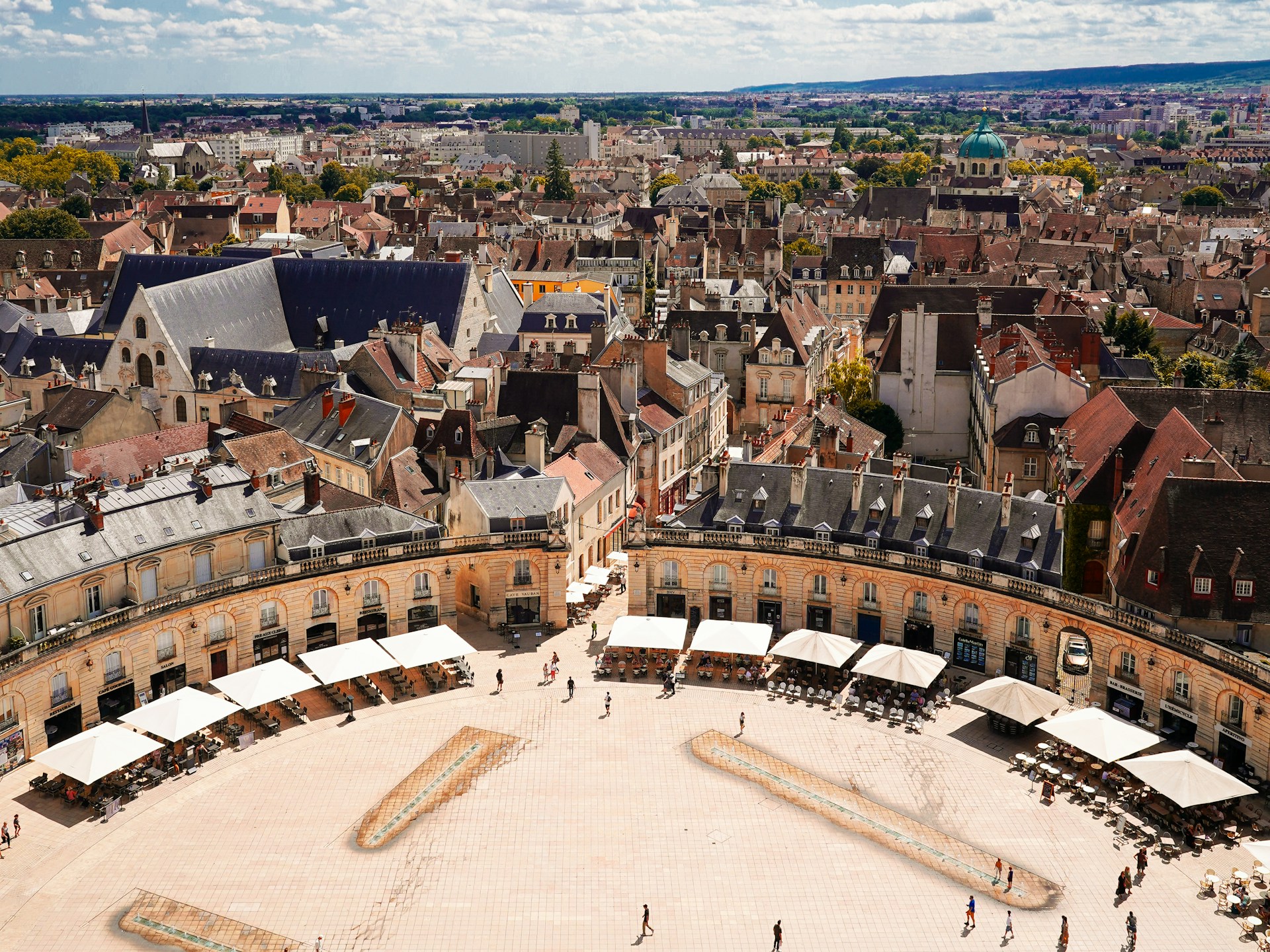
The heart of Dijon. The former seat of the powerful Dukes of Burgundy dominates Place de la Libération with its elegant classical facade, but behind it lies a patchwork of medieval and Renaissance buildings that tell the story of Burgundy’s golden age.
I still remember the first time I walked into the square at sunset: the palace glowing, kids running through the fountains, café terraces buzzing. It felt grand, but not intimidating – more like a living drawing room for the city.
Highlights:
- Court of Honor & Place de la Libération: Designed by Mansart (the architect of Versailles), this sweeping, curved square is one of France’s most beautiful urban spaces.
- Tour Philippe le Bon: The ducal tower. Climb the 316 steps (book in advance) for the best 360° view of Dijon’s rooftops and distant vineyards.
- Musée des Beaux-Arts: Free, and one of France’s richest museums outside Paris, with stunning tombs of the Dukes and a strong collection of medieval and Renaissance art.
Practical tips:
- Best time: Late afternoon for golden-hour photos; tower climb just before sunset if slots are available.
- Tickets: Museum is free; tower requires timed ticket (reserve online or at the tourist office in high season).
- Food nearby: I like grabbing a coffee at the café on Place de la Libération and just people-watch for a while.
Family / Romantic / Adventurous? Family-friendly (kids love the fountains), romantic at night with the palace lit up, and mildly adventurous if you count the tower climb.
2. Place de la Libération
Technically part of the palace complex, but it deserves its own mention because so much of Dijon life flows through here. On warm evenings I often end up sitting on the low stone edges around the fountains, ice cream in hand, chatting with friends until the light fades.
Don’t miss:
- The subtle light show on the palace facade at night in summer.
- The view down Rue de la Liberté – Dijon’s main shopping street – from the palace steps.
3. Église Notre-Dame de Dijon & the Owl (La Chouette)
Notre-Dame isn’t a towering Gothic cathedral like in Paris or Reims; it’s smaller, darker, and to me, more atmospheric. Its western facade, with rows of blind arcades and strange gargoyles, looks almost like a stone theater curtain.
On my first visit, a local friend insisted I find “the owl” before going inside. It’s a tiny stone carving on the church’s north side, worn smooth from centuries of people rubbing it for good luck. The tradition: touch it with your left hand, make a wish, and don’t break eye contact with the wall. Silly? Maybe. But I do it every time I’m in Dijon.
History & significance:
- Built in the 13th century, Notre-Dame is a masterpiece of Burgundian Gothic architecture.
- The façade’s 51 gargoyles are mostly 19th-century reconstructions (the originals fell in 1240), but they still give the church a wonderfully eccentric character.
Practical tips: Go early in the morning or late afternoon for a quieter, more contemplative visit. Combine with a stroll around the surrounding medieval streets – Rue Verrerie and Rue de la Chouette are full of timber-framed houses and tiny shops.
4. Marché des Halles (Covered Market)
The market is my non-negotiable stop on every trip. Designed in part by Gustave Eiffel’s workshop, the iron-and-glass hall is beautiful, but it’s the smells and sounds that make it special: ripe cheeses, fresh bread, strawberries in spring, chanterelles in autumn, and vendors who have clearly known their customers for decades.
I usually arrive hungry around 10:00, do a slow lap to see what’s in season, then assemble a picnic: a wedge of Époisses or Brillat-Savarin cheese, a baguette, some cherries or figs, and maybe a slice of pâté en croûte. If you’re staying in an apartment, this is where you should shop for at least one home-cooked dinner.
Market days (as of 2026): Tuesday, Thursday, Friday, Saturday mornings – Saturday is the most festive but also the busiest.
Family tip: Kids love the colorful produce stands and the small rotisserie chickens turning slowly, dripping onto potatoes below. Grab a roast chicken and sides for an easy, budget-friendly meal.
5. Musée des Beaux-Arts de Dijon
One of France’s oldest museums, completely renovated in recent years, and amazingly, still free. I try not to rush through it: even if you’re not an art person, the building itself is worth a wander.
What to look for:
- The tombs of the Dukes of Burgundy: Incredible Gothic sculptures of mourners circling the base – haunting and beautiful.
- Medieval and Renaissance rooms: They give a sense of how rich and powerful Burgundy was before it became part of France.
- Views into the palace courtyards: Perfect photography spots.
Tip: It’s a great place to escape midday heat or a rainy afternoon. There are usually lockers, so you can drop your bag and wander freely.
6. Tour Philippe le Bon (Philippe the Good Tower)
If you only climb one tower in Dijon, make it this one. On clear days you can see all the way to the first waves of Burgundy’s vineyards.
The climb is narrow and spiraling, with a few landings where I always pretend to “admire the architecture” but really just catch my breath. When you step out at the top, the city unfurls in every direction: rusty rooftops, church spires, and the neat geometry of Place de la Libération below.
Practical tips:
- Book a time slot in advance, especially in summer and on weekends.
- Wear decent shoes; the stone steps can be a bit slippery.
- Not ideal for claustrophobic travelers or very young children.
7. Parc Darcy
Just above Place Darcy and the historic Porte Guillaume, Parc Darcy is where I often come with a takeaway coffee or sandwich. There’s a fountain, formal terraces, and plenty of shade – and it’s only a few minutes’ walk from the busy shopping streets, but feels much calmer.
Family-friendly: There’s a small playground and lots of space to run around. In summer, kids often play near the fountains at the park’s edge.
8. Cité Internationale de la Gastronomie et du Vin
Opened in 2022, this complex has quickly become a staple in any travel guide for Dijon. At first I worried it would be a tourist trap, but each visit has been better than the last.
What’s inside:
- Interactive exhibitions on French gastronomy and Burgundy wines.
- Wine-tasting experiences and classes (great even if you’re a beginner).
- Restaurants, shops, and a cinema, plus event spaces.
My experience: I booked a late-afternoon wine tasting on a rainy day and it turned into a mini masterclass on Burgundy terroir. The sommelier answered all my “basic” questions without a hint of snobbery.
Tip: Combine a visit here with a walk along the nearby canal, or make this your rainy-day anchor activity.
9. Rue de la Liberté & Shopping Streets
Rue de la Liberté runs like a spine through the historic center, from Place Darcy to Place de la Libération. It’s lined with shops, from French chains to local boutiques, and always full of life.
I use it as my orientation line: if I get lost in side streets, I just drift back toward Rue de la Liberté and know I’ll find my way.
Don’t miss: The side streets – Rue de la Chouette, Rue Verrerie, and Rue Musette – where you’ll find smaller, more characterful shops, wine bars, and galleries.
10. Tombs of the Dukes of Burgundy
Technically part of the Musée des Beaux-Arts, these tombs are important enough to call out separately. The alabaster effigies of Philip the Bold and John the Fearless rest atop intricately carved arcades filled with mourners in black cloaks.
The first time I saw them, the room was nearly empty. The quiet, the detail of the sculptures, and the sense of history – this was once one of the most powerful courts in Europe – made it one of the most moving moments of my trip.
11. Quartier des Antiquaires (Antiques Quarter)
East of Les Halles, the antiques quarter is a maze of narrow streets and hidden courtyards. I love coming here on quiet weekdays, peeking into shop windows filled with old books, furniture, and curiosities.
Hidden gem: Some inner courtyards are open; if you see an open gate, respectfully step in for a look. I once stumbled upon a tiny courtyard with a fig tree and stone staircase that felt straight out of a period film.
12. Canal de Bourgogne & Port du Canal
When I need a break from museums and monuments, I walk to the port and follow the Canal de Bourgogne path. Boats bob in the water, cyclists glide past, and the city feels suddenly slower.
Activities:
- Walk or jog along the canal towpath.
- Rent a bike (especially good for families with older kids).
- Pack a picnic or pick up food at Les Halles first.
Tip: If you’re staying 4–5 days in Dijon, make this your “reset” afternoon after a busy morning of sightseeing.
13. Parks & Gardens: Jardin Darcy & Jardin de l’Arquebuse
Dijon has several green spaces, but Jardin de l’Arquebuse is my favorite for a longer stroll. It combines a botanical garden, arboretum, and natural history museum.
Family note: The small natural history museum is free and surprisingly engaging for kids; it’s a great option on a cloudy morning.
14. Cathédrale Saint-Bénigne de Dijon
Less famous than Notre-Dame, but equally interesting, Saint-Bénigne is built over the crypt of an early Christian martyr. The interior is more sober than flamboyant, and that simplicity is part of its charm.
Tip: If you’re interested in religious history, ask about access to the crypt; it gives a deeper sense of the site’s age.
15. Musée de la Vie Bourguignonne (Museum of Burgundian Life)
Set in a former Cistercian monastery, this museum recreates 19th–20th century Burgundian life with shopfronts, tools, costumes, and domestic scenes. It’s free, quirky, and oddly charming.
I popped in one rainy afternoon “just for 20 minutes” and emerged more than an hour later, weirdly invested in old mustard advertisements and apothecary jars.
16. Musée d’Art Sacré & Musée Archéologique
Two lesser-known museums that reward curious travelers:
- Musée Archéologique: In a former Benedictine abbey, with artifacts from prehistory through the Middle Ages.
- Musée d’Art Sacré: Religious art displayed in a deconsecrated church – atmospheric and often empty.
Tip: If you’re staying 5 days in Dijon, include at least one of these for a deeper cultural dive and as an escape from crowds.
17. Rue des Godrans, Rue Berbisey & Nightlife Streets
For nightlife, these streets are your map. When I meet local friends for drinks, we often gravitate here.
What you’ll find:
- Wine bars pouring excellent Burgundy by the glass.
- Cocktail bars and casual pubs (popular with students).
- Tapas-style spots and small restaurants.
Noise note: Fun to visit, less fun to sleep above. If you like quiet nights, avoid booking accommodation directly on these streets.
18. Place François Rude (“Place du Bareuzai”)
My favorite square in Dijon. There’s a carousel (a hit with kids), a central fountain, and a statue of a grape treader (nicknamed “le Bareuzai,” from a local word for “bare-footed”). Timber-framed houses lean over the square, and café terraces ring the edges.
I often end my day here with a glass of local wine. It’s lively but not chaotic, and you feel wrapped in architecture and history.
19. Parcours de la Chouette (Owl’s Trail)
The Owl’s Trail is a self-guided walking route marked by little metal owls in the pavement. You can pick up a booklet or app from the tourist office and follow the numbered stops.
On my first trip, I did this almost religiously; now I tend to follow the owls loosely and peel off whenever a side street looks interesting.
Family tip: Kids love hunting for the owl plaques – it turns sightseeing into a game.
20. Vineyards of the Côte de Nuits (Just Outside Dijon)
Technically beyond city limits, but integral to understanding Dijon. A short drive or train ride south takes you into the Côte de Nuits, home to some of the world’s greatest Pinot Noir.
My ritual: When I have 4 or 5 days in Dijon, I always dedicate one day to the vineyards – either by bike along the Voie des Vignes from Dijon to Nuits-Saint-Georges, or on a guided wine tour so I don’t have to worry about driving.
Tip: Book tastings ahead, especially in smaller domaines. And don’t be shy about telling them your level of wine knowledge; good hosts will adapt.
3, 4 & 5 Day Itineraries for Dijon (With Personal Stories)
Here’s how I’d structure 3 days in Dijon, then how I stretch that into a 4 day itinerary for Dijon or even a full 5 days in Dijon. Each day blends big sights, hidden gems, and plenty of food breaks – because this is Burgundy, after all.
3 Day Itinerary for Dijon: Classic Highlights
Day 1: Getting Oriented – Palaces, Owls & Old Town Charm
I like to spend my first day in Dijon entirely on foot, just letting the city’s historic center unfold.
Morning: Palais des Ducs & Place de la Libération
After dropping my bag at my usual guesthouse near Rue de la Liberté, I head straight to Place de la Libération. There’s something grounding about starting where the Dukes once ruled.
- Grab a coffee on the square, facing the palace.
- Wander into the Musée des Beaux-Arts – focus on the ducal tombs and palace rooms.
- Climb Tour Philippe le Bon if you’ve pre-booked a late-morning slot.
Tip: If you’re jet-lagged, keep the morning light: palaces and museums at a slow pace, plenty of breaks, and fresh air on the tower top.
Lunch: Around Place François Rude
For lunch, I often drift toward Place François Rude. The square is lively, and nearby streets have plenty of bistros. Look for a menu featuring œufs en meurette (poached eggs in red wine sauce) or a simple plat du jour.
Afternoon: Notre-Dame & the Owl Trail
- Visit Notre-Dame, then find La Chouette on the north wall and make your wish.
- Pick up the Parcours de la Chouette booklet or app at the tourist office and follow part of the route through the old town.
- Duck into side streets whenever something catches your eye: a timber-framed house, a courtyard, a smell of baking bread.
Hidden gem stop: Pause in a quiet church or in one of the palace courtyards to rest your feet.
Evening: Dinner & First Taste of Burgundy Wine
For your first night, choose a classic Burgundian bistro in the historic center. Order:
- Bœuf bourguignon or coq au vin
- A glass (or two) of Côte de Nuits or Côte de Beaune wine
After dinner, walk back through Place de la Libération. The palace lit up at night feels like a different place than it did in the morning.
Day 2: Markets, Local Life & Gastronomic Culture
Day 2 is about food and local rhythms – a perfect anchor for any 3 day itinerary for Dijon.
Morning: Marché des Halles & Antiques Quarter
Time your visit for a market day (Tue, Thu, Fri, Sat). I usually arrive around 9:30–10:00:
- Do a full lap of Marché des Halles, even if you’re not buying much.
- Order a coffee and pastry at one of the cafés just outside the halls.
- Chat with a cheesemonger – ask which local cheeses they recommend this week.
Afterwards, wander the Quartier des Antiquaires east of the market. Peek into antique shops and look for open courtyard gates.
Lunch: Market Picnic or Simple Bistro
If the weather is good, buy picnic supplies at the market: cheese, bread, charcuterie, fruit, maybe a small bottle of wine. Walk to Jardin de l’Arquebuse or a nearby square to eat.
Otherwise, choose a small local bistro with a decent formule déjeuner (fixed-price lunch menu) – this is often the best value meal of the day.
Afternoon: Cité Internationale de la Gastronomie et du Vin
- Head to the Cité Internationale de la Gastronomie et du Vin for a few hours.
- Visit the main exhibition on French gastronomy (usually 1–2 hours).
- Book a wine tasting or mini-class if you’re interested in Burgundy wines.
My experience: I found the exhibits surprisingly interactive. Even after many trips to Burgundy, I learned new things about how food culture is officially protected in France.
Evening: Wine Bar Night
Choose a cave à vin or wine bar in the historic center or near Rue Berbisey. Tell the staff it’s your first time in Dijon and you’d like to try a flight of local wines – they’ll usually curate a few glasses for you.
Pair with a plate of charcuterie and cheese and call it dinner if you’re not too hungry.
Day 3: Churches, Parks & Your Own Rhythm
On your last day in a 3 days in Dijon plan, balance some final sightseeing with time to simply be in the city.
Morning: Saint-Bénigne & Museums
- Visit Cathédrale Saint-Bénigne and, if open, the crypt.
- Choose one lesser-known museum: Musée de la Vie Bourguignonne, Musée d’Art Sacré, or Musée Archéologique.
Tip: These museums are usually free, making them ideal if you’re keeping costs down.
Lunch: Café Terrace & People-Watching
Pick a terrace you’ve walked past and thought, “That looks nice,” and make it your lunch base. I like those in or near Place du Théâtre or back in Place François Rude.
Afternoon: Parc Darcy & Last-Minute Shopping
- Walk up to Parc Darcy for a short, relaxing wander.
- Return via Rue de la Liberté for any last shopping: mustard, gingerbread (pain d’épices), wine, or local ceramics.
Evening: Farewell Dinner
For your final night, choose somewhere a little special – perhaps a restaurant with a modern take on Burgundian cuisine. Make a reservation, dress up a little, and toast your time in Dijon with one last glass of red.
4 Day Itinerary for Dijon: Adding a Deeper Layer
If you have 4 days in Dijon, keep the 3-day structure above and add:
Day 4: Canal Walks, Hidden Corners & Flex Time
On my fourth day, I usually slow down. The pressure to “see everything” has eased, and I can just enjoy.
Morning: Canal de Bourgogne & Port du Canal
- Walk or bike to Port du Canal.
- Follow the towpath for a while – as long or short as you like.
- Stop on a bench to read, journal, or simply watch the water.
Lunch: Casual Canal-Side or Back in Town
Depending on what’s open near the port, either eat canal-side or return to the center to try a new bistro you spotted earlier.
Afternoon: Repeat a Favorite or Explore a New Museum
Use this time to:
- Return to a place you loved (I often do a second lap of Les Halles or the Beaux-Arts).
- Visit any museum you missed.
- Shop for food souvenirs: mustard from a reputable shop, pain d’épices from a bakery, local wine from a good caviste.
Evening: Nightlife Taster
Dip into Dijon’s nightlife more intentionally:
- Start with a wine bar in the historic center.
- Check out a cocktail bar or live music venue around Rue Berbisey or Rue des Godrans.
5 Day Itinerary for Dijon: Adding Vineyards & Day Trips
With 5 days in Dijon, you can combine in-depth city exploration with a taste of the surrounding Burgundy countryside.
Day 4: Vineyards of the Côte de Nuits
This is my favorite day when I have time: a full escape into the vines.
Options:
- Guided wine tour: Easiest, especially if you want to taste freely. Many tours leave from Dijon and visit villages like Gevrey-Chambertin, Chambolle-Musigny, and Nuits-Saint-Georges.
- DIY by train: Take a regional train to Gevrey-Chambertin or Nuits-Saint-Georges, then walk or taxi between nearby vineyards (book tastings ahead).
- Bike the Voie des Vignes: For active travelers, rent bikes and follow the signposted “vineyard way” from Dijon heading south.
My experience: I joined a small-group tour once where we visited a family winery. Tasting Pinot Noir in the cellar, while the winemaker explained each parcel’s character, made every glass I’ve had since then more meaningful.
Day 5: Flex Day – Day Trip or Deep Dive
Your final day in a 5 day itinerary for Dijon can go a couple of ways, depending on your interests:
Option A: Day Trip to Beaune
- Take an early train to Beaune (about 20 minutes).
- Visit the Hospices de Beaune, wander the old town, maybe add another winery visit.
- Return to Dijon for dinner.
Option B: Deeper Dijon
- Visit any remaining museums or churches.
- Spend several unhurried hours café-hopping and people-watching.
- Do a food or cooking class (some are based around Dijon specialties).
Tip: I often leave the last day relatively unplanned, using it to revisit places I connected with the most or to follow locals’ last-minute suggestions.
Local Food in Dijon: What & Where to Eat
Dijon is one of the great food cities of France. Beyond mustard, there’s an entire repertoire of Burgundian dishes that are rich, comforting, and perfect with local wine.
Must-Try Dishes & Specialties
- Bœuf Bourguignon: Beef slowly braised in red wine with onions, mushrooms, and bacon.
- Coq au Vin: Chicken stewed in wine – when done well, the meat falls off the bone.
- Œufs en Meurette: Poached eggs in a red wine sauce, often served over toast – my favorite Burgundian starter.
- Jambon Persillé: Parsleyed ham in aspic – much tastier than it sounds; try it at least once.
- Escargots de Bourgogne: Snails baked with garlic and parsley butter; classic and surprisingly approachable.
- Époisses & Local Cheeses: A strong, creamy cheese often washed in local brandy; also look for Brillat-Savarin, Chaource, and Comté from nearby Jura.
- Pain d’Épices: Dijon-style gingerbread, less sweet than some versions, excellent with tea or as a souvenir.
- Dijon Mustard: Of course. Buy from a reputable producer or mustard bar where you can taste different styles.
Where to Eat: Personal Favorites & Strategies
I avoid listing specific restaurant names that change often, but here’s how I choose where to eat and some types of places I return to:
- Near Les Halles: Great for casual lunches on market days; I look for short menus with daily specials featuring seasonal ingredients.
- Old Town Bistros: For classic dishes; I check blackboards for menu du jour around 18–25€ at lunch.
- Modern Wine Bistros: Contemporary takes on Burgundian cuisine; usually have excellent wine lists and small plates to share.
- Gourmet Restaurants: For a splurge night; book ahead, especially Friday and Saturday.
Saving Money on Food
- Lunch over dinner: Eat your main meal at lunchtime with a fixed-price menu; have a lighter dinner of wine and snacks.
- Apartment stays: If you’re in Dijon 4–5 days, consider an apartment and cook with produce from Les Halles at least once.
- Picnics: Markets, bakeries, and supermarkets make picnics easy and fun.
- Tap water: Ask for a carafe d’eau – perfectly normal and free.
Nightlife, Entertainment & Cultural Experiences in Dijon
Dijon’s nightlife is more low-key than a big capital, but there’s plenty to do once the sun sets.
Wine Bars & Pubs
- Wine bars: Concentrated around the historic center; ideal for tasting by the glass with cheese and charcuterie.
- Student pubs: Around Rue Berbisey; lively, especially Thursday–Saturday.
Culture & Events
- Théâtre & Opera: Check programs at the Grand Théâtre or cultural centers for concerts, opera, and plays.
- Cité de la Gastronomie: Hosts tastings, workshops, and occasional events in the evenings.
- Summer festivals: Open-air concerts and cultural events (details in the events section below).
Romantic Ideas
- Sunset from Tour Philippe le Bon (timed slot permitting).
- Evening stroll from Place de la Libération to Place François Rude, ending with dessert and wine.
- Canal-side walk at dusk, especially in late spring or early autumn.
Family-Friendly Evenings
- Carousel rides in Place François Rude.
- Ice cream in the old town and a run through the fountains in Place de la Libération (in warm weather).
- Early dinner at a simple brasserie where kids are welcome.
Day Trips from Dijon
One of the strengths of using Dijon as a base is how easy it is to reach other Burgundian highlights.
Beaune
Why go: Wine capital of Burgundy, charming old town, famous Hospices de Beaune with its colorful tiled roof.
How to get there: Direct regional trains from Dijon (about 20 minutes), or by car.
Route des Grands Crus / Côte de Nuits Villages
Why go: Classic Burgundy vineyard landscapes, world-class wine villages such as Gevrey-Chambertin, Vosne-Romanée, Nuits-Saint-Georges.
How: Guided tour, rental car (with a designated driver), or by bike/train combo.
Abbaye de Fontenay
Why go: A UNESCO-listed Cistercian abbey in a peaceful valley; tranquil and visually stunning.
How: Best by car or organized tour from Dijon.
Morvan Regional Natural Park
Why go: Lakes, forests, and hiking; a complete change of scenery from the city and vineyards.
How: Car required for flexibility.
Major Events & Festivals in Dijon (2026–2027)
Exact dates change yearly, but here are some recurring events you can expect around 2026–2027. Always confirm closer to your travel dates.
International Gastronomy & Wine Events
- Foire Internationale et Gastronomique de Dijon (Dijon International & Gastronomy Fair): Usually late October–early November. Large fairground event celebrating food and wine from Burgundy and a featured guest country.
- Events at Cité Internationale de la Gastronomie: Throughout the year, expect thematic weekends, wine fairs, and cooking demonstrations.
Music & Cultural Festivals
- Summer music festivals: Open-air concerts in city squares and parks; programming typically announced in spring.
- Heritage Days (Journées du Patrimoine): Mid-September weekend when many historical buildings open free or offer special tours.
Wine-Related Events
- Harvest season (Vendanges): Late September–October in surrounding vineyards (Côte de Nuits, Côte de Beaune). Not a single event, but a wonderful time to visit if you want to feel the region at work.
Cultural Etiquette & Local Customs in Dijon
Understanding a few basics about French and Burgundian customs will make your stay smoother and more enjoyable.
Greetings & Politeness
- Always say “Bonjour, Madame / Monsieur” when entering a shop or restaurant; say “Au revoir, merci” when leaving.
- Use vous (formal “you”) with strangers and service staff unless invited to use tu.
- A simple attempt at French is appreciated, even if you switch to English afterwards.
Dining Etiquette
- Meals are usually unhurried; don’t expect the bill automatically. Ask for it: “L’addition, s’il vous plaît.”
- Tipping is not obligatory (service is included), but rounding up or leaving 5–10% for good service is appreciated.
- It’s less common to share plates than in some countries; if you want to, mention it when ordering.
Wine Culture
- It’s perfectly fine to ask for guidance when choosing a wine; locals expect it, especially with Burgundy’s complexity.
- Tastings in domaines are often by appointment; be on time and don’t wear heavy perfume (it interferes with smelling the wine).
Dress & Behavior
- Dijon is relaxed but stylish; smart-casual is a safe default.
- In churches, dress modestly and keep voices low.
- On public transport, offer seats to elderly or pregnant passengers.
Practical Travel Tips for Dijon
Getting To & Around Dijon
Arriving by Train
- From Paris: TGV from Gare de Lyon (about 1h40).
- From Lyon: Direct trains (about 2 hours).
- The main station is Gare de Dijon-Ville, a 10–15 minute walk to the historic center.
Local Transport
- On foot: The best way; most attractions are within a compact area.
- Tram & Bus: Efficient for reaching the Cité de la Gastronomie, some outer neighborhoods, and shopping zones.
- Bikes: Public bike systems and rentals are available; great for the canal and flat routes.
- Car: Helpful for day trips into the countryside but not needed in the city; parking in the historic center can be tricky and expensive.
SIM Cards & Connectivity
- Look for French or EU-wide prepaid SIMs at major phone shops or some supermarkets in Dijon.
- Free Wi-Fi is common in hotels and many cafés; ask staff for the code.
Money-Saving Tips
- Stay in an apartment for 4–5 day stays to self-cater some meals.
- Use lunch menus for more elaborate food at lower prices.
- Take advantage of free museums like the Musée des Beaux-Arts and Musée de la Vie Bourguignonne.
- Walk or use public transit instead of taxis whenever possible.
Visa Requirements & Driving
(Always double-check with official sources before traveling; this is general guidance as of 2026.)
- Dijon is in France, part of the Schengen Area. Many nationalities (including most of Europe, UK, US, Canada, Australia, New Zealand, and others) can enter visa-free for short stays (typically up to 90 days in 180).
- If your country requires a Schengen visa, apply in advance at the French consulate or visa center in your home country.
- Driving: Most visitors can use their foreign driver’s license for short stays; some may need an International Driving Permit (IDP) in addition. Check before traveling.
- Renting a car is straightforward; pick up from Dijon station or airport hubs, and make sure you understand manual vs. automatic availability and insurance coverage.
Safety
- Dijon is generally safe, including at night in the main areas.
- Use normal city precautions: watch bags in crowded markets, avoid leaving valuables visible in cars, and be mindful after drinking.
Best Seasons for Activities
- Spring (April–June): Mild weather, blooming parks, good for city walks and early vineyard trips. Great for a 3 or 4 day itinerary for Dijon.
- Summer (July–August): Warm to hot, longer days, more events; some smaller businesses may close for holidays in August.
- Autumn (September–October): My favorite: harvest season, golden vineyards, comfortable temperatures, fewer crowds.
- Winter (November–March): Colder, quieter, with cozy bistros and sometimes Christmas markets; good for budget travelers and those who prefer museums and food over outdoor activities.
Summary & Final Recommendations
Dijon is a city that rewards both quick visits and slow stays. In 3 days in Dijon, you can see the key must-see attractions: the ducal palace, Notre-Dame and its owl, Les Halles, and the main museums, while getting a solid introduction to Burgundian food and wine.
With 4 days in Dijon, you can add canal walks, lesser-known museums, and more time to simply enjoy the rhythm of the city. A 5 day itinerary for Dijon lets you fold in vineyards, day trips to Beaune or the countryside, and deeper cultural experiences at the Cité Internationale de la Gastronomie et du Vin.
For most travelers, the best time to visit Dijon is spring (April–June) or autumn (September–October), when the weather is comfortable and the food and wine seasons are in full swing. Summer brings long evenings and festivals, while winter offers a quieter, more introspective Dijon of museums, markets, and candlelit bistros.
However long you stay, let yourself wander. Follow the little owl markers, step through open courtyard doors, linger over a glass of wine in Place François Rude, and let Dijon reveal itself at its own unhurried pace.