Why Visit Mont Saint-Michel Bay?
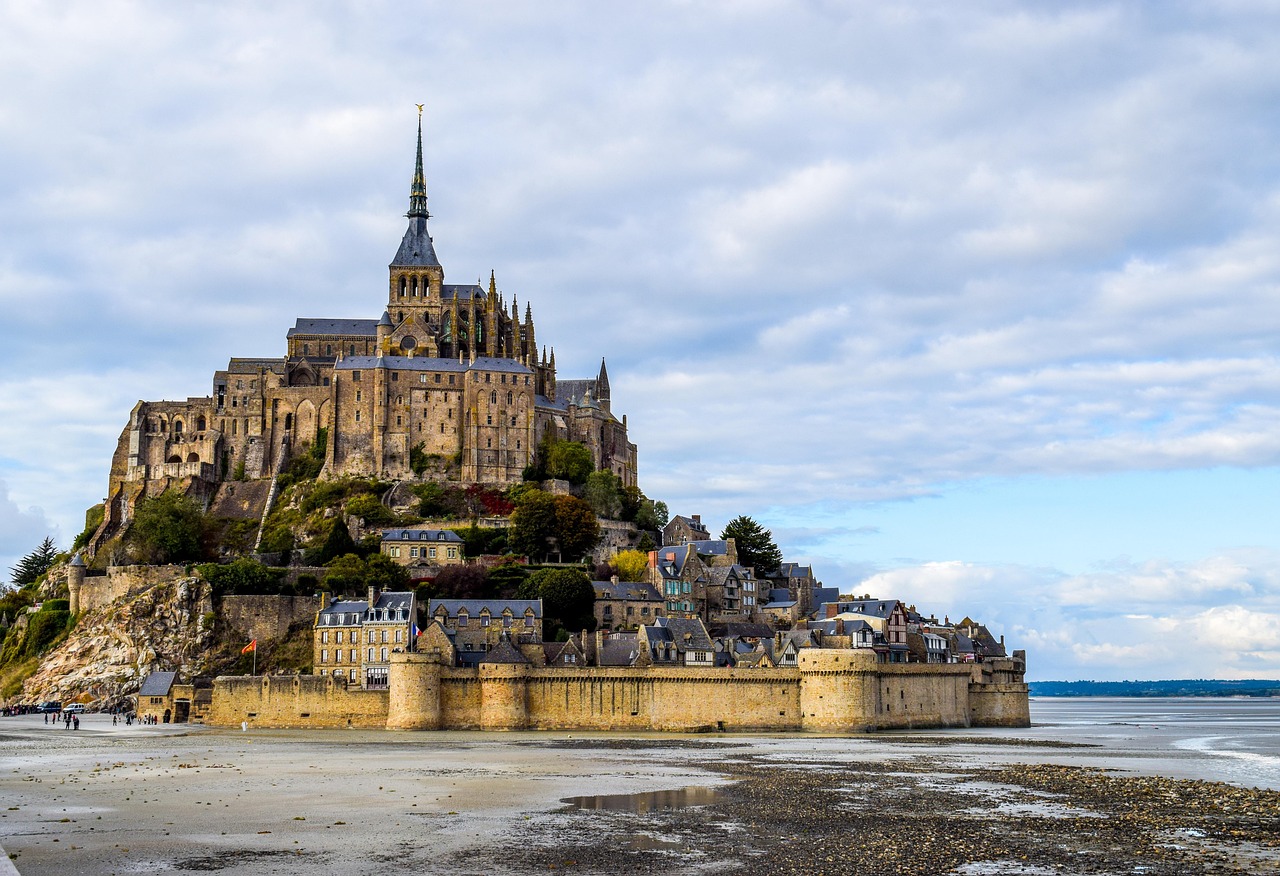
Mont Saint-Michel Bay is one of those rare places where landscape, history, and myth fuse into something almost theatrical. The abbey itself—perched on its granite outcrop, all flying buttresses and impossibly narrow stairways—is the headline act, but the bay is the real story: a wide, silvery amphitheatre where some of Europe’s most powerful tides race in and out, reshaping the sands and the light every few hours.
Across 2–4 days you can:
- Climb through a vertical medieval village to a Gothic abbey that still rings with monastic chant.
- Cross the bay barefoot with a certified guide, feeling the tug of quicksand and the rush of the incoming tide—an unforgettable, mildly adventurous, but family-friendly experience.
- Wander quiet lanes at dusk when the day-trippers vanish and the island glows amber under its night-time illumination.
- Eat salt-meadow lamb and buttery galettes in tiny, family-run restaurants that survive on locals and regulars, not tour buses.
- Use the bay as a base for day trips to Cancale’s oyster farms, the corsair city of Saint-Malo, the granite lanes of Dinan, or the D-Day beaches further north.
If you’re weighing up a 2 day itinerary for Mont Saint-Michel Bay versus 3 days in Mont Saint-Michel Bay or even 4 days in Mont Saint-Michel Bay, the good news is: all work. Two days will give you the “wow” moments; three or four let you discover the quieter villages, the best local food, the hidden chapels, the tidal rhythms, and the true cultural experiences that make this corner of France addictive.
Understanding Mont Saint-Michel Bay & Its Historical Layout
The first time I arrived, back in the early 2010s, you still approached along the old causeway, with rental cars parked almost to the water’s edge. Today, after a major environmental restoration project, the mount once again feels like an island: the carparks have shifted inland, a graceful footbridge now arcs across the tidal flats, and the Couesnon River has been “freed” to help the tides scour away silt.
Think of the area in concentric circles, both geographically and historically:
- The Rock (Le Mont) – a vertical village wrapped around the abbey. At its base, the Grand Rue with inns and shops; above, twisting alleys, the parish church, and the monastery buildings crowning the summit.
- The Ramparts – 13th–15th century fortifications, a circuit you can walk, seeing how the island defended itself and reading the bay like a map under your feet.
- The Bay – vast sands, salt meadows, and river mouths. Historically dangerous—quicksand, fast tides, fog—but also a major pilgrimage route, with pilgrims once crossing from different points along the coast.
- The Mainland Villages – Beauvoir, Pontorson, Genêts, and others, which grew as service points for pilgrims and later for tourists, but still keep their own rhythms, markets, and family farms.
The chronological layering is visible in stone:
- 8th–10th centuries: Origins as a sanctuary and early Benedictine monastery on a rock that was still linked more closely to the mainland.
- 11th–13th centuries: Romanesque and early Gothic expansion—the “Merveille” (Marvel), those elegant cloisters and refectories built over sheer void.
- Hundred Years’ War era: Fortifications thickened; the mount never fell to the English, and its military profile strengthened.
- 18th–19th centuries: The abbey turned prison, then rediscovered as a romantic ruin; artists and early tourists arrive.
- Late 20th–early 21st centuries: Mass tourism, then a deliberate effort to restore the island’s maritime character by removing the old causeway and carparks.
When you walk from the modern shuttle stop across the new bridge toward the medieval gate, you’re actually walking through that entire history: from a 21st-century environmental project back into a layered medieval stronghold. The key to enjoying the best places to visit in Mont Saint-Michel Bay is to do this walk at different times of day—once in early morning quiet, once as the sun drops and the abbey lights up.
Suggested Itineraries: 2, 3 & 4 Days in Mont Saint-Michel Bay
Below are flexible itineraries that you can adapt depending on how many days you have—each grounded in real stays I’ve done in 2022–2024, updated with timing tips for 2026. I’ll give an overview here, then we’ll go deeper into each quarter and monument afterwards.
2 Day Itinerary for Mont Saint-Michel Bay
If you only have 2 days in Mont Saint-Michel Bay, focus on the essentials: the abbey, the village, a ramparts walk, a taste of local food, and at least a short guided walk into the bay.
- Day 1: Arrive by midday. Afternoon exploring the medieval village and ramparts. Late-afternoon or evening abbey visit. Dinner on the mount. Night walk.
- Day 2: Morning guided bay walk (3–4 hours), picnic or lunch in Beauvoir or Pontorson, then a final panoramic stroll along the bridge before departure.
3 Day Itinerary for Mont Saint-Michel Bay
With 3 days in Mont Saint-Michel Bay you can add a day of inland or coastal exploration and slow down enough to catch sunrise or moonrise over the bay.
- Day 1: As above: village, abbey, ramparts, night-time atmosphere.
- Day 2: Bay crossing (longer version), visit Saint-Aubert Rock, explore Beauvoir’s lanes, dinner in a low-key crêperie with locals.
- Day 3: Morning in Pontorson (market day if possible), afternoon excursion to Genêts or the Couesnon barrage, sunset on the bridge.
4 Day Itinerary for Mont Saint-Michel Bay
A 4 day itinerary for Mont Saint-Michel Bay lets you treat the mount as a base: fit in a day trip to Cancale and Saint-Malo and still have time for slow, aimless walks along farm lanes.
- Day 1: Classic mount exploration; stay overnight on the island if budget allows.
- Day 2: Full bay crossing and Saint-Aubert Rock; quiet evening on the mainland with a farm dinner or riverside picnic.
- Day 3: Day trip to Cancale (oysters) and Saint-Malo (ramparts, corsair history, beaches).
- Day 4: Inland day: Dol-de-Bretagne, small chapels, or cycling around Pontorson; final evening light-show views of the mount.
12 Key Quarters, Monuments & Sites in Mont Saint-Michel Bay
Here we’ll deep-dive into the main quarters, monuments, and key sites that shape any serious travel guide for Mont Saint-Michel Bay. Each subsection blends history, significance, and my own notes from repeated visits—what to eat nearby, how to time your visit, and what to look for that most people miss.
1. The Medieval Village & Grand Rue
The Grand Rue—the narrow, cobbled main street that snakes up from the main gate—is where every visit physically begins, but it doesn’t have to be where your experience becomes “just like everyone else’s”.
On my last three trips (April 2023, October 2024, and February 2025), I made a point of arriving either very early (before 9:00) or in the late afternoon (after 16:30). In high season, the middle of the day turns the Grand Rue into a slow-moving river of umbrellas, backpacks, and selfie sticks. At the edges of the day, it feels almost like a stage set between performances—shop shutters half-open, delivery carts rattling over stone, cats slinking out of side alleys.
The street itself is medieval in its line and volume but dressed in centuries of adaptation: timbered façades, overhanging eaves, carved wooden signs. Look up and you’ll see tiny attic windows and old pulley systems used to hoist goods. Several of the current souvenir shops occupy spaces that were once pilgrims’ hostels and taverns.
How to Walk the Grand Rue (Without Losing Your Soul)
- Enter through the King’s Gate (Porte du Roi) with its drawbridge and portcullis. Pause just inside to let the first wave of visitors surge past. The acoustics here are wonderful; you can hear snatches of every language echoing under the vault.
- Take the first side alley upward whenever the main street feels too tight. Many of these lead to staircases that rejoin the main route higher up, but they’re usually quieter and far more atmospheric.
- Notice the layering of signs—modern menus nailed over older wood, faded painted letters half-visible beneath. It’s a literal palimpsest of tourism, from 19th-century “romantic ruin” visitors to 21st-century day trippers.
Eating on the Grand Rue
It’s no secret that much of the food directly on the Grand Rue is pricier and sometimes more about throughput than craft. Still, there are pockets worth seeking out, especially in shoulder seasons when the pace slows and the kitchen has time to care.
One February evening in 2025, when a chill wind rattled the shutters, I ducked into a tiny crêperie halfway up the street. I was the only customer for nearly an hour; the owner, a woman in her 60s, told me how her parents had run a simple canteen for pilgrims before the modern tourist boom. Her galette complète—buckwheat, egg, ham, and cheese—arrived with crisped edges and the faint nuttiness that marks good Breton buckwheat. A glass of dry cider later, the storm outside felt distant.
Tip: For more authentic local food in Mont Saint-Michel Bay, you’ll often eat better just off the main drag or on the mainland, but the Grand Rue is unbeatable at night for sheer atmosphere—timbered façades lit by lanterns, the occasional waft of woodsmoke, and the sense of climbing into the past.
2. The Abbey of Mont Saint-Michel
The abbey is the reason the mount exists. Even if you rarely set foot in churches, this one deserves your full attention. It’s not just a religious site; it’s an architectural puzzle built vertically over centuries, the result of faith, engineering bravado, and a lot of stubborn monks.
Layout & What to Notice
The circuit takes you through a sequence that roughly tracks the community’s life:
- West Terrace: A wide platform with sweeping bay views. Stand here and imagine the medieval pilgrim’s first glimpse upwards—this was the threshold between secular and sacred.
- The Church: The nave is Romanesque, heavy and grounded; the choir, rebuilt after a collapse, is Gothic, all verticality and light. I like to stand where these styles meet and feel the shift in mood.
- The Cloister: Perhaps the most photogenic spot: a garden in the sky, framed by delicate arches. Visit in the late afternoon if you can; the columns cast repeating shadows that look like a stone lacework.
- Refectory & Guest Halls (La Merveille): These vast, rib-vaulted spaces, stacked one above another on the cliff face, are an engineering feat. They show how the abbey functioned practically: monks above, pilgrims and guests below.
- Prison Cells & Wheel: Later, when the abbey became a prison, a giant wooden treadwheel was used to haul supplies. It’s a brutal contrast with the airy cloister above.
On a chilly November morning in 2024, I joined the first entry slot at 9:00. A thin mist still hovered in the bay. For almost fifteen minutes in the cloister, I was completely alone except for a pair of sparrows. Then, faintly, a group of monks from the modern community began morning chants in a side chapel: a low, steady sound that made the stone feel alive. These unscripted moments are why I always advise: go early or go late.
Practical Tips for Visiting the Abbey
- Tickets & Timing: In 2026, booking a timed ticket online is strongly advised in high season. Aim for the first slot of the morning or one of the last in the evening.
- Dress Code: It’s a religious site—no need to be formal, but avoid beachwear. Shoulders covered, respectful clothing, and keep voices low in chapels.
- Photography: Allowed almost everywhere, but avoid flash in dim interiors and never photograph during religious services without explicit permission.
- Accessibility: There are many stairs and uneven stone surfaces. If you have mobility issues, focus on lower terraces and ramparts; sadly the full abbey circuit is challenging without good mobility.
3. Ramparts & Coastal Walks
Walk the ramparts once in daylight, once at dusk, and you’ll understand why Mont Saint-Michel survived so many sieges and why its silhouette haunts so many paintings.
Starting from the entrance gate, you can climb up onto the walls at several points. The most rewarding is to ascend near the lower village and follow the circuit clockwise, with the bay on your right. Every few meters offers a new angle: the bridge slicing through mirrored water, the salt meadows changing color with the light, distant specks of walkers crossing the sands.
One July evening in 2022, as the last shuttle buses hummed away and the sky turned bruise-purple, I walked this circuit almost alone. A lone accordion played somewhere in the village below. When the abbey’s floodlights snapped on, stone details that had been invisible in daylight—carved gargoyles, arrow slits, weathered coats of arms—suddenly sprang into focus.
Tip: For families, this is a perfect way to burn energy: kids love peering through loopholes and imagining invaders wading through the mud below. Just keep a close eye on them; some stretches are narrow, and the drop is real.
4. The Bay & Tidal Crossings
Everything in Mont Saint-Michel Bay is dictated by one fact: this is one of Europe’s most extreme tidal ranges. The sea can retreat 15 kilometers and then roar back in at the speed of a galloping horse (as local lore has it). The sands are laced with quicksand pockets where freshwater springs bubble up from below.
Walking into this landscape barefoot, with a certified guide, is one of the must-see, must-feel cultural experiences in the region.
Guided Crossings: What to Expect
On a clear June morning in 2023, I joined a 3-hour loop that started from the mainland near the bridge, circled out into the bay, and approached the mount from behind. Our guide, a wiry local in his 40s, had been walking this bay since he was a child. He carried a long wooden staff which he used to prod the sand, reading the firmness like a language.
- Barefoot & Light: Shoes come off early; the bay feels best underfoot. The sand is cool, then sometimes unexpectedly warm where the tide recently slid away.
- Quicksand Demonstrations: You’ll be shown safe patches where, if you shift your weight just so, your feet sink and the sand liquefies. It’s unnerving at first, but guides know exactly where and how to play with this safely.
- Tide Stories: Our guide pointed out lines of seaweed and driftwood marking recent high-tide levels, and told stories of pilgrims caught out centuries ago—why the bay has always been both sacred and feared.
Safety Tip: Never, ever attempt to cross the bay alone unless you are a seasoned local and know the tides intimately. The patterns of currents and quicksand shift constantly. A guided walk is adventurous but controlled, suitable for most reasonably fit visitors aged roughly 6+.
5. Saint-Aubert Rock & Chapel
South of the main mount, a smaller rocky outcrop called Rocher de Tombelaine often gets more press, but closer in, the Saint-Aubert rock and its tiny chapel encapsulate the origins of the whole site. According to legend, the Archangel Michael appeared three times in dreams to Bishop Aubert of Avranches, ordering him to build a sanctuary on the rock.
The chapel is usually visited as part of a guided bay walk, which makes the arrival feel earned. On a low-tide afternoon in September 2024, we climbed the last few meters of damp rock to find the building locked but luminous in the sideways sun, its stone worn silky by centuries of salt wind. Our guide pulled a weathered booklet from his pack and read the foundational legend of Mont Saint-Michel, his voice nearly drowned by gusts.
Tip: This is a more contemplative, less crowded site and a favorite with couples looking for a romantic moment away from the main island. Even kids seemed to fall quiet for a few minutes, the novelty of being on a “secret” rock outweighing the lack of snack stands.
6. The Causeway & Panoramic Footbridge
The new causeway-footbridge, opened in stages over the last decade, has transformed arrival. Instead of driving almost to the gates, you now park several kilometers away, then either walk, bike, or take a shuttle along a gently curving bridge that floats over the tidal flats.
I recommend doing the full walk at least once: it takes about 30–40 minutes at an easy pace, and the perspective you gain on the mount is unmatched. The abbey’s profile slowly detaches from the mainland and becomes more sculptural; you see the way the island rises from the sands like the prow of a stone ship.
On a misty March afternoon in 2025, I walked out as the tide was turning. At first, the bay was a matte expanse of gray-brown. Half an hour later, thin sheets of water had begun to snake in, turning everything reflective. The mount’s reflection elongated and wobbled; the bridge seemed to hover. It felt like one of those rare places where the built and natural environments have reached a truce.
Tip: For photographers, the bridge is the best spot for atmospheric architectural shots of the entire island. Early morning (sun rising behind you as you face the mount) is ideal; so is blue hour, when the abbey is lit and the sky still holds a trace of color.
7. The Couesnon Barrage & Riverfront
Roughly halfway between the shuttle parking and the start of the footbridge lies the Coulée du Couesnon, a modern barrage (dam) and riverfront promenade that’s worth a dedicated stop. Built as part of the broader project to restore the island’s maritime character, the barrage periodically releases flows of river water to help flush silt out of the bay.
Stand on the viewing platform during a release and you’ll feel the rumble of water beneath your feet. Look upstream and you see the Couesnon as a tamed, rural river; downstream, it widens and braids into the bay’s complex channels.
I’ve often used this spot as a pause-point: a place to drink a coffee from a thermos, adjust layers, and watch birds working the margins. In winter, flocks of waders and gulls churn the mud for food; in summer, swallows skim the water’s surface. It’s a reminder that Mont Saint-Michel Bay is an ecosystem first, postcard second.
8. Beauvoir & Farm Lanes
Beauvoir is the closest village to the mount and where many visitors sleep if they don’t stay on the island itself. On first glance, it’s a string of hotels, B&Bs, and restaurants lining the road to the carparks. But slip just one or two streets back and you find a softer Beauvoir: farm lanes, vegetable gardens, and low, stone houses with hydrangeas bursting in summer.
On a late August evening in 2023, after a day of thick crowds on the mount, I walked a loop through the fields just north of Beauvoir. The mount hovered above the horizon like a dark cut-out, while cows grazed in meadows streaked with tidal channels. A local farmer, seeing my camera, nodded toward the mount and said simply, “On ne s’en lasse pas” – you never get tired of it.
Beauvoir is also where you’ll find some of the most authentic local food in Mont Saint-Michel Bay, especially if you’re willing to dine early (before 19:30) or late (after 21:00), when tour groups thin out. Look for places with short, seasonal menus: lamb from the salt meadows, mussels when in season, and homemade galettes.
9. Pontorson – Gateway Town
Pontorson, about 9 km inland, is the practical gateway: this is where the train drops you, where bus connections run to the mount, and where you’ll find supermarkets, banks, and a local weekly market (typically Wednesday mornings, check 2026 schedules).
I’ve grown fond of Pontorson over the years. It’s not conventionally beautiful in the way Saint-Malo is, but its grid of streets holds a quiet charm: slate-roofed houses, a stout church, a scattering of cafés where locals linger over coffee long after you’d expect them to be at work.
On market day, stalls fill the main square: fishmongers selling glistening mackerel and scallops, cheesemongers with wheels of raw-milk Camembert and local tomme, butchers with pré-salé lamb (raised on the salt meadows of the bay). If you’re staying in a self-catering place, this is where you want to shop. If not, it’s still worth buying picnic supplies: a wedge of cheese, a baguette, some fruit, and a bottle of cider to share on the riverbank or back in your room.
Tip: For budget travelers, Pontorson makes an excellent base. Accommodation is generally cheaper than on the mount or in Beauvoir, and you can be at the shuttle parking in 15–20 minutes by bus or car.
10. Genêts & Coastal Trails
On the bay’s western flank, the village of Genêts is a quiet gem that many visitors never see. It was historically one of the starting points for pilgrims crossing the bay, and today it’s a base for guided walks and independent coastal hikes with constant, shifting views of the mount.
I spent two nights in Genêts in June 2022, staying in a small guesthouse run by a retired couple who seemed pleasantly baffled that anyone would choose their village over the main tourist drag. Each evening, after the heat softened, I walked a path along the shoreline, the mount a dark-blue triangle in the distance, the water glinting between patches of salt meadow grass. I met exactly three other people in two hours.
For those building a 3 day itinerary for Mont Saint-Michel Bay who want one day away from the main crowds, Genêts is perfect: a taste of unhurried Normandy life, easy, flat walking, and plenty of birdlife: herons, egrets, and, in winter, migrating geese.
11. Cancale & Saint-Malo Day Trip
Strictly speaking, Cancale and Saint-Malo are just beyond the immediate Mont Saint-Michel Bay, but in travel terms they are natural extensions. From the mount, you’re about an hour’s drive to Cancale’s oyster beds, and another 20 minutes to the walled corsair city of Saint-Malo.
On a bright May morning in 2023, I left the bay just after sunrise and drove west along the coast. By 9:30, I was perched on Cancale’s harbor wall, eating oysters opened on the spot by a vendor in a wool cap. The taste was like drinking the ocean in concentrated form—briny, mineral, clean. Later, in Saint-Malo, I walked the ramparts, listening to the surf crash against granite fortifications built by privateers who once terrorized the Channel.
If you have 4 days in Mont Saint-Michel Bay, devote one to this duo: it broadens your sense of the region’s maritime history and gives you a different kind of architectural spectacle—urban fortifications instead of a solitary abbey.
12. Dol-de-Bretagne & Inland Chapels
Dol-de-Bretagne, a small inland town about 30–40 minutes from the bay, offers a different chapter of the story: megaliths, a brooding Gothic cathedral, and quiet lanes lined with stone houses. It’s a fine target for those who like their cultural experiences without crowds.
On a drizzly October day in 2024, I ducked into Dol’s cathedral just as a choir rehearsal began. The voices rose into the dim vaults with a raw, local energy—no polished tourist show, just a community singing into stone that has seen a thousand such afternoons. Later, I followed a signed trail out of town to a line of standing stones in a field, sheep cropping the grass around them. The mount felt far away, but the sense of deep time was the same.
Dol and similar towns also host small traditional music evenings—fest-noz—where locals dance Breton circle dances to live fiddle and bombarde. It’s one of the most joyful cultural experiences you can have in the region, and visitors are usually welcomed warmly if they join in respectfully.
Traditional Cuisine & Local Food in Mont Saint-Michel Bay
Food here is rooted in the bay’s unique landscape: salt-meadow lamb grazes on grass washed by the tides, dairy cows produce rich cream, and the nearby coasts provide mussels, oysters, and fish. The most memorable meals I’ve had in the bay have been in modest, family-run places well away from the souvenir-laden terraces.
Signature Dishes to Try
- Agneau de pré-salé (Salt-meadow lamb): The sheep graze on salty, herb-studded meadows, which lends the meat a subtle, savory complexity. Best enjoyed simply roasted or grilled, with local potatoes.
- Galettes & Crêpes: Buckwheat galettes (savory) and wheat crêpes (sweet) are Breton staples. Look for fillings like local cheese, ham, eggs, and seasonal vegetables.
- Moules de bouchot: Rope-grown mussels from the bay, plump and sweet when in season (typically late spring to early autumn). Served marinière (white wine, shallots, parsley) or with cream.
- Cider & Pommeau: Apple-based drinks are everywhere: dry, sparkling cider to drink with galettes, and pommeau (apple juice fortified with calvados) as an aperitif.
- Butter & Salted Caramel: The dairy here is superb; try salted-butter caramel in crêpes, on ice cream, or simply by the spoonful if you’re shameless like me.
Where to Eat Like a Local
Inside the mount, step off the Grand Rue to find quieter, more personal spots—look for short menus and handwritten specials. On the mainland, head for Beauvoir, Pontorson, and small villages where restaurants live off regulars, not just coach groups.
One of my favorite dinners was in a low-key bistro on the outskirts of Pontorson in May 2024: wooden tables, two chalkboards, and a kitchen you could glimpse through a hatch. The lamb came in thick slices, pink at the center, with a jus that tasted almost of the sea; dessert was a simple far breton, a dense custard-like cake studded with prunes. Around me, families celebrated birthdays, farmers discussed weather, and I felt that rare sense of being folded into a place rather than just observing it.
Tip: In July and August 2026, book dinners a day ahead, especially if you’re relying on smaller mainland restaurants. Many close one or two days a week; check signs or ask your host.
Where to Stay: On the Mount vs. Mainland
Staying on the Island (Inside the Old Quarter)
Sleeping on the mount is an experience I recommend at least once in your life. I’ve done it three times now, most recently in November 2024. After the last shuttle leaves and the shops pull down their metal grilles, the island exhales. The cobbles empty, the wind takes over the soundtrack, and the abbey glows like a lantern above you.
Pros:
- Magical early-morning and late-night walks when day-trippers are gone.
- Short stroll home after dinner; no worrying about shuttle times.
- Atmosphere that makes up for smaller rooms and higher prices.
Cons:
- Rooms are often small and can be noisy if facing the main street.
- Higher prices; you’re paying for the privilege (and I’d argue it’s worth it once).
- Lots of stairs; consider luggage weight and mobility issues.
Staying on the Mainland
Most of my longer stays (3–4 nights) have been on the mainland: Beauvoir for close proximity and views, Pontorson for practicality, and Genêts for peace. Each has its personality:
- Beauvoir: Best for families and couples who want to see the mount from their window. Easy to hop on shuttles; lots of mid-range hotels and B&Bs.
- Pontorson: Ideal if arriving by train or wanting supermarkets, ATMs, and broader dining options. Good base for exploring inland.
- Genêts & small villages: For those craving quiet lanes, bird song, and starry skies. You’ll need a car or be very comfortable with limited buses and a bit of walking.
Evenings in Mont Saint-Michel Bay
Evenings are when the bay shows its most poetic side. After sunset, the abbey’s façades are lit from below, turning buttresses and statues into glowing reliefs. The soundscape shifts: instead of chatter and camera shutters, you hear wind, gulls, and the occasional distant engine crossing the bridge.
Night Walks on the Mount
On my last autumn visit, I made it a ritual: after dinner, I’d walk slowly from the main gate up to the abbey entrance, then loop along the ramparts. The stone walls, slick with centuries of touch, radiate warmth from the day’s sun. From certain corners, you see the mainland lights twinkling like a line of grounded stars.
In summer, the abbey occasionally offers night openings with subtle sound-and-light installations in some rooms. They’re tasteful, more about mood than spectacle, and a good way to experience spaces you might have rushed through by day.
Atmosphere: Busy vs. Quiet Hours
- Busy evening (peak season, 19:00–21:00): Restaurants are full, terraces hum, and the lower village feels festive. Great for families; kids can burn off energy exploring.
- Quiet late-night (after 22:30): The mount feels semi-abandoned; you might meet a handful of other night-owls and the occasional cat. It’s romantic and a bit eerie—perfect for couples or solo travelers who like a touch of mystery.
Events & What’s New in 2026–2027
Mont Saint-Michel Bay doesn’t chase big festivals the way larger cities do, but its calendar has a quiet rhythm. For 2026–2027, expect:
- Major Spring & Autumn Tidal Events: Several times a year, “great tides” create dramatic water movements around the mount. In 2026, these are forecast around March, April, September, and October—check local tide tables for exact dates. Viewing platforms along the bridge and near the barrage will be busier but electrifying.
- Abbey Cultural Season 2026: The Centre des Monuments Nationaux typically programs evening concerts (choral, organ, chamber music) in the abbey’s church and refectory during spring and summer. Expect 2026 to lean into choral and early music; schedules are usually announced in late winter.
- Local Fêtes & Markets: Pontorson and nearby villages host summer fêtes with music, food stalls, and sometimes small fireworks. These aren’t global events, but they’re delightful windows into local life; posters go up in town halls and bakeries a few weeks ahead.
- Infrastructure Tweaks: For 2026, authorities are fine-tuning shuttle schedules and improving cycling paths to make car-free access even easier. Expect more e-bike rentals in Pontorson and Beauvoir.
Day Trips & Nearby Attractions
Once you’ve savored the main must-see attractions in Mont Saint-Michel Bay, consider these side adventures:
- Cancale (Oysters & Harbor): About 1 hour by car. Eat oysters on the sea wall, walk the coastal path, visit oyster farms.
- Saint-Malo (Corsair City): Combine with Cancale or dedicate a full day. Rampart walk, beaches, maritime museum, atmospheric alleys.
- Dinan: Medieval inland town with half-timbered houses and a beautiful riverside; 1–1.5 hours by car.
- Dol-de-Bretagne & Megaliths: Cathedral, standing stones, and quiet lanes, 30–40 minutes away.
- Granville & Chausey Islands: On the Normandy side, Granville offers another walled upper town and boats to the Chausey archipelago—wild, low-key islands with tidal pools and sandy coves.
Tip: For day trips, a rental car is the most flexible option. Public transport exists but is patchy outside main axes; check timetables carefully if relying on buses or trains.
Cultural Etiquette & Local Customs
This region straddles Normandy and Brittany, with a strong sense of local identity and pride in language, food, and history. A few simple habits will make your cultural experiences smoother and more rewarding.
- Greet properly: Always start interactions with Bonjour, Madame/Monsieur. It sets a respectful tone; launching straight into a question is considered abrupt.
- Restaurant rhythm: Meals are slower-paced. Don’t expect the check automatically; ask politely: L’addition, s’il vous plaît. Lingering over coffee is normal.
- Religious spaces: In the abbey and parish church, keep voices low, dress modestly, and avoid eating or drinking inside. Respect areas roped off for prayer.
- Photography etiquette: It’s fine to photograph public spaces, but be discreet when people are in frame, especially children. At markets, ask vendors if you want close-ups of their stalls.
- Tides & Nature: Locals take the bay seriously. Follow your guide’s instructions, don’t wander alone into restricted areas, and pack out all trash.
- Language: English is widely understood in tourist areas, less so in inland villages. A few French phrases go a long way and often result in warmer service.
Practical Travel Advice & Logistics for Mont Saint-Michel Bay
How to Get There
- By Train: From Paris, trains run to Pontorson–Mont-Saint-Michel (via Rennes or Dol-de-Bretagne). From the station, shuttle buses connect to the bay in about 15–20 minutes.
- By Car: From Paris, allow about 4 hours. Well-signposted from major highways. Park in the official lots; overnight parking is possible in designated areas.
- By Bus/Coach: Several tour operators run day trips from Paris and nearby cities; these are convenient but often rushed. Consider them only if you truly have one day.
Getting Around the Bay
- Shuttles: Free shuttle buses (“Passeur”) run from the main carparks/hotels area to the foot of the mount frequently throughout the day. In 2026 schedules are expected to run late into the evening in high season.
- On Foot: Walking from the parking to the mount via the bridge is highly recommended at least once.
- Bike & E-bike: Increasingly common; dedicated lanes make it easy from Beauvoir and Pontorson. You’ll park bikes before the bridge area.
- Car: Useful for day trips and exploring inland villages; not used on the mount itself, of course.
Tickets & Money-Saving Strategies
- Abbey Ticket: The main paid site. No broad “combined ticket” system yet for the region, but if you’re visiting many French monuments nationwide, check if any national passes apply.
- Off-Peak Visits: Visiting in shoulder season (April–early June, mid-September–October) cuts accommodation costs and crowds dramatically.
- Food Budget: Eat your main meal at midday (when some restaurants offer formules or set menus), then go lighter at night with crêpes or a picnic.
SIM Cards & Connectivity
- eSIMs: For most international travelers, buying a regional eSIM (EU data package) before arrival is simplest.
- Physical SIMs: Available in larger supermarkets and phone shops in towns like Pontorson, Dol-de-Bretagne, Saint-Malo.
- Wi-Fi: Most hotels and many restaurants provide free Wi-Fi. On the mount, signal can be patchy in thick stone buildings.
Visa Requirements & Driving Licenses
- Visas: Mont Saint-Michel Bay lies within France’s Schengen Area. Many nationalities can visit visa-free for short stays (up to 90 days in 180). Check the latest Schengen rules for your passport.
- Driving Licenses: EU/EEA licenses are accepted as-is. Many other countries’ licenses are accepted with or without an International Driving Permit (IDP); check current French regulations. When in doubt, carry an IDP alongside your home license.
Accessibility & Terrain
- Cobbles & Stairs: The mount is steep and uneven. Good walking shoes are essential; avoid slick soles.
- Wheelchair Access: Lower parts of the village and some rampart stretches are partially accessible, but the abbey and upper town are challenging. Plan accordingly and ask at the tourist office for current accessible routes.
- Bay Walks: Not suitable for those with serious mobility issues or poor balance; discuss with guides in advance if you have concerns.
Best Seasons & Weather Considerations
- Spring (April–June): My personal favorite. Wildflowers in the meadows, mild temperatures, manageable crowds. Ideal for a 3 day itinerary for Mont Saint-Michel Bay that includes walks and day trips.
- Summer (July–August): Long days, lively evenings, peak crowds and prices. Plan abbey visits early or late; book well ahead.
- Autumn (September–October): Golden light, cooler air, some of the year’s most dramatic tides. Great balance of atmosphere and calm.
- Winter (November–March): Quiet, moody, sometimes stormy. Some restaurants and hotels close; check ahead. Magical if you like solitude, but come prepared for rain and wind.
Dress & Gear
- Layers: The bay breeds its own microclimate. Wind chill can be significant even in summer.
- Footwear: Sturdy walking shoes for the mount; old sneakers or sandals you don’t mind getting muddy for bay walks. Many go barefoot for the crossing.
- Sun & Wind Protection: Sunscreen, a hat, and a light scarf or buff are useful; the combination of wind and reflection off sand and water can catch you off guard.
Photography Rules & Etiquette at Historic Sites
- No Drones: Drone use is heavily restricted around the mount and abbey for safety and heritage protection reasons.
- Tripods: Allowed in many outdoor areas, but can be restricted inside during busy times. Be considerate of others’ movement.
- Respect Quiet: In chapels or during services, put the camera away unless clearly permitted.
Saving Money
- Stay in Pontorson or inland villages rather than on the mount if budget is tight.
- Picnic for one meal a day using market produce; splurge on one special dinner.
- Travel in shoulder season and midweek where possible.
Summary & Final Recommendations
Mont Saint-Michel Bay is not just a day-trip “tick” on a bucket list; it rewards time. If you can, give it at least 2 days, ideally 3, and if you want to fold in Cancale or Saint-Malo, 4 days in Mont Saint-Michel Bay makes a wonderfully rounded itinerary.
Use this travel guide for Mont Saint-Michel Bay as a framework, but leave space for serendipity: an unexpected choir rehearsal in a side chapel, a last-minute bay walk when the tide looks just right, a slow coffee in Pontorson’s square watching daily life go by.
Best seasons? For most travelers, late April to mid-June and mid-September to late October offer the best balance of weather, light, and manageable crowds. Summer is busiest but festive; winter is stark and soulful if you come prepared.
Whatever the season, walk the bridge at least once, climb to the abbey early or late, taste salt-meadow lamb, and stand somewhere on the ramparts after dark, watching the tide slide silently around this improbable rock. It’s in those quiet, off-peak moments that Mont Saint-Michel Bay stops being a postcard and becomes a place you’ll carry with you long after you’ve left.