Why Visit Normandy in 2026
Normandy is France at its most quietly dramatic: alabaster cliffs plunging into the Channel, apple orchards stitched between hedgerows, medieval abbeys rising from tidal flats, and fishing boats unloading still-wriggling seafood at dawn. It’s a region that wears its history openly—from Viking invasions and Joan of Arc’s martyrdom to the D‑Day landings—and yet its day‑to‑day rhythm is strikingly gentle: market mornings, long lunches, seaside walks, and sunsets over wide, empty beaches.
In 2026, Normandy feels especially alive. The region is still riding the wave of recent D‑Day anniversaries, with refurbished museums and interpretive trails along the landing beaches. New farm‑stays are opening in the Pays d’Auge, young chefs are modernizing classic Norman dishes (without betraying the butter and cream that define them), and coastal towns like Honfleur and Granville are curating ambitious arts festivals.
If you’re planning a 4 day itinerary for Normandy or stretching to 7 days in Normandy, this guide is designed to help you navigate the must‑see attractions, under‑the‑radar villages, and the very practical realities of traveling a multi‑town region: driving distances, train connections, where to base, and how to save money. I’ll speak from my own repeated visits—sometimes solo with a notebook and camera, sometimes with family in tow, sometimes with friends chasing oysters and cider.
Table of Contents
- Why Visit Normandy
- Suggested Itineraries (4–7 Days in Normandy)
- 18 Key Towns, Sub‑Areas & Landscapes
- Norman Cuisine & Where to Taste It
- Evenings in Normandy
- Cultural Etiquette & Local Customs
- Getting Around & Practical Travel Advice
- Day Trips & Nearby Regions
- What’s New & Events in 2026–2027
- Summary & Final Recommendations
Suggested Itineraries: 4–7 Days in Normandy
These itineraries blend iconic sites, hidden gems, and real local experiences. Each can be adapted into a 4 day itinerary for Normandy, expanded into 5, 6, or 7 days in Normandy, or broken into shorter themed trips (D‑Day focus, food & cider, coastal landscapes, etc.).
4 Day Itinerary for Normandy: First‑Timer’s Highlights
This is the itinerary I use when friends tell me, “I have only four days in Normandy—what are the absolute must‑see attractions?” It focuses on the D‑Day beaches, Bayeux, Honfleur, and Mont‑Saint‑Michel, with a strong emphasis on cultural experiences and local food.
Day 1 – Bayeux & Omaha Beach
I usually start in Bayeux because it’s beautifully preserved, walkable, and emotionally gentler than beginning directly on the beaches. On my most recent spring visit in 2026, I arrived by train from Paris Saint‑Lazare (about 2.5 hours with a change in Caen) and walked the 10 minutes into the medieval center, wheeling my small suitcase over cobblestones still damp from early rain.
- Morning – Bayeux Tapestry & Old Town
Drop your bags at a central guesthouse and head straight to the Musée de la Tapisserie de Bayeux. The 11th‑century tapestry is more gripping than any modern graphic novel, and the audio guide (also in English) is essential. I always allow at least 90 minutes—once to follow the story of the Norman Conquest, and a second slow pass just for the details. - Lunch – Local food in Bayeux
For a first taste of local food in Normandy, I like a simple brasserie near the cathedral: order moules marinières in season, or a galette complète with ham, cheese, and egg, plus a bolée of dry local cider. - Afternoon – Omaha Beach & American Cemetery
Pick up a rental car in Bayeux (book in advance; offices usually close for lunch) and drive 30–35 minutes to Omaha Beach. Stop first at the Normandy American Cemetery. Even if you’ve seen photos, the sight of thousands of white crosses overlooking the sea is overwhelming. I always walk down the path to the sand afterward; standing with the waves at your feet connects the serene present with the chaos of June 6, 1944.
Tip: For this kind of 4 days in Normandy trip, a car gives you flexibility along the D‑Day coast. You can technically arrange local tours from Bayeux, but with a family or a couple, a compact rental is usually cheaper and more convenient.
Evening: Drive back to Bayeux, park just outside the old center (street parking is free in the evening), and eat at a small bistro. Try teurgoule, a cinnamon rice pudding, for dessert—it’s a Norman grandmother’s recipe in a bowl.
Day 2 – D‑Day Beaches: Utah, Pointe du Hoc & Sainte‑Mère‑Église
On a full D‑Day day, I like to start early and move westward, following the coastline. The drive times are short, but the emotional weight is heavy; build in quiet pauses.
- Morning – Pointe du Hoc
Pointe du Hoc, with its lunar landscape of bomb craters, shattered bunkers, and wild cliff‑top grasses, is one of the most vivid D‑Day sites. On windy days you can literally taste the salt in the air. I once arrived just as a storm cleared; the clouds tore open and a bright shaft of light fell across the cliffs—one of those moments that stays with you. - Midday – Utah Beach & Museum
Continue to Utah Beach. The beach itself feels peaceful, almost banal, but the museum just behind the dunes is excellent—compact, detailed, and well‑curated. I’ve seen school groups here standing in complete silence in front of veterans’ testimonies. - Afternoon – Sainte‑Mère‑Église
Drive inland a few minutes to Sainte‑Mère‑Église, the town made famous by the paratrooper whose parachute snagged on the church tower. The small airborne museum is worth a visit, and the square is a good place for a coffee or crepe break.
Evening: Either return to Bayeux for a second night or, if you’re pushing toward Mont‑Saint‑Michel the next day, overnight near Avranches or in a rural chambre d’hôtes around Granville.
Day 3 – Mont‑Saint‑Michel
Mont‑Saint‑Michel is one of the must‑see attractions in Normandy, and I’ve visited it in just about every season. It’s also one of the most misunderstood. The key is timing and pacing.
- Arrive early or late
From Bayeux, you’re looking at about 1.5–2 hours’ drive. Park in the official lots and either walk the causeway (about 40 minutes) or hop the shuttle. I try to arrive before 9 a.m. or after 4 p.m. to avoid the heaviest crowds. - Abbey visit
The abbey itself is a marvel of medieval engineering stacked on rock. Book a timed ticket in advance, especially in high season. I like to linger in the cloister, where sea air drifts in between the columns. - Lunch
The main street is lined with tourist traps; you can survive them, but I prefer to snack lightly (a crepe, an ice cream) and plan a proper meal back on the mainland in a farmhouse inn. If you must tick it off your list, La Mère Poulard is famous for its foamy omelette, but it’s more of a rite of passage than a culinary revelation.
Evening: If your budget allows, consider staying nearby to see the abbey floodlit at night. With a 4 day itinerary for Normandy, you’ll probably need to push on toward Honfleur or Deauville—about 2.5–3 hours’ drive—so plan accordingly.
Day 4 – Honfleur & Côte Fleurie
End your 4 days in Normandy in pure seaside charm. Honfleur, with its slate‑fronted houses reflected in the Vieux Bassin, has inspired painters for centuries, and it’s still my favorite place for a slow final day.
- Morning – Honfleur Old Port
Stroll the harbor, visit the wooden Église Sainte‑Catherine, and pop into a few galleries. If you’re an art lover, don’t miss the Musée Eugène Boudin, which anchors Honfleur’s role in the birth of Impressionism. - Lunch – Seafood on the quay
Order a plateau de fruits de mer—mounds of oysters, whelks, shrimp, and crab—with a chilled local white. Even with kids, you can usually get a half‑plate portion and some fries. - Afternoon – Deauville & Trouville
Cross the bridge to Deauville and Trouville (about 20 minutes’ drive). Walk the famous Deauville boardwalk, lined with art‑deco bathing cabins named after movie stars, then drive back to Honfleur for your final evening.
Departure: From Honfleur, it’s around 2.5 hours by car back to Paris; if you’re relying on public transport, you’ll backtrack to Le Havre or Deauville for trains.
5, 6 & 7 Day Itineraries for Normandy
With 5 days in Normandy, I usually add time in the Pays d’Auge for cider farms and half‑timbered villages. At 6 days in Normandy, I layer in Rouen and the Alabaster Coast (Étretat, Fécamp). At 7 days in Normandy, you can begin to breathe: longer walks on empty beaches, lazy afternoons at markets, and detours to places like Granville and the Cotentin Peninsula.
Because of the space constraints here, I’ll weave the detailed, day‑by‑day narrative into the following regional sections rather than repeating long daily logs. Think of the above 4‑day plan as your core, and the next sections as your menu of add‑ons to build a 5, 6, or 7 day itinerary for Normandy that matches your interests: history, food, art, hiking, or family travel.
18 Essential Towns, Sub‑Areas & Landscapes in Normandy
Normandy is not one coherent city but a patchwork of landscapes and small centers, each with its own character. Below are 18 of the best places to visit in Normandy, described not just as dots on a map, but as lived‑in places: where I stayed, what I ate, and what I’d suggest you do differently.
1. Rouen: Medieval Spires & Modern Energy
Rouen is my usual gateway when I come from Paris by train: just 1 hour 20 minutes from Saint‑Lazare, yet it feels distinctly Norman. The Gothic cathedral dominates the skyline, its lace‑like façade changing color with the weather. Monet painted it more than 30 times; I’ve photographed it almost as obsessively—on frosty winter mornings when breath clouds the air, in summer when buskers play violins on the square, in spring 2026 when scaffolding finally came down from a long restoration of part of the tower.
Things to do in Rouen:
- Walk the half‑timbered streets around the Gros‑Horloge, Rouen’s ornate astronomical clock.
- Visit the Historial Jeanne d’Arc, a multimedia museum dedicated to Joan of Arc, whose trial and execution took place here.
- Explore the excellent Musée des Beaux‑Arts, with strong Impressionist holdings.
Food & stays: I like to base near the cathedral for one night at the beginning or end of a trip. For local food, try a small bistro for duck à la rouennaise or creamy sole normande. Rouen is also a good place to pick up a rental car: agencies cluster near the station, and escaping the city onto the A13 or A150 is relatively simple.
Best use: An overnight stop on your way in or out, or as a base if you want to rely on trains to reach the coast (e.g., day trips to Dieppe, Le Havre, or Caen).
2. Honfleur: Impressionist Harbor & Romantic Nights
Honfleur is where I often end trips—there’s something fitting about closing a week of driving and exploring in a place built for strolling. The Vieux Bassin is lined with narrow, slate‑covered houses that catch the late‑afternoon light; I still remember sitting on the quay in 2025 with a paper cone of hot frites, watching sailboats ease in on the tide.
Behind the postcard, there’s a working town: early mornings, I like to slip down to the fish market and watch locals buying for the day. Step just two or three streets back to find quieter lanes, half‑timbered facades, and tiny bakeries.
Romantic & family‑friendly: Honfleur does both well. Couples can linger in wine bars; families can ride the little tourist train and grab crepes in the square. For kids, the wooden Sainte‑Catherine church feels like an upside‑down ship’s hull.
Best use: A 2‑night base if you’re planning 5–7 days in Normandy, combining Honfleur with the Côte Fleurie beaches and inland Pays d’Auge.
3. Deauville & Trouville: Belle‑Époque Glamour & Beach Life
Deauville and Trouville sit opposite each other across the Touques River. On one side, Deauville flashes movie‑festival glamour, casino lights, and groomed horses trotting along the dawn surf. On the other, Trouville is more relaxed, with simple beach cabins, a lively fish market, and a slightly bohemian streak.
I usually stay in Trouville; the atmosphere feels more everyday, and you’re a 10‑minute walk from Deauville’s famous wooden boardwalk. My ideal day here: a morning coffee on Trouville’s beach, a walk along Deauville’s Planches, an afternoon horse ride booked at one of the local riding schools, then grilled fish at the harbor market stalls.
Family tip: The shallow, lifeguard‑patrolled beaches and easy train access from Paris make this a great weekend stop with kids, especially in summer.
4. Pays d’Auge: Cider Routes & Half‑Timbered Villages
The Pays d’Auge is the soft, bucolic heart of Normandy: rolling hills, apple orchards, black‑and‑white half‑timbered farmhouses, cows in impossibly green meadows. It’s here that the region’s famous cider, Calvados, and cheeses (Camembert, Livarot, Pont‑l’Évêque) are born.
I keep coming back to this area when I need to slow down. In autumn 2024, I stayed three nights on a cider farm outside Beuvron‑en‑Auge; we woke to mist over the orchards and the sound of apples tumbling into crates.
Things to do:
- Drive the Cider Route (Route du Cidre), following brown signs between small producers who offer tastings and tours.
- Visit Beuvron‑en‑Auge, one of France’s “most beautiful villages,” with its immaculate timbered houses and flower boxes.
- Stop at a farm for a table d’hôtes dinner: simple, seasonal, and generous.
Best use: A 2–3 night base if you want a rural counterpoint to the coast. You’ll need a car. Ideal for couples and families looking for hidden gems in Normandy.
5. Bayeux: Tapestry, Cathedral & Perfect Base
Bayeux is my favorite base for a history‑focused trip: large enough to have good restaurants and services, small enough to feel intimate. The Bayeux Tapestry alone justifies a detour, but the town’s charm runs deeper: a quiet river, old stone houses with waterwheels, and a cathedral whose crypts smell faintly of incense and age.
From Bayeux, you can reach Omaha Beach in about 30 minutes, Utah in under an hour, and even Mont‑Saint‑Michel or the Cotentin with a longer day trip. For a 5 day itinerary for Normandy centered on D‑Day and Mont‑Saint‑Michel, 3 nights in Bayeux is a practical choice.
6. Caen: University City & War Memory
Caen is often overlooked, but I’ve grown fond of it. Bombed heavily in 1944, it’s a mix of old and new: William the Conqueror’s castle, twin abbeys, 20th‑century reconstruction, and a lively university scene.
The Caen Memorial Museum is one of the most comprehensive World War II museums in Europe. I still remember the hush in the Cold War gallery during my 2023 visit, as visitors compared that era’s anxieties with today’s. Caen also has practical advantages: frequent trains to Paris, car rentals, and good bus connections to the coast.
7. D‑Day Coast: Omaha, Utah, Juno, Gold & Sword
The D‑Day beaches are not a single site but a long, varied coastline punctuated by dunes, cliffs, cemeteries, small villages, and museums. I’ve visited in bright July sun, in November drizzle, and in the soft, low light of March; each time, I found different details—a forgotten bunker overgrown with wildflowers, an old photo in a village café, a veteran’s family returning with grandchildren.
Key stops & experiences:
- Omaha Beach & American Cemetery (Colleville‑sur‑Mer) – The most famous and arguably the most charged emotionally.
- Pointe du Hoc – Dramatic cliffs and intact craters.
- Utah Beach & Museum – Excellent interpretation with original landing craft.
- Arromanches – The remains of the artificial Mulberry harbor still rise from the sea at low tide.
- Juno Beach Centre (Courseulles‑sur‑Mer) – Focused on Canadian forces, with good bilingual exhibits.
Practical tip: Give this coast at least 1–2 full days, especially in a 6 day itinerary for Normandy. Choose 2–3 main sites and accept that you can’t see everything deeply in one go.
8. Mont‑Saint‑Michel & Bay
Beyond the abbey itself, the bay of Mont‑Saint‑Michel is a wild, shifting landscape of tides and quicksand flats. On my second visit, I joined a guided barefoot walk across the bay. We set off from the mainland with a certified local guide, wading through channels, watching flocks of birds scatter as the water moved in. It’s one of the most memorable adventurous things to do in Normandy, but never attempt it alone—the tides are genuinely dangerous.
The surrounding countryside (technically straddling the Normandy–Brittany border) is dotted with simple inns and farm‑stays. Staying here for a night or two transforms Mont‑Saint‑Michel from a rush‑through attraction into a living landscape, especially at dawn or after dark.
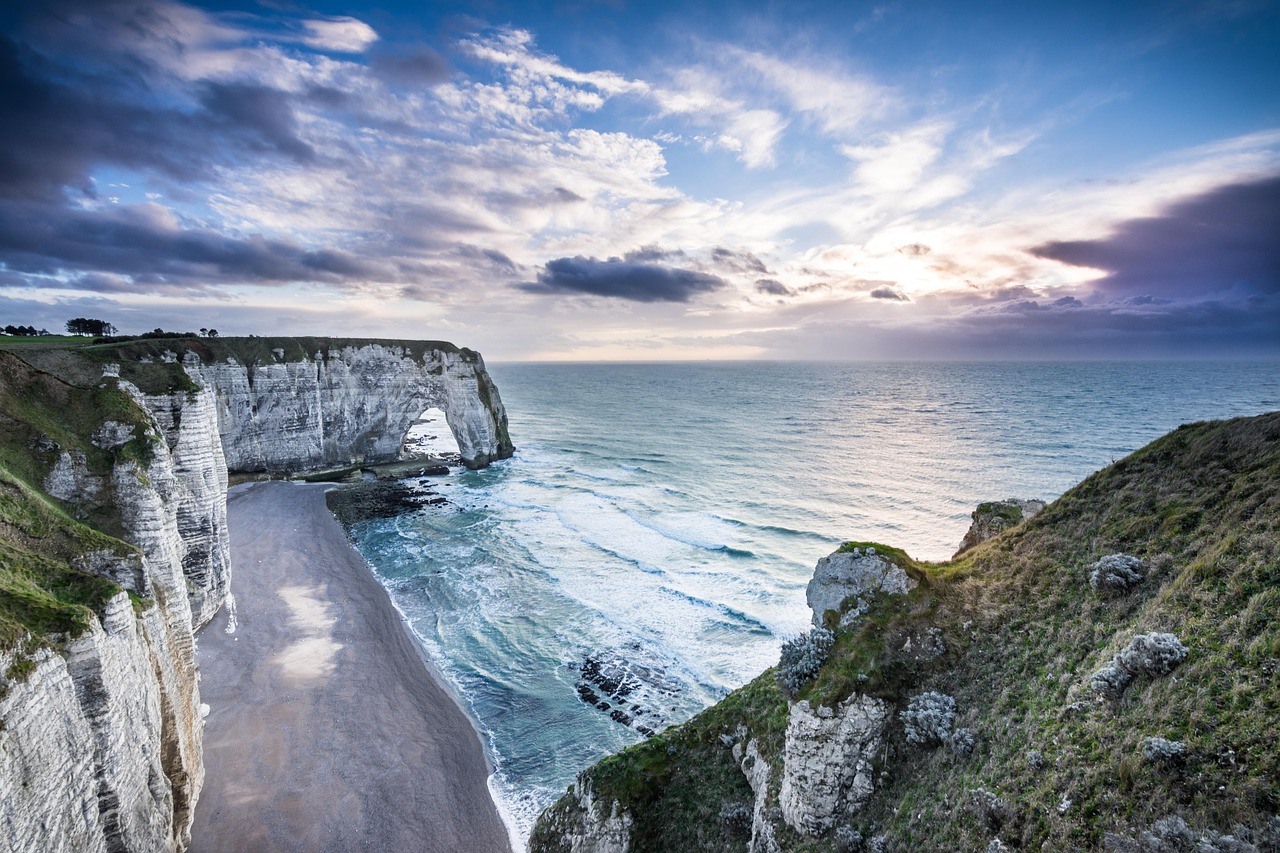
9. Étretat: Alabaster Cliffs & Coastal Walks
Étretat is where Normandy becomes almost surreal: white chalk cliffs carved into arches, a needle‑like rock spire, and a village wedged between sea and slopes. I’ve returned here again and again, usually in shoulder season when the crowds thin and the light softens.
What to do:
- Climb the trails on either side of the beach for views back over the natural arches.
- Pack a picnic from the village market and eat on the grass above the cliffs.
- At low tide, explore the pebbly beach and small sea caves (watch the tide carefully).
Romantic & adventurous: This is a superb place for couples, hikers, and photographers. Families with young kids need to keep a very close eye near cliff edges.
10. Fécamp & Yport: Workaday Ports & Quiet Beaches
While Étretat grabs the headlines, Fécamp and nearby Yport are where I go to breathe. Fécamp is a real fishing port with a long pebble beach, a monumental abbey, and the Palais Bénédictine, where the liqueur is still made in a fantastically ornate factory‑museum.
Yport, a tiny former fishing village tucked between cliffs, is one of the hidden gems in Normandy. On a June evening, I watched local families barbecuing on the beach as the sun dropped behind the headlands—a scene that never appears in brochures but defines Normandy for me.
11. Le Havre: Concrete Modernism & Cultural Surprises
Le Havre divides opinion: some travelers dismiss it as a concrete port city, others (myself included) are fascinated by its postwar modernist architecture and its role as a living, working harbor. The city center, rebuilt by Auguste Perret after WWII, is a UNESCO site, and the grid of wide boulevards and modular apartment blocks is oddly beautiful at golden hour.
The MuMa (Musée d’art moderne André Malraux) has one of France’s best Impressionist collections, with big windows looking over the water. I once spent a rainy afternoon there, the sea gray and choppy outside, while inside Monet’s seascapes glowed on the walls—a perfect contrast.
12. Dieppe: Clifftop Castle & Saturday Market
Dieppe is where Parisians have been escaping to the sea since the 19th century. It has a broad pebble beach, a castle museum on the cliffs, and one of the best Saturday markets in Normandy. The first time I visited the market, I arrived early and watched as stalls of cheese, seafood, and flowers spilled into side streets. I tried raw scallops sliced thin with a squeeze of lemon, bought on the spot from a fishmonger.
Dieppe is slightly rough‑edged in places, but that’s part of its appeal. It’s less polished than Deauville, more lived‑in than Étretat.
13. Cotentin Peninsula: Wild Headlands & Quiet Villages
The Cotentin Peninsula, jutting into the Channel, feels like Normandy’s wild frontier. Small ports, windswept dunes, and rural interiors where hedgerows and stone farmhouses dominate. I spent a week here in early 2022, working remotely from a cottage near Barfleur, and it remains one of my most peaceful stretches of time in France.
Highlights:
- Barfleur – Tiny granite harbor village with exceptional light.
- Saint‑Vaast‑la‑Hougue – Oysters, Vauban towers, and boat trips.
- Cap de la Hague – Dramatic coastal walks, almost Celtic in mood.
Best use: Ideal for a second or third trip to Normandy, especially with a car and a love of quiet landscapes.
14. Granville: “Monaco of the North” & Christian Dior’s Garden
Perched on cliffs above the sea, Granville combines a working fishing port, an old fortified upper town, and a slightly faded but charming seaside resort. It’s sometimes called the “Monaco of the North,” but don’t expect Riviera glitz; think more along the lines of Belle‑Époque villas and family ice‑cream stands.
Fashion lovers should visit the Christian Dior Museum, housed in the designer’s childhood home, with a garden dropping away toward the sea. I visited during a 2025 exhibition that traced Dior’s Norman roots; seeing couture dresses against a backdrop of storm‑tossed waves was unexpectedly moving.
15. Regional Nature Parks: Marshes, Bocage & Birdlife
Normandy has several parcs naturels régionaux—protected landscapes that preserve its marshes, hedgerows, and traditional farming structures. The Parc naturel régional des Marais du Cotentin et du Bessin is my favorite, especially in spring when flooded meadows reflect the sky and migratory birds pause on their journeys.
In 2023, I stayed on a small farm here that offered canoe trips through the marshes at dusk. We glided between willows as herons lifted off ahead of us—one of those quiet, low‑key cultural experiences in Normandy that rarely make big itineraries but stay with you.
16. Domfront & Suisse Normande: Hills & Adventure
Inland, toward the Orne, Normandy becomes unexpectedly hilly. Locals call it the Suisse Normande (Norman Switzerland), a region of wooded valleys and rocky outcrops threaded by the Orne River. Domfront, with its ruined castle on a promontory, is a gateway town with views across the bocage.
Adventurous activities: rock‑climbing, kayaking, and paragliding are popular here, making it a good addition to a 6 or 7 day itinerary for Normandy if you want something more active than beach walks.
17. The Alabaster Coast (Côte d’Albâtre)
Running from Le Tréport down past Étretat toward Le Havre, the Côte d’Albâtre is a continuous wall of chalk cliffs broken by small ports and beaches. You don’t need to hike it all; choose a base like Veules‑les‑Roses, Saint‑Valery‑en‑Caux, or Étretat and explore sections.
On one solo trip, I spent a full day walking the coastal path between two villages, stopping for a picnic overlooking the sea. I saw perhaps a dozen people all day, most of them local dog‑walkers—a reminder that things to do in Normandy include not just big museums, but also simple, slow immersion in its landscapes.
18. Giverny & the Seine Valley
Strictly speaking, Giverny sits at the border of Normandy and Île‑de‑France, but it’s usually folded into Normandy trips. Monet’s house and gardens are an immersive art experience: you step straight into the water‑lily paintings, the Japanese bridge, the beds of irises and tulips. I’ve visited in April, May, and September; each season is different, but the crowds are constant—book timed tickets ahead.
The surrounding Seine Valley, with chalk cliffs and loops of river, is ideal for a slow drive or bike ride, connecting Rouen, small riverside villages, and eventually Paris.
Norman Cuisine: Butter, Cream, Cider & the Sea
Eating in Normandy means embracing richness: butter, cream, Camembert, apples, and seafood. But within that palette, each sub‑area has its specialties.
Signature Dishes by Sub‑Area
- Pays d’Auge: Cider, Calvados, poulet Vallée d’Auge (chicken in cream, apples, and mushrooms), and Camembert.
- Coastal towns (Honfleur, Granville, Fécamp): Oysters, mussels, scallops, and fish stews like marmite dieppoise.
- Rouen & Seine Valley: Duck dishes, apple tarts, and hearty tripes à la mode de Caen for the adventurous.
- Inland bocage: Farmhouse cheeses, apple pastries, and teurgoule rice pudding.
Where to Taste Local Food in Normandy
Farm‑stays & agriturismi‑style stays: While Italy has agriturismi, Normandy has fermes‑auberges and tables d’hôtes. Around the Pays d’Auge, I’ve stayed at cider farms where dinner is whatever the farmer’s wife felt like cooking that day: a roasted chicken from their own yard, potatoes in cream, a simple salad, generous cheese board, and homemade apple tart.
Family‑run inns & trattoria‑style bistros: Look in smaller towns like Beuvron‑en‑Auge, Saint‑Vaast‑la‑Hougue, or Yport for no‑frills dining rooms with checkered tablecloths. Menus are often written on chalkboards; I’ve had some of my best meals in these places for under €25 per person.
Local markets: If you like self‑catering or picnics, plan your route around markets: Dieppe on Saturday, Bayeux on Saturday, Honfleur on Wednesday and Saturday, Caen on Friday and Sunday. Load up on cheese, saucisson, bread, fruit, and a bottle of cider.
My Favorite Food Moments
- A chilly March lunch in Arromanches: a steaming bowl of fish soup, topped with grated cheese and croutons, eaten while watching waves crash against the remains of the Mulberry harbor.
- A long summer dinner under apple trees in the Pays d’Auge, the air smelling faintly of blossoms and cows, the table crowded with neighbors and children running between the chairs.
- Fresh oysters in Saint‑Vaast‑la‑Hougue, eaten standing at a harbor stall with nothing but a squeeze of lemon and the sound of rigging tapping against masts.
Saving Money on Food
Normandy is kinder on the budget than Paris, but costs can add up. To save over a multi‑day trip:
- Make lunch your main restaurant meal (menus around €18–€25) and keep dinner simple with picnic food.
- Choose accommodation with kitchenettes in touristy towns like Deauville, Honfleur, or Étretat.
- Buy cider and Calvados directly from producers rather than souvenir shops.
Evenings in Normandy: After‑Dark Rhythm
Evenings in Normandy are generally quiet. This is not a region of nightclubs and all‑night bars, but of golden‑hour walks, long dinners, and small cultural events.
Small‑Town Squares & Harbors
In Honfleur, the harbor glows with restaurant lights reflected on the water. In Bayeux, the cathedral is floodlit and couples stroll the lanes with ice creams. In Granville or Dieppe, locals fish off the quays or sit on benches watching the last boats come in.
Festivals & Seasonal Celebrations
- Cider & Apple Festivals (Autumn): Many villages in the Pays d’Auge hold harvest fairs with cider pressing, traditional music, and market stalls.
- Seafood Fêtes (Spring & Autumn): Look for scallop festivals (fête de la coquille Saint‑Jacques) in ports like Port‑en‑Bessin and Granville.
- Summer Concerts: Many towns organize outdoor concerts in July–August—posters at the tourist office are your best guide.
Family‑Friendly Evenings
With children, evenings usually mean beach walks, playgrounds, and early dinners. I’ve had some of the simplest yet happiest nights watching my friends’ kids chase waves on an almost empty beach at Courseulles‑sur‑Mer while we adults shared a bottle of cider on a blanket.
Cultural Etiquette & Local Customs in Normandy
Normans are generally reserved but warm once you break the ice. A few cultural pointers will make your cultural experiences in Normandy smoother.
Greetings & Politeness
- Always begin interactions with a polite Bonjour, Monsieur / Madame. It matters.
- In shops, say Bonjour when you enter and Au revoir when you leave.
- Smiles are more subtle than in some cultures; don’t mistake reserve for coldness.
Dining Customs
- Many restaurants close between lunch and dinner; check opening hours.
- It’s polite to keep hands visible above the table (resting wrists on the edge), rather than in your lap.
- Tip 5–10% if service was good, even though a service charge is included in prices.
Visiting War Sites & Cemeteries
- Dress respectfully; loud behavior at cemeteries or memorials is frowned upon.
- Many sites have veterans or their families visiting; be discreet with photography.
Driving & Rural Norms
- On narrow country roads, slow down and give way to farm equipment.
- Don’t walk through private orchards without permission, even if they’re unfenced.
Getting Around & Practical Travel Advice for Normandy
Car vs Train vs Bus
Is a car essential? For a deep, multi‑town exploration—especially rural areas and the Alabaster Coast—a car is very helpful. For a shorter 4 day itinerary for Normandy focused on Rouen, Caen, Bayeux, and some organized D‑Day tours, you can manage with trains and buses.
By Car
- Pick‑up points: Paris (all major airports and city stations), Rouen, Caen, Bayeux, Deauville.
- Driving distances: Paris–Rouen ~1.5 hours; Paris–Caen ~2.5 hours; Bayeux–Omaha Beach ~30 minutes; Bayeux–Mont‑Saint‑Michel ~1.5–2 hours; Honfleur–Étretat ~1 hour.
- Parking: Many historic centers have paid parking just outside the old core; follow blue P signs.
- Foreign licenses: Most non‑EU licenses are accepted; if your license is not in French or English, bring an International Driving Permit. Check your rental company’s policy in advance.
By Train & Bus
- Trains: From Paris Saint‑Lazare to Rouen, Caen, Deauville, Le Havre, and Cherbourg. From Paris Montparnasse to Granville.
- Buses: Regional buses connect smaller towns, but schedules may be limited on weekends and in rural areas.
SIM Cards & Connectivity
For easy navigation and communication, pick up a French SIM at major train stations, airports, or supermarkets. Brands like Orange, SFR, and Bouygues offer prepaid data SIMs. Coverage is generally good, though some valleys and marshes have spotty reception.
Visa Requirements
Normandy follows French and Schengen visa rules. EU/EEA and many Western nationals can enter visa‑free for short stays; others require a Schengen visa. Always check the official French consulate website before travel, as regulations change.
Money‑Saving Tips Over a Multi‑Day Trip
- Travel in shoulder season (May–June, September–October) for better prices and lighter crowds.
- Base yourself in one or two towns (e.g., Bayeux + Honfleur) rather than changing hotels every night.
- Use supermarket picnics for some meals; splurge on one special dinner per area.
- Check for regional rail passes if you’ll be using trains heavily.
Best Seasons for Different Activities
- Spring (April–May): Wildflowers, fewer crowds, cool but pleasant walking weather, Monet’s gardens in bloom.
- Summer (June–August): Beach weather, long evenings, busiest and most expensive season.
- Autumn (September–October): Cider harvest, apple festivals, beautiful light on cliffs, quieter coasts.
- Winter (November–March): Stormy seas, very quiet rural areas, reduced opening hours; best for introspective trips and low prices.
Day Trips & Nearby Regions from Normandy
- Paris: 1–2 hours by train from Rouen or Caen; easy for a quick culture fix or onward flights.
- Brittany (Saint‑Malo, Cancale): From Mont‑Saint‑Michel, you’re about 1.5 hours from Saint‑Malo by car; ideal if you want to extend your coastal trip.
- Loire Valley: About 3–4 hours’ drive from central Normandy; better as a next‑leg destination than a strict day trip.
When planning, remember that Normandy rewards a slower approach; don’t cram too many regions into a short stay.
Normandy in 2026–2027: Events & What’s New
Normandy’s event calendar mixes history commemorations, food festivals, and arts programming. Highlights expected for 2026–2027 include:
- D‑Day Commemorations (June 6, annually): Ceremonies at cemeteries and memorials across the D‑Day coast, with particularly significant gatherings every five years.
- Scallop & Seafood Festivals: Ports like Port‑en‑Bessin, Granville, and Dieppe host annual fêtes de la coquille Saint‑Jacques in late autumn and spring—check local tourism sites for exact 2026–2027 dates.
- Maritime Festivals: Tall‑ship gatherings and harbor fêtes rotate between ports such as Rouen, Le Havre, and Cherbourg.
- Arts & Music: Summer classical and jazz festivals in abbeys and historic venues, plus an evolving contemporary art scene in Le Havre and Rouen.
Many events are confirmed only 6–12 months ahead; consult the official Normandie Tourisme website closer to your travel dates for updated schedules.
Summary: Key Takeaways & Final Recommendations
Normandy is not a place you “do” in a weekend; it’s a region to inhabit, even briefly. Whether you’re mapping out a 4 day itinerary for Normandy or a leisurely 7 days in Normandy, a few principles hold:
- Anchor your trip with 2–3 bases: for first‑timers, I recommend Bayeux (history), Honfleur or Deauville (coast), and, if time allows, the Pays d’Auge (countryside) or Rouen (city & art).
- Mix iconic and hidden: visit Mont‑Saint‑Michel and the D‑Day beaches, but also give yourself hours in small ports like Yport or Saint‑Vaast‑la‑Hougue, or on a random farm lane in the Pays d’Auge.
- Let food guide you: follow cider routes, market days, and seafood seasons; they’ll lead you to real life in Normandy.
- Choose your season wisely: for most travelers, May–June and September are ideal, balancing weather, crowds, and prices.
Above all, leave space in your schedule—for a second coffee in a harbor café, for an unscripted walk along a cliff path, for a conversation with a cheesemonger at a market. That’s where Normandy stops being a list of must‑see attractions and becomes a place you’ll want to return to, as I have, year after year.