Why Visit the German Alpine Road?
The German Alpine Road is Germany’s oldest scenic route, a 450-kilometre ribbon stretching from Lindau on Lake Constance to Schönau am Königssee near the Austrian border. It is, in many ways, the gentle, slower-soul cousin to the Autobahn: no frantic overtaking lanes, just a meandering two‑lane road that curls between emerald meadows, baroque onion-domed churches, glassy lakes, and saw‑toothed peaks.
In 2026, when much of Europe’s tourism feels hyper-optimised, the German Alpine Road still rewards those willing to linger. It’s a route of modest distances but dense experiences: village bakeries that still sell yesterday’s pretzels cheaper “vom Vortag,” small-town brass bands playing on market squares, family-run guesthouses where breakfast eggs come from the hens out back, and hikes that begin literally at the hotel’s doorstep.
What makes it special for me, as someone who has lived in Munich for years and returns to this route at least twice annually, is how many trips it contains within one: family-friendly lakes and summer toboggans, romantic sunsets over Chiemsee, adventurous via ferrata above Berchtesgaden, and quiet, almost meditative drives in shoulder season when traffic thins and the mountains feel close enough to touch.
In this 2026 travel guide for the German Alpine Road, I’ll walk you through a practical, story-driven itinerary broken into 7–14 legs (I’ll focus on a 10‑leg itinerary but explain how to adapt it), with personal anecdotes from my recent drives, tips on where to sleep and eat, and the hidden gems that don’t make the brochure racks.
Table of Contents
- Why Visit the German Alpine Road?
- Route Overview & How to Use This Guide
- Recommended Itinerary: 10 Legs Across the German Alpine Road
- Leg 1: Lindau & Lake Constance – Gentle Start at the Water’s Edge
- Leg 2: Lindenberg – Oberstaufen – First Hills & Cheese Country
- Leg 3: Immenstadt – Sonthofen – Of Lakes, Alpsee, and Early Peaks
- Leg 4: Oberstdorf & Kleinwalsertal Detour – Into the High Alps
- Leg 5: Bad Hindelang – Oberjoch Pass – Allgäu’s Balcony Road
- Leg 6: Füssen & Schwangau – Castles, Lakes & Classic Postcards
- Leg 7: Garmisch-Partenkirchen & Zugspitze Region – High Drama
- Leg 8: Walchensee – Kochelsee – Mittenwald – Lakes & Painted Villages
- Leg 9: Tegernsee – Schliersee – Chiemsee – Beer Gardens on the Water
- Leg 10: Berchtesgaden & Königssee – Grand Finale at the Eagle’s Peaks
- 18 Key Stops & Viewpoints in Detail
- Eating & Sleeping Along the German Alpine Road
- Evenings on the Road
- Extra Day Trips & Nearby Attractions
- Cultural Etiquette & Local Customs
- Route Logistics & Driving Advice (2026–2027)
- Practical Travel Tips: Money, SIMs, Visas, Car Rental
- What’s New in 2026–2027: Events & Travel Scene Changes
- Summary & Best Seasons to Visit
Route Overview & How to Use This Guide
The German Alpine Road officially runs from Lindau on Lake Constance (west) to Schönau am Königssee (east). You can absolutely drive it in either direction, but after trying both, I prefer west-to-east for these reasons:
- You start gently along the lake and rolling Allgäu hills before the mountains build in drama.
- Navigation is easier as you follow the majority of signposted “Deutsche Alpenstraße” direction.
- Ending at Königssee and Berchtesgaden feels like a natural crescendo.
This guide is built around a 10-leg itinerary for the German Alpine Road, which I consider the sweet spot between time and depth – 1–2 days per leg, 10–14 days in total. I’ll also point out where you can compress it into 7–9 legs or stretch to 12–14 legs if you want a truly slow journey.
Distances per leg are intentionally modest: usually 50–80 km of actual driving per day, leaving hours to walk, swim, ride cable cars, or simply sit in a beer garden and watch the light move across the peaks. Think of it less as a road “trip” and more as a chain of basecamps connected by beautiful tarmac.
Recommended 10-Leg Itinerary for the German Alpine Road
Leg 1: Lindau & Lake Constance – Gentle Start at the Water’s Edge (1–2 Days)
I almost always begin my German Alpine Road journeys by arriving a night early in Lindau. There’s something psychologically soothing about starting at water level. The mountains are only a distant line across Lake Constance; the road, quite literally, has somewhere to grow.
My latest start here was in May 2025: a bright, slightly hazy afternoon, blossom still on the trees, cyclists crowding the causeway to the island old town. If you’re driving in from Zurich, Stuttgart, or Munich, Lindau makes a perfect “reset” stop before you drop into slow-travel mode.
Why Lindau is Worth a Night
The old town sits on an island linked to the mainland by a narrow causeway. Cobbled streets, pastel facades, and the famous harbour with its lighthouse and Bavarian lion guarding the entrance – the scene is so archetypal that it almost feels staged, but it isn’t. In the blue hour, with the Swiss Alps faintly visible across the water and the ferry lights sliding by, it’s one of those places where people unconsciously lower their voices.
Things to Do in Lindau
- Harbour Promenade Walk: Do this once in the afternoon and again after dinner. In 2025, there was a street musician playing gentle jazz near the lighthouse; children were chasing bubbles in front of the lion statue. Stop for a scoop at the small gelato stand near the Mangturm.
- Lighthouse Climb (Neuer Leuchtturm): For a tiny fee you can climb the spiral staircase. On a clear day you’ll see the faint saw-blade of the Allgäu Alps – the direction you’ll drive. It’s a nice mental map before you start.
- Old Town Meander: The Maximilianstraße is the main spine, but dip into side alleys for murals and small boutiques. I like Hafenküche for a coffee and slice of Zwetschgenkuchen (plum cake in late summer).
- Lake Cruise: If you have a second day to spare, a short cruise towards Bregenz (Austria) introduces the lake’s scale. It’s not essential to the Alpine Road, but it’s a calming prologue.
Eating in Lindau
Lake Constance is white-fish territory. If you eat fish, try:
- Felchen (whitefish) grilled or smoked
- Bodenseefischknusperle – little battered fish bites that kids love
- Local apple juice or cider – the lakeshore is orchard country
I often arrive late and go simple: a plate of Käsespätzle (cheese noodles) at a harbour-side restaurant with a view of the sunset. Yes, it’s touristy; yes, it’s about 2–3 € more than inland. You’re paying for the view. For a cheaper, more local feel, head one block back from the water where the menus lose their multilingual gloss.
Where to Sleep
For a classic start to a German Alpine Road road trip itinerary, book a small guesthouse on the mainland just outside the island. Parking is easier and cheaper, and you can walk onto the island in 10–15 minutes. If you’re with kids, look for family rooms with lake views – waking them up to their first sight of the water sets the tone.
Driving Notes for Leg 1
You won’t actually cover much of the Deutsche Alpenstraße yet; this leg is about arrival and decompression. If you’re tight on time and planning a 7-leg itinerary for the German Alpine Road, you can reduce Lindau to a single afternoon and night, then roll out early the next morning.
Leg 2: Lindenberg – Oberstaufen – First Hills & Cheese Country (1 Day)
The morning you actually “start” the German Alpine Road feels different. Leaving Lindau, you’ll pick up the first brown signs marked Deutsche Alpenstraße and begin climbing gently into the Allgäu region. The vibe shifts from lakeshore to rolling dairy country: cows with bells, barns with hanging flowers, and that particular sweet smell of cut grass that always, for me, signals the beginning of summer.
Scenic Drive: Lindau to Lindenberg
The first stretch to Lindenberg im Allgäu is an easy warm-up. I like to leave Lindau after the school rush – around 9:30–10:00 – when the traffic has thinned. The road here is ordinary but pleasant: orchards, small villages, the occasional framed glimpse of mountains still far away.
Lindenberg bills itself as a “sunny town” and statistically, it’s not wrong. On my 2025 spring trip the sky was a clean, high blue as I pulled into a bakery for a second breakfast: a Butterbreze (buttered pretzel) and strong coffee. If you’re doing this with kids, this is a good first playground stop; most German towns have a well-equipped Spielplatz within a few minutes’ walk of the centre.
Oberstaufen: Wellness, Cheese & Your First Real Hills
From Lindenberg, the road tightens gently as you approach Oberstaufen, one of the first real “resort” towns on the route. It’s known for its wellness culture – Schrothkur health cures, spa hotels – but also for its down-to-earth Allgäu core: cows, cheese, and sturdy hikers in their 70s who will overtake you on uphill trails.
On my last summer pass through, I checked into a simple Gästehaus above the town with a balcony facing the Nagelfluhkette ridgeline. In late afternoon, cowbells echoed up the valley; swallows looped just beneath the balcony rail. This is the sort of place where even a short, 20‑minute leg stretch walk feels like an event.
Things to Do Around Oberstaufen
- Hündle or Hochgrat Cable Cars: Two nearby cable cars offer easy access to panoramic ridge walks. Hündle is more family-friendly with a summer toboggan run; Hochgrat is wilder and more dramatic. In 2025 I took the first Hochgrat cable car up at 9:00, walked along the ridge for 90 minutes, then descended to beat the midday crowds.
- Cheese Dairy Visit: This is one of the best places along the German Alpine Road to understand Allgäu’s dairy culture. Look for a Sennerei (cheese dairy) where you can watch production in the morning and taste aged Bergkäse. Kids usually enjoy the viewing windows and the chance to meet cows.
- Village Centre Stroll: Oberstaufen’s main street is compact but busy. In the evening, locals and visitors mingle over ice cream or beer. Try to notice how many people greet each other by name – this is still a relatively tight-knit community under the tourism layer.
Food & Hidden Gems
For a hearty lunch, order Allgäuer Kässpatzen with crispy onions and a side salad. If you’re vegetarian, this will become your road trip staple, so pace yourself. Meat eaters should try Schweinsbraten (roast pork) with Knödel (dumplings). A small hidden gem: a hamlet bakery to the south of town (ask your host for the nearest Dorfbäckerei) where locals queue from 6:30 a.m. Weekday mornings have a lovely, everyday feel as farmers come in for bread and gossip.
Driving Notes for Leg 2
This leg is a good place to “calibrate” your sense of distance vs. time. It’s only about 60–70 km from Lindau to Oberstaufen via Lindenberg, but with stops it will easily fill a day. For a 9 leg itinerary for the German Alpine Road, you could push on to Immenstadt in the same day, but I like the slow start.
Leg 3: Immenstadt – Sonthofen – Of Lakes, Alpsee, and Early Peaks (1–2 Days)
Leaving Oberstaufen, the road begins to feel recognisably “Alpine.” Forested slopes grow steeper, views open suddenly between trees, and the horizon loses its gentle hilliness in favour of more decisive peaks. This is one of my favourite driving stretches when I’m on a motorcycle: winding but not yet stressful, with regular lay-bys where you can pull over and simply look.
Immenstadt & Großer Alpsee
Immenstadt is a workaday town that doesn’t try too hard to charm you, and I appreciate it for that. The real star is just west: Großer Alpsee, a long, deep-blue lake strung out beneath forested hillsides. On hot July weekends it fills with paddleboards and families picnicking on the grassy shore; on a cool October morning in 2024, I had it almost to myself, mist curling off the surface like breath.
- Lakeside Walks & Swimming: There’s a good, mostly flat path along the northern shore. In summer, look for official bathing spots with toilets and small kiosks selling ice cream and fries. The water is refreshing but rarely bone-chilling by late afternoon.
- Alpsee Coaster: Above the lake is an all-season coaster track that’s wildly popular with families. I admit, I’ve ridden it more times than is strictly dignified, especially on my 2023 autumn trip with friends. Kids from 6 upward will love it; nervous adults can ride gently.
Sonthofen: Everyday Alpine Life
Continuing east, Sonthofen has a slightly military feel – there’s a Bundeswehr base – but it’s also where the mountains start to close in. This is a town where you’ll notice more hiking stores than souvenir shops. I often use Sonthofen as a refuelling and provisioning stop: top up the tank, pick up picnic supplies at a supermarket, and check the local weather forecast posted outside the tourist office.
Hidden tip: behind the main street there’s a small, shady park along the river Iller. On an August afternoon in 2022 I sat here with a takeaway Leberkässemmel (a Bavarian meatloaf-in-a-roll staple) and watched teenagers practice tricks on their bikes at the adjacent skate park. It’s an excellent reality check if you’ve been in full tourist mode; this is how ordinary life looks in the Alpine foothills.
Family-Friendly, Romantic, Adventurous?
- Family-friendly: Alpsee coaster, easy lakeside paths, playgrounds in Sonthofen.
- Romantic: Late afternoon swim in Großer Alpsee followed by dinner with a view; the light on the water can be gorgeous.
- Adventurous: Use Sonthofen as a base for more serious hiking into nearby valleys like Hinterstein – though that technically belongs to the next leg.
Driving Notes for Leg 3
Immenstadt to Sonthofen is a short hop; if you’re compressing into an 8 leg itinerary for the German Alpine Road, you can comfortably combine this with the Oberstaufen leg and push on towards Bad Hindelang for the night. But if the weather is fine, I always argue for an unhurried day around Alpsee.
Leg 4: Oberstdorf & Kleinwalsertal Detour – Into the High Alps (1–2 Days)
The official German Alpine Road doesn’t strictly require you to detour to Oberstdorf, but skipping it feels like flying to Italy and ignoring the gelato. It’s a 15–20 minute side-trip south from Sonthofen, and suddenly you’re in a proper Alpine valley, flanked by high peaks and laced with walking paths.
Oberstdorf: Gateway to the Allgäu High Alps
Oberstdorf is famous for ski jumping and winter sports, but in summer and autumn it transforms into a walking town. The centre is car-light; most hotels encourage you to leave the vehicle in a peripheral parking lot and explore on foot.
- Nebelhorn Cable Car: The three-stage cable car to the Nebelhorn offers one of the best “easy access” high viewpoints in Allgäu. In October 2024, after an early snow, I stood at the top platform with a hot chocolate, watching clouds spill over the Austrian border peaks like foam.
- Breitachklamm Gorge: North of Oberstdorf, this narrow gorge walk is spectacular after rain or snowmelt. The path is safe and well-railed, making it a thrilling but secure excursion for school-age kids.
Kleinwalsertal Detour (Austria, but Road-Linked Only to Germany)
From Oberstdorf, a unique detour leads into Kleinwalsertal, an Austrian valley that is only road-accessible from Germany. You cross an unmarked border – no controls, just a subtle shift in road signage. I’ve come up here on rainy days when higher peaks were socked in; the valley has a cosy, sheltered feel.
If you’re on a tight schedule or prefer to keep your German Alpine Road road trip itinerary purely domestic, you can skip this, but for those who like odd geographical quirks, it’s a delight.
Overnight Choices
Staying in Oberstdorf for a night or two is worthwhile if you’re building a 12 leg itinerary for the German Alpine Road. Pick a guesthouse with a sauna – even in summer, evenings can be cool. I like waking early for a pre-breakfast walk through dew-wet meadows; church bells mark the half-hours, and the air smells faintly of woodsmoke and cows.
Driving Notes for Leg 4
Technically, you’ll need to backtrack to Sonthofen or Hindelang to rejoin the main route. If you’re going for a compact 7 leg itinerary for the German Alpine Road, treat Oberstdorf as a half-day spur rather than an overnight: early start, cable car up, late lunch, then back over to Bad Hindelang for the evening.
Leg 5: Bad Hindelang – Oberjoch Pass – Allgäu’s Balcony Road (1 Day)
This leg, from Bad Hindelang over the Oberjoch Pass, is where driving enthusiasts begin to grin. Hairpins tighten, elevation climbs, and the views back into the Allgäu cowl like waves. It’s also where less confident drivers sometimes tense up; if that’s you, plan this stretch for mid-morning when traffic is light and visibility good.
Bad Hindelang: Quiet Base Before the Climb
Bad Hindelang is a compact spa town that I’ve used as a base many times. It has enough restaurants and hotels to offer choice, yet still feels more village than resort. The pedestrian core is small; in the evening, guests in hotel bathrobes shuffle between sauna and dinner, and the local brass band sometimes rehearses in the community hall, sounds drifting out into the street.
On my last November 2025 visit, an early dusting of snow had turned the upper slopes white while the valley remained green. Kids were throwing snowballs at the upper bus stop while parents stood in autumn jackets below. That shoulder-season mix is one of my favourite Bavarian experiences.
Driving the Oberjoch Pass
The road from Bad Hindelang to Oberjoch is a classic: around 300 curves, a well-engineered grade, and several lay-bys with big views. It’s fully paved and suitable for regular cars, motorhomes, and motorcycles.
- Viewpoints: About halfway up, look for a signed viewpoint with a sweeping panorama back over the Hindelang valley. I like to stop here with a coffee from a travel mug and simply breathe. Early mornings, you may find paragliders launching from nearby slopes.
- Driving Tips: Use low gears on the ascent and descent; don’t ride your brakes. Locals know the road well; if a faster car appears in your mirror, pull into the next lay‑by and let them pass.
Family & Adventure Options
- Family-friendly: At the top near Oberjoch and further towards Unterjoch, there are easy meadows and short walking loops, plus in summer you’ll find alpine playgrounds with slides and climbing frames built in wood.
- Adventurous: This region has excellent via ferrata (fixed rope routes) and longer hikes; ask at the Bad Hindelang tourist office for current conditions – they post daily mountain weather and trail updates.
Driving Notes for Leg 5
From Bad Hindelang over Oberjoch, you’re bending southeast back towards the main trunk of the German Alpine Road. Depending on your pace, you can overnight in Bad Hindelang, or push onward after the pass and sleep closer to Pfronten or Füssen to set up the castle leg.
Leg 6: Füssen & Schwangau – Castles, Lakes & Classic Postcards (1–2 Days)
Even if you’ve never heard of the German Alpine Road, you’ve seen its most famous view: Neuschwanstein Castle perched above Schwangau, a confection of turrets and towers against dark forest and limestone peaks. This is the most crowded leg of the route, but also one of the most essential. With a bit of local strategy, you can make it feel less like standing in line at a theme park and more like stepping into a slightly improbable fairytale.
Füssen: Medieval Gateway
Füssen is a pretty, compact town straddling the Lech river. Pastel houses, a castle on a hill, and a web of lanes that reward aimless wandering. I always recommend at least a half-day here, ideally an overnight, because once the day-trippers leave, the old town exhales.
- Stroll the old town, ducking into the Hohe Schloss (High Castle) courtyard for painted trompe-l’oeil facades.
- Walk the Lech riverside path at sunset; the water is a surreal turquoise, especially in late spring snowmelt.
Neuschwanstein & Hohenschwangau – How to Visit in 2026
As of 2026, Neuschwanstein remains one of Germany’s most visited attractions. Advance online booking for castle tours is essential in high season (May–October) and strongly recommended year-round. Time slots are strictly enforced.
My standard strategy, tested repeatedly through 2023–2025:
- Sleep in Füssen or Schwangau the night before.
- Book the first or second tour slot of the morning (usually between 9:00–9:30) for Neuschwanstein.
- Arrive at the ticket centre in Hohenschwangau village 60–75 minutes early to collect tickets and walk/hike up.
The walk up to Neuschwanstein from the ticket centre takes 30–40 minutes at a calm pace; horse-drawn carriages are available for those with mobility issues, but they still require a short uphill walk at the end. I prefer to walk – the path passes through shady woodland and offers glimpses back to Hohenschwangau Castle and Alpsee.
Viewpoints & Photos
- Marienbrücke (Mary’s Bridge): The classic side-on view of Neuschwanstein. As of 2026, expect timed capacity controls on very busy days; sometimes the bridge is briefly closed for safety. Go as early as possible; by 11:00 it can feel like a conveyor belt. I was there in September 2025 just after 9:00 and shared the view with only a couple of other early risers.
- Secret-ish Forest Trails: Above Marienbrücke are steep unofficial paths that social media loves. They are not recommended; the terrain is eroding and local authorities periodically close them. Respect barriers – mountain rescue operations are not how you want to spend your holiday.
Lakes & Gentle Walks
After the castle crowds, I like to decompress with a lap around Alpsee, the lake nestled behind Hohenschwangau. The path is easy, partly shaded, and often surprisingly quiet compared to the castle hill. On an August 2024 afternoon, I watched a swan family navigating the reeds while just above us, buses shuttled fortress-wards in a separate, louder world.
Food & Local Flavours
Castle-side restaurants are expensive and often rushed. Instead:
- Have a big hotel breakfast.
- Pack snacks or buy sandwiches in Füssen before you go.
- Plan a late, lingering lunch back in Füssen at a tavern with outdoor seating.
Try Schweinshaxe (pork knuckle) if you’re hungry after hiking; it’s a Bavarian classic. Or go lighter with Obazda (cheese spread) and a Brezn (pretzel) plus local wheat beer. Füssen has a few excellent ice cream parlours – a bribe that works wonders with tired kids.
Driving Notes for Leg 6
Traffic around Schwangau can be heavy in peak months. If you’re on a 10 legs of German Alpine Road schedule, dedicate a full day to Füssen/Schwangau, sleeping either side of the visit to maintain flexibility for weather shifts.
Leg 7: Garmisch-Partenkirchen & Zugspitze Region – High Drama (1–2 Days)
This leg carries you north-east via smaller roads (with some deviations from the strictest Alpine Road line, depending on route choice) towards Garmisch-Partenkirchen, the de facto capital of Bavarian mountaineering and home to Germany’s tallest peak, the Zugspitze.
The Drive: Füssen to Garmisch
Depending on your chosen variant, you may skirt lakes like Plansee across the border in Austria, or stay entirely on the German side via Reutte and then Garmisch. Check your navigation; signage for Deutsche Alpenstraße is decent but not infallible. In 2025, roadworks east of Füssen diverted traffic – Google Maps knew, the old printed maps did not.
Garmisch vs Partenkirchen
Though administratively one town, Garmisch and Partenkirchen still feel distinct. Garmisch is the more modern, commercial side; Partenkirchen has a beautifully preserved historic Ludwigstraße with frescoed facades and a more old-world air.
Must-Do: Partnachklamm & Zugspitze (Weather-Permitting)
- Partnachklamm Gorge: A dramatic gorge walk accessible from the ski stadium area. The path is carved into the cliff, with tunnels and overhangs; bring a light rain jacket, as water drips constantly. It’s safe for school-age kids but narrow in places.
- Zugspitze: On a clear day, the cable car or cog railway plus cable car combo to Germany’s highest point is unforgettable. On a cloudy day, you’ll see nothing but white. Always check the summit webcam (widely available online and on hotel info screens) before committing; in 2024 I skipped a planned visit because the peak was entirely fogged in, and spent a glorious day on lower, sunny trails instead.
Adventure & Family Options
- Adventurous: Garmisch is a hub for serious hiking and climbing. If you’re building a 13 leg itinerary for the German Alpine Road, consider a multi-day stop here to do a hut-to-hut trek.
- Family-friendly: The Hausberg area has gentle trails, playgrounds, and in summer, alpine slides.
- Romantic: Evening strolls through Partenkirchen’s old quarter, followed by dinner in a wood-panelled Stube with candles and local wine or beer.
Driving Notes for Leg 7
Parking in Garmisch-Partenkirchen can be tight in high season; book accommodation with guaranteed parking if possible. For a 9 legs of German Alpine Road approach, one night is enough if you focus on Partnachklamm and a town stroll; for a deeper experience, stay two nights and pick your mountain day based on weather.
Leg 8: Walchensee – Kochelsee – Mittenwald – Lakes & Painted Villages (1–2 Days)
Heading east, you enter what I think of as the “lake-and-larch” chapter of the German Alpine Road: shimmering waters, steep forested slopes, and villages famous for their Lüftlmalerei – elaborate facade paintings.
Walchensee & Kochelsee: Two Very Different Lakes
Walchensee is one of Germany’s deepest and, on sunny days, most Caribbean-looking lakes. The road along its northern shore is a joy to drive; lay-bys offer chances to slip down to the pebbly shore for a quick dip or picnic. I’ve lost count of how many times I’ve pulled over here “just for five minutes” and stayed an hour.
Kochelsee, lower and often moodier, has inspired painters for centuries. The tiny hamlet of Herzogstandbahn in between offers a cable car up to ridgeline views over both lakes – a classic half-day excursion.
Mittenwald: Painted Houses & Violin Heritage
Further south, looping back into the heart of the mountains, lies Mittenwald, one of the prettiest villages on the entire route. The houses on the main street are lavishly painted with religious scenes, trompe-l’oeil columns, and window frames. It’s almost too picturesque – yet still a real place, with laundry on the balconies and locals doing their errands.
- Violin Museum: Mittenwald has a centuries-long tradition of violin making. The small museum is a gem; in 2023 I wandered in on a rainy afternoon and ended up listening to a visiting musician test instruments in an upstairs room. If you’re travelling with musically inclined teenagers, this is quietly inspiring.
- Leutaschklamm Gorge: A short drive away, this gorge straddles the Austrian border with a series of walkways and bridges; it’s less claustrophobic than Partnachklamm and very family-friendly.
Driving Notes for Leg 8
The Walchensee–Kochelsee road (B11/B11a) includes some steep descents with tight curves. In wet weather, drive conservatively. If your itinerary is stretching to a 14 leg itinerary for the German Alpine Road, you can give Walchensee and Mittenwald each their own night, using them as bases for hikes and lake days.
Leg 9: Tegernsee – Schliersee – Chiemsee – Beer Gardens on the Water (2 Days)
This leg, running through Tegernsee, Schliersee, and on towards Chiemsee, is where my “local” life in Munich and my “traveller” life on the German Alpine Road blur. These are my personal weekend lakes; I’ve watched them in every season: frozen and white in January, glassy and green in May, busy and sunburnt in August, mist-laced and quiet in November.
Tegernsee: Refined Yet Accessible
Tegernsee has a reputation for being posh – and yes, you’ll see expensive cars and discreet villas – but its lakefront remains surprisingly democratic. The biggest public magnet is the Bräustüberl Tegernsee, a historic brewery restaurant right on the water. It’s touristy and local at once; I’ve shared tables here with families from Munich, hikers from across Germany, and retirees who’ve been coming since the 1960s.
Order a Maß (litre) of beer only if you’re not driving afterwards; otherwise stick to a Halbe (0.5 L) or try the excellent Spezi (cola-orange mix) that fuels generations of Bavarian teenagers. Signature dishes include crispy roast pork and Obazda.
Schliersee: Quieter, Homier
Just over the hills, Schliersee feels more intimate. The lakeside path is one of my favourite easy evening walks; on a still day the peaks reflect perfectly, and fishermen sit patiently on little stools. There’s an open-air museum, the Markus Wasmeier Freilichtmuseum, a recreated historic farmstead that kids tend to love for its animals and hands-on feel.
Chiemsee: Bavaria’s Inland Sea
Further east, the landscape opens out again and you reach Chiemsee, sometimes called the “Bavarian Sea.” The Alpine Road officially skirts its southern shore, but it’s worth dropping north to Prien am Chiemsee or Gstadt to catch a boat to Herrenchiemsee island, where King Ludwig II built his Versailles-inspired palace.
In 2024, I took a late-afternoon boat from Gstadt, touring the palace with a small group as the last sunlight slanted through the fountains. Visiting towards the end of the day is a good way to dodge the big coach groups that dominate late morning.
Eating & Evenings
All three lakes have excellent lakeside beer gardens. At Tegernsee and Schliersee, locals will linger until almost dark on summer evenings, kids playing on the grass while parents nurse a last drink. At Chiemsee, sunsets can be spectacular – silhouetted boats, the Chiemgau Alps as backdrop.
Driving Notes for Leg 9
This is a denser leg with multiple lakes. For a relaxed 11 leg itinerary for the German Alpine Road, give Tegernsee/Schliersee one night and Chiemsee another. If you’re in a rush, you can just pause for lunch at Tegernsee and push on, but to me, these lakes are the soul of the middle Alpine Road.
Leg 10: Berchtesgaden & Königssee – Grand Finale at the Eagle’s Peaks (2–3 Days)
The final leg of the German Alpine Road is its most dramatic: the Berchtesgaden Alps, a tight knot of limestone peaks with knife-edge ridges and deep valleys. Königssee, a long, fjord-like lake, sits at the heart of it all; the village of Schönau am Königssee marks the official eastern end of the route.
Berchtesgaden Town
Berchtesgaden itself is a compact town built on a slope, with a mix of historic houses and 20th-century additions. I usually base myself either here or in Schönau; both have their charms. Berchtesgaden is better for rainy-day museums and cafes; Schönau is closer to the lake.
Königssee Boat Trip
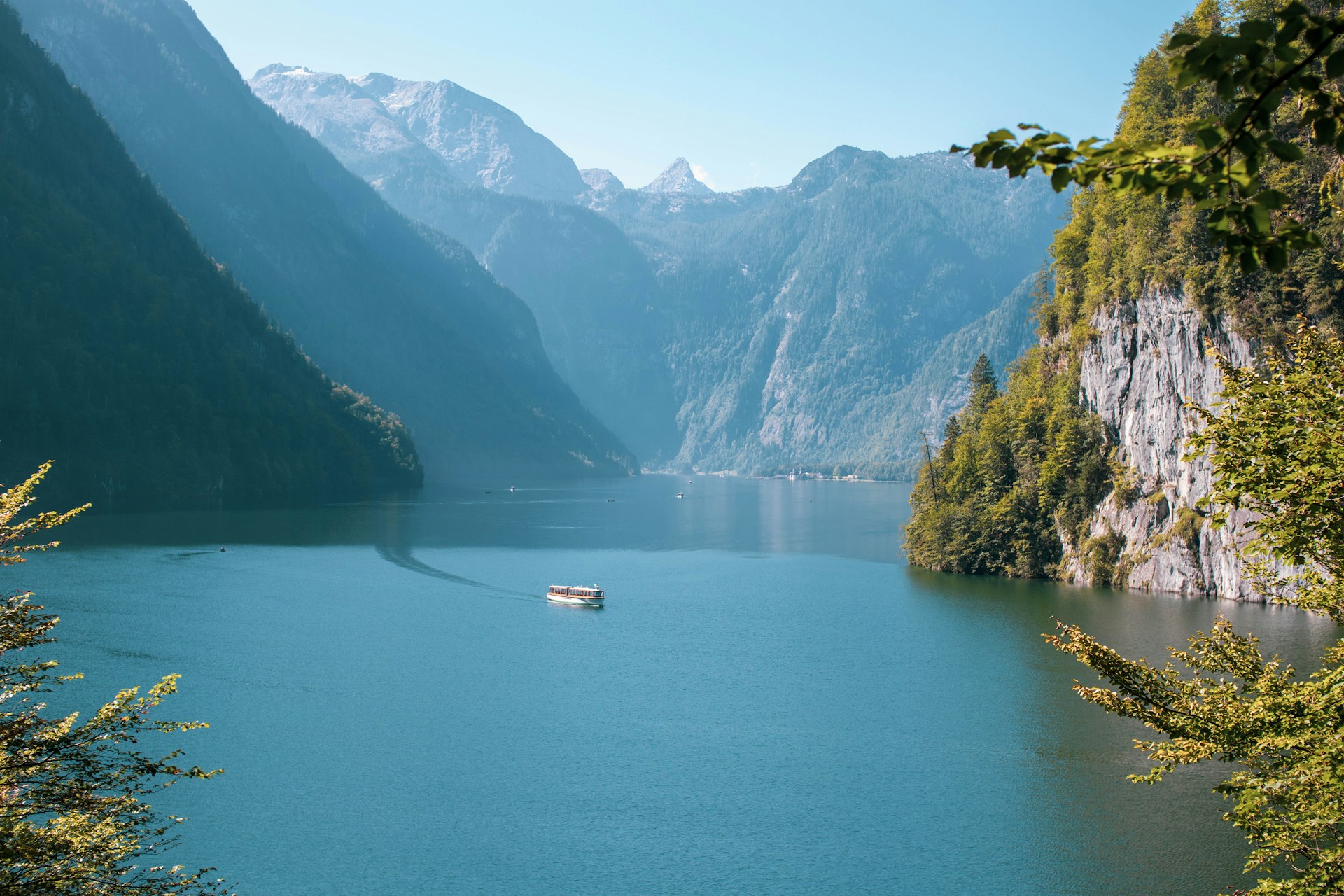
The electrically powered boats on Königssee glide silently; halfway down the lake, the captain stops, steps out, and plays a trumpet or flugelhorn to demonstrate the echo bouncing back from the sheer rock walls. Even if you know it’s coming, it’s goosebump-inducing.
Boats run year-round but with reduced frequency in winter. In high season, go early; by late morning, queues can snake across the dock. On my June 2025 visit, I caught the 8:30 boat to St. Bartholomä, walked along the shore, then continued to Salet and the smaller Obersee, whose mirrored surface has made it Instagram-famous. It’s still possible to find quiet there if you walk to the far end meadow.
Other Highlights: Jenner, Watzmann, Eagle’s Nest
- Jennerbahn Cable Car: Rapid access to sweeping views over Königssee. Several short and moderate hikes start near the top station.
- Watzmann Family Hike (Lower Slopes): The iconic Watzmann peak dominates the skyline; you don’t have to be a mountaineer to enjoy its lower trails. Ask at the tourist office for family-friendly options.
- Kehlsteinhaus (Eagle’s Nest): The notorious Nazi-era mountaintop retreat, now a restaurant and viewpoint, is accessible by special buses in season. It’s historically loaded and visually spectacular. In 2026, interpretive displays continue to emphasise critical engagement with the past rather than glamourising it.
Romantic & Reflective Moments
My favourite time here is late September, when the summer crowds have thinned but the larches are turning gold. On a 2024 evening, I stood on a small dock at Schönau, the lake empty and darkening, the Watzmann outlined in fading light. A couple sat nearby sharing a thermos of tea in comfortable silence. If you’re ending a honeymoon or anniversary trip here, take one night just to do nothing but sit and look.
Driving Notes for Leg 10
This is the natural terminus of your German Alpine Road road trip itinerary. From Berchtesgaden, you can either loop back to Munich (about 2 hours by Autobahn), continue into Austria (Salzburg is under an hour away), or drop south into the Tauern region for more mountains.
18 Key Stops & Viewpoints Along the German Alpine Road
Many of these have already appeared in the itinerary above, but here’s a focused look at eighteen of the best places to visit on the German Alpine Road, with a blend of history, significance, and personal tips:
- Lindau Island – Medieval harbour town on Lake Constance, with its lion statue and lighthouse framing the Alps. Historically a free imperial city and important trading point on the lake. Tip: Walk the harbour twice – in full daylight and at blue hour – to see how the mood changes.
- Oberstaufen – Wellness town and gateway to the Nagelfluhkette. The Schrothkur cure tradition dates back to the 19th century. Tip: Use the local guestcard (often included with accommodation) for discounted cable car rides.
- Großer Alpsee – Glacial lake near Immenstadt. Historically part of the via salina salt trade route area. Tip: Park at the western end in late afternoon for sunset silhouettes of sailing boats.
- Oberstdorf – Major winter sports hub; ski jumping competitions here have a long tradition. Tip: In summer, ride one cable car up and walk down via an easy trail to save knees and still get mountain time.
- Breitachklamm – One of Central Europe’s deepest gorges. Formed by glacial meltwater; the path has existed since the early 20th century. Tip: Go after rain for maximum drama, but wear waterproofs.
- Bad Hindelang – Spa town with origins in salt and later tourism. Tip: Ask your guesthouse if they offer access to the local spa complex; many do via guest cards.
- Oberjoch Pass – Historically an important trading route into Tyrol, now a favourite for drivers. Tip: Stop at least twice: once on the ascent, once on the descent – the views are different each way.
- Füssen Old Town – Former centre of lute-making; the Museum der Stadt Füssen touches on this heritage. Tip: Climb slightly above town for river and rooftop views – follow signs to the castle.
- Neuschwanstein Castle – Ludwig II’s famous fantasy, begun in 1869 and never fully completed. Inspired by Wagnerian operas and medieval legends. Tip: If you’re claustrophobic, be aware that tours move in compact groups through narrow corridors; manage your expectations.
- Hohenschwangau Castle – Ludwig’s childhood castle, more authentically lived-in than Neuschwanstein. Tip: Visit here first if doing both; its history gives context to Ludwig’s later obsessions.
- Garmisch-Partenkirchen’s Ludwigstraße – Historic trading street on the old route to Italy. Tip: Look up: facade paintings hide small details like animals and humorous figures.
- Partnachklamm – Gorge used historically to float logs downstream; now a protected natural monument. Tip: Bring 1 € coins; some tunnels have dim lighting, and small handheld torches can be rented or bought.
- Walchensee North Shore – A classic “open road” stretch where the lake gleams beside you. Tip: Watch for swimmers near unofficial access points; drive slowly and give cyclists wide berth.
- Herzogstand Ridge – Historically a hunting ground for Bavarian royals; now a beloved viewpoint. Tip: Do the ridge walk between Herzogstand and Heimgarten only in good weather and with proper footwear – the drop-offs are real.
- Mittenwald – Violin-making centre since the 17th century. Tip: Step into one of the still-active luthier workshops if the door is open and a sign invites visitors; be quiet and respectful.
- Tegernsee Abbey & Bräustüberl – Former Benedictine abbey turned brewery and restaurant. Tip: If weather is bad, the vaulted interior is cosy; on sunny days, insist on the terrace for lake views.
- Herrenchiemsee Palace – Ludwig II’s Versailles project; only parts completed before his death. Tip: The gardens are nearly as enjoyable as the interiors; spend time outside if the weather is fine.
- Königssee & St. Bartholomä – Pilgrimage church and fishing hamlet dating back centuries; berchtesgadener Reinanke (whitefish) is a local specialty. Tip: Try smoked fish from one of the small stalls by the church; eat it still warm with simple bread.
Eating & Sleeping Along the German Alpine Road
Where to Sleep: Inns, B&Bs, and Alpine Hotels
Accommodation along the German Alpine Road ranges from simple farm stays to polished spa resorts. My general pattern after many trips:
- Alternate between splurge and simple: One night in a wellness hotel with sauna and big breakfast, followed by a couple of nights in modest guesthouses. It keeps budgets sane while still feeling indulgent.
- Prioritise parking and walkability: In busy towns (Füssen, Garmisch), choose places that include parking and are within walking distance of the centre, so you can leave the car once parked.
- Use farmstays with kids: Around Allgäu and Chiemgau, Ferien auf dem Bauernhof (farm holidays) are common. Children can meet animals; breakfasts are usually outstanding.
Eating: Local Food in the German Alpine Road Region
Expect hearty mountain fare: lots of cheese, potatoes, dumplings, and pork. Vegetarian options are better than they used to be, though vegans may need to plan more carefully.
- Kässpatzen: Alpine macaroni-and-cheese, often with fried onions. Best after a long hike.
- Allgäuer Bergkäse: Hard mountain cheese; buy a wedge for picnic sandwiches.
- Schweinsbraten & Schweinshaxe: Roast pork and pork knuckle; classics in beer halls.
- Forelle & Renke: Trout and whitefish from the lakes, often served simply grilled.
- Apfelstrudel & Kaiserschmarrn: Desserts that double as meals if you’re not careful.
My personal routine on a long driving day: a big breakfast, light picnic lunch (bread, cheese, apples, nuts) at a scenic pull-out, and then a proper hot dinner. It keeps energy levels steady and makes use of the many lovely picnic spots that get overlooked.
Planning Fuel & Charging Stops
There are regular petrol stations along the entire route; you’re rarely more than 30–40 km from one. That said, in high summer or on public holidays, some can be busy. I habitually refill when I hit half a tank, especially before mountain segments like Oberjoch or Walchensee–Kochelsee.
For EVs, 2026 infrastructure is solid in most towns: look for chargers at supermarkets and municipal car parks. Bring both RFID cards and app options (e.g., EnBW, Maingau). Some remote valleys still have sparse coverage; plan overnight charging at your accommodation where possible.
Budgeting for a Long-Distance Trip
- Accommodation: Budget 40–70 € per person per night for midrange guesthouses, more in Garmisch and Chiemsee lakeside.
- Food: A main course in a restaurant runs 12–22 €. Lunch from a bakery can be under 7 €.
- Transport: Fuel costs vary; in 2025/26 plan roughly 1.70–2.00 € per litre of petrol or diesel. Tolls are negligible in Germany itself (no motorway toll for cars), but some parking fees at popular sites add up.
To save money, aim for one restaurant meal per day and make the other from supermarkets and bakeries. Local cheese and bread are excellent; you won’t feel deprived.
Evenings on the Road
One of the quiet joys of the German Alpine Road is what happens after the day-trippers leave. Towns that felt busy at midday soften; streets empty except for locals walking dogs, older couples heading to their regular Stammtisch (reserved table), and a few travellers lingering over dessert.
Small-Town Main Streets After Dark
In places like Oberstaufen, Füssen, and Mittenwald, I like to wander without agenda after dinner. Streetlights reflect in cobblestones; occasionally you’ll hear a television through an open window or a snatch of brass band rehearsal. It’s an underrated way to feel the texture of a place.
Route-Side Bars & Live Music
You won’t find big clubs here, but many hotels and beer gardens occasionally host live folk music or light jazz. Check local noticeboards; in 2024, I stumbled into an open-air brass concert in a tiny Allgäu village simply because I followed the sound of trumpets.
Star-Camping & Quiet Nights
If you’re travelling by campervan, look for official Stellplätze (RV parking) slightly outside towns, often with minimal light pollution. Walchensee and sections around Berchtesgaden can be spectacular for stargazing on clear nights. Wild camping is generally not allowed; use official sites or ask at farms that sometimes allow overnight stays for a small fee.
Where to Pause vs Blow Through
- Worth an evening: Lindau, Oberstaufen, Füssen, Garmisch-Partenkirchen, Mittenwald, Tegernsee, Berchtesgaden/Schönau.
- Fine for quick stops: Sonthofen, some smaller Chiemgau villages, purely functional transit towns without lake or old-town centres.
Extra Day Trips & Nearby Attractions
Once you’re on the German Alpine Road, it’s tempting to stick to the script, but several worthwhile excursions lie just beyond the immediate corridor.
- Salzburg (from Berchtesgaden): Under an hour by car or bus. Baroque old town, fortress, Mozart history. Good rainy-day option at the end of your trip.
- Innsbruck (from Garmisch or Mittenwald): Cross into Austria for Tyrolean capital flair and the Nordkette cable car rising directly from town.
- Lech & Arlberg (from Oberstdorf region): Mountain resort famous for skiing; in summer, lush alpine meadows and well-marked hiking trails.
- Munich (from Tegernsee/Chiemsee): Easy 1–1.5 hour hop for big-city museums, beer gardens, and a contrast to the mountain villages.
These make most sense if you’re building a 12–14 legs of German Alpine Road journey and want to lace in urban or cross-border experiences.
Cultural Etiquette & Local Customs
Everyday Courtesy
- Greeting: In shops and small hotels, a simple “Grüß Gott” (Bavarian greeting) or “Guten Tag” is appreciated. Don’t launch directly into requests.
- Quiet Hours: Many guesthouses observe quiet hours from around 22:00 to 7:00. Keep noise down in hallways and balconies.
- Cash vs Card: Cards are widely accepted, but some small inns and mountain huts still prefer cash. Have some euros handy.
In Nature
- Stay on Marked Trails: Alpine meadows are fragile; wandering off can damage pasture and protected plants.
- Gates & Fences: If you pass through a gate on a hiking path, leave it as you found it – open if it was open, closed if it was closed. This matters for livestock.
- Swimming Etiquette: At lakes, respect posted zones; some areas are private or nature reserves. Topless sunbathing is not unusual at some beaches but is less common inland; follow local cues.
In Beer Gardens & Restaurants
- Seating: In traditional beer gardens, it’s normal to share tables. Ask “Ist hier noch frei?” before sitting.
- Tipping: 5–10% is standard if service was good. Round up to a convenient amount and tell the server the total you want to pay.
- Ordering: Many places appreciate if you order all at once (food and drinks), especially at busy times; it helps the kitchen.
Route Logistics & Driving Advice (2026–2027)
Which Direction to Drive?
I recommend west-to-east (Lindau to Königssee) for first-timers. You build gradually from gentle lakes to dramatic peaks, and signage tends to assume this direction. East-to-west works if you’re coming from Salzburg or Vienna and want to end at Lake Constance.
Realistic Daily Distance
On a map, 450 km seems like 4–5 hours of driving. On the ground, with scenic detours, photo stops, and town exploration, it translates to 7–14 days depending on your style:
- 7 leg itinerary: 60–90 km per day, minimal side trips, one night each in key hubs.
- 10 leg itinerary: 40–70 km per day, plenty of time for lakes and short hikes.
- 14 leg itinerary: 30–50 km per day, lots of two-night stays and day hikes.
Vehicle Suitability
- Regular car: Perfect. Most locals drive compacts; narrow streets favour smaller vehicles.
- Motorcycle: Fantastic ride; bring waterproofs and warm layers even in summer.
- Campervan/RV: Feasible, but some village streets and mountain roads are tight. Check campsite availability in high season; book ahead near lakes.
- 4x4: Not necessary; roads are paved. Snow tyres are compulsory in winter conditions.
Seasonal Closures & Weather
The German Alpine Road is generally open year-round, but:
- Winter (Dec–Mar): Snow and ice possible; some high passes may have temporary closures or require chains. Many cable cars run limited schedules; lakes partly frozen.
- Spring (Apr–May): Snow linger at higher elevations; lower valleys green and blooming. Some mountain huts open only from late May.
- Summer (Jun–Aug): Warm, often stormy afternoons. Popular sites crowded, but all facilities open.
- Autumn (Sep–Nov): My favourite: stable weather in September, foliage in October, quiet in November. Some seasonal businesses close by early November.
Breakdowns & Assistance
Germany has excellent roadside assistance. If you rent a car, check what service is included. The ADAC (German automobile club) is the main provider. Mobile coverage is generally good in valleys and towns, patchy in some gorges; download offline maps.
Permits & Borders
No special permits are required to drive the German Alpine Road. If you detour into Austria (e.g., Plansee, Kleinwalsertal, Innsbruck), you may need a motorway vignette if you use Austrian motorways – but many cross-border day trips can be done on vignette-free roads. Always carry ID (passport or ID card).
Practical Travel Tips for the German Alpine Road
How to Get Around
Car rental is by far the most flexible option. Pick up in Munich, Stuttgart, or Zurich and drop in the same or another city. Manual transmissions are common; if you need an automatic, book early.
Public transport: It’s possible to piece together much of the route by train and bus, especially between larger towns (Lindau, Immenstadt, Füssen, Garmisch, Berchtesgaden), but you’ll lose spontaneity and some scenic by-ways. For a purist German Alpine Road experience, self-drive is best.
Saving Money
- Travel in shoulder season (May–June, September–early October) for lower prices and fewer crowds.
- Use guest cards (Kurkarte) provided by many towns; they often include free local buses and discounts on attractions.
- Have at least one picnic day per three days; supermarket picnics in Bavaria are surprisingly good.
SIM Cards & Connectivity
As of 2026, EU roaming rules mean that travellers from EU countries can use their home plans in Germany at domestic rates. Non-EU visitors should consider:
- Prepaid SIMs from Telekom, Vodafone, or O2, available at supermarkets, electronics stores, and some petrol stations.
- eSIMs purchased online before arrival; convenient if your phone supports them.
Coverage is good in towns and valleys; expect some black spots in deep gorges and on remote mountain roads.
Visa Requirements & Driving Licences
Germany is part of the Schengen Area. Many nationalities can enter visa-free for short stays; check official sources based on your passport. Stays beyond 90 days in 180 typically require a visa.
Foreign driving licences are generally accepted if they are in Roman script. An International Driving Permit (IDP) is recommended (and in some cases required) if your licence is in a non-Roman alphabet or if your rental company insists on it. Always carry your physical licence, IDP (if applicable), and passport when driving.
What’s New in 2026–2027: Events & Travel Scene Changes
While specific festivals and events can change, several recurring highlights along or near the German Alpine Road are worth noting for 2026–2027:
- Local Almabtrieb (Cattle Drives): In September and early October, many Allgäu and Chiemgau villages celebrate the return of cows from high pastures. Expect decorated cattle, brass bands, and food stalls. Dates vary by village; tourist offices publish schedules each summer.
- Music Festivals at Lake Chiemsee & Tegernsee: Summer open-air concerts (classical and jazz) are a growing feature. Check 2026 programmes from local Kulturvereine (cultural associations) closer to your travel date.
- Infrastructure Upgrades: Several sections of the Deutsche Alpenstraße are undergoing minor improvements in 2026, especially around Füssen and Chiemsee. Expect occasional temporary traffic lights or short detours but no major long-term closures.
- Sustainability Initiatives: More towns are introducing or expanding guest buses and shuttle systems to reduce private car traffic to popular sites (e.g., Garmisch’s Partnachklamm, Berchtesgaden’s Königssee area). In 2026–2027, you can expect stronger encouragement to park at designated lots and use shuttles in peak season.
Summary & Best Seasons to Visit the German Alpine Road
The German Alpine Road is less about ticking off a checklist of must-see attractions and more about inhabiting a landscape: driving with the windows open to cowbells and church bells, stopping for swims in lakes that catch the sky, and lingering over dinners where the menu hasn’t changed much in decades – and doesn’t need to.
Key Takeaways
- Allow at least 7 days to do the route justice; 10–12 days makes for a truly relaxed trip.
- Drive west-to-east (Lindau to Königssee) for a natural build-up in scenery.
- Mix iconic highlights (Neuschwanstein, Zugspitze, Königssee) with quieter gems (Walchensee, Großer Alpsee, Mittenwald’s back lanes).
- Travel in late spring or early autumn for the best balance of weather and crowds.
- Use guestcards, picnics, and farmstays to keep costs sensible without feeling constrained.
Best Seasons by Interest
- Families: June–early September for open summer toboggans, warm lakes, and school holidays.
- Couples: May–June and September–October for quieter towns and cosy evenings.
- Hikers & Adventurers: Late June–September for full trail access and stable mountain conditions.
- Winter Lovers: December–March if you combine the route with skiing in Oberstdorf, Garmisch, or Berchtesgaden – but be ready for winter driving.
Whether you choose a compact 7 legs of German Alpine Road or stretch to an indulgent 14 legs of German Alpine Road, the essence remains the same: a slow journey stitched together by curves in the road, changes in light, and the quiet satisfaction of arriving each evening somewhere new – but always recognisably, reassuringly Bavarian.