Why Visit Sellin Pier in 2026
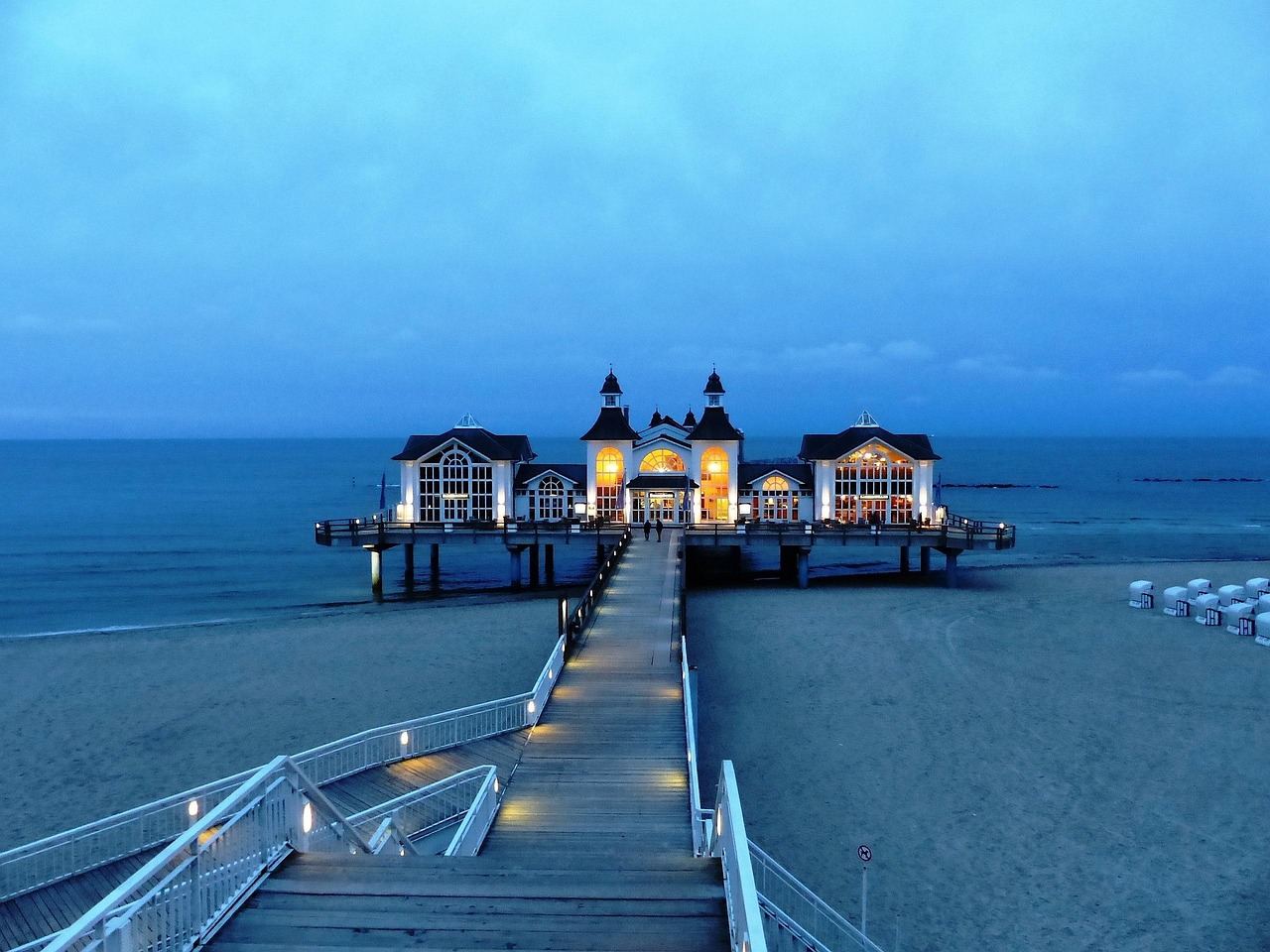
There are many piers in Europe, but there is only one Sellin Pier. It sits on Rügen Island off Germany’s Baltic coast, knifing out into the sea from beneath a dramatic staircase, fronted by chalk cliffs and framed by a wide crescent of pale sand. The pier building itself looks like something from a Baltic fairy tale – turreted, white, and gloriously symmetrical.
What makes Sellin Pier special isn’t just the architecture, though. It’s the way the place changes throughout the day and across the seasons:
- At dawn, the Baltic is often a mirror of soft silver. Joggers pad quietly past you on the promenade, and the pier café is just waking up.
- By midday, families spread out across the Strandkörbe (those classic North German beach chairs), and the pier becomes the hub of beach life.
- At sunset, couples drift towards the railings, the chalk cliffs ignite in orange light, and the whole place takes on a cinematic glow.
- After dark, the building lights up like a ship at anchor, and the sound of waves mixes with low conversation from the restaurant and bar.
Sellin Pier is also a perfect base for short trips along Rügen’s southeastern coast: to the tranquil village of Baabe, the livelier resort of Binz, and the forested Granitz ridge. You can have a classic “seaside holiday” here – but you can also hike, cycle, explore local history, and seek out quiet coves that day-trippers never find.
If you’re wondering how to visit Sellin Pier in 2026, what the best time to visit Sellin Pier is, or how to structure a 1 day itinerary for Sellin Pier versus a 3 day itinerary for Sellin Pier, this guide is for you. We’ll get into practicalities like Sellin Pier tickets and tips, opening hours, and how to beat the crowds, but also into subtler things: the etiquette of sharing the beach, how locals really feel about sunrise photos, and where to find a decent coffee within a five-minute walk.
Table of Contents
- 1. Orientation: Getting to Know Sellin Pier
- 2. Walking Through Sellin Pier: A Room‑by‑Room, View‑by‑View Guide
- 3. Eight Essential Viewpoints & Adjacent Sites
- 4. 1–3 Day Itineraries for Sellin Pier
- 5. Eating & Drinking Around Sellin Pier
- 6. Where to Stay & How to Get Around
- 7. Sellin Pier After Dark & Off‑Hours Magic
- 8. Day Trips & Nearby Attractions from Sellin
- 9. Cultural Etiquette & Local Customs
- 10. Practical Travel Advice: Tickets, Seasons, SIMs, Money‑Saving Tips
- 11. What’s New: Events & Changes on Sellin Pier 2026–2027
- 12. Summary & Final Recommendations
Orientation: Getting to Know Sellin Pier
Sellin is one of the “Amber Spas” on Rügen Island, known for its classic resort architecture: white villas with ornate balconies, pastel details, and a strong sense of turn‑of‑the‑century nostalgia. The pier itself has come and gone in various incarnations since 1906; storms and war destroyed earlier versions, and the current reconstruction opened in 1998. It’s both lovingly retro and cleverly modern.
Everything in Sellin orbits around three axes:
- Wilhelmstraße – the main avenue lined with villas, cafés, and shops.
- The Cliff & Staircase – the dramatic descent from town down to the beach and pier.
- The Pier & Beach – the beating heart of Sellin’s seaside life.
When I stay in Sellin for more than a night, I usually structure my days around these three axes: a morning walk along Wilhelmstraße for coffee and people‑watching, midday at the beach or on the pier, and late afternoon hikes along the cliffs, looping back in time for blue hour on the water.
Walking Through Sellin Pier: A Step‑by‑Step Guide
Many guides give you the postcard information; I want to give you the muscle memory. Here’s exactly how you’ll move through Sellin Pier and what to look for at each step.
1. The Approach: Wilhelmstraße & Cliff Edge
My ritual always begins at the top of Wilhelmstraße, near the little cluster of shops and bakeries. By the time you reach the seaward end, the villas thin out and the air changes: more salt, more wind. You’ll know you’re close when you see the railings and a widening of the pavement.
Step up to the cliff edge before you even think about the stairs. This is your first establishing shot of Sellin Pier: the pier building below, the long wooden arm stretching over the water, the chalk‑tinged cliffs enclosing the bay. On clear days, the horizon is such a clean line it looks drawn.
Tip: Come here first thing on your arrival day, even if you’re tired. Seeing the pier from above helps you orient everything else you’ll do.
2. The Grand Staircase Descent
The staircase is as much a part of the experience as the pier itself. There are roughly 80–90 steps, broken into platforms. Take it slowly – not because it’s steep (it is), but because each landing offers a subtly different composition of pier, sea, and beach.
On my last spring visit in 2026, I walked down just after a rain shower; the wet wooden handrails smelled like a ship’s deck, and low clouds blurred the horizon. It was one of those moments when Sellin feels more Nordic than German.
Accessibility note: If stairs are an issue, don’t worry. To the right of the main staircase, there’s a modern glass lift (elevator) from the cliff to the beach, usually operating from roughly 10:00–18:00 in shoulder seasons and longer in summer. In high season, there can be a short queue mid‑morning and late afternoon.
3. The Beach Level & Pier Entrance
At the bottom, you step onto a wide boardwalk that acts as a small plaza. From here, the pier building looms ahead, while the beach arcs away on both sides, dotted with Strandkörbe in season. This is where most visitors fumble for their cameras the first time – and where locals weave around them with amused tolerance.
Stand slightly to the left of the staircase, near the first row of beach chairs, and turn back towards the pier. This is the iconic front‑on angle: symmetrical, closer than the cliff‑top shot, but still wide enough to capture the turrets and the pier stretching out behind.
4. Inside the Main Pier Building
Step through the central doors and you’re in the main hall – high ceilings, lots of glass, a mix of white and warm wood. On sunny days, the Baltic pours through the windows; on stormy days, you feel wrapped in a bright cocoon while watching waves fracture against the pilings.
The building houses:
- The main restaurant and café with large windows over the water.
- Smaller lounge areas, sometimes set aside for events or wedding receptions.
- Access points to the side terraces and the long pier walkway.
Food here is better than you’d expect for such a prime location, though still priced for the view. I tend to come for coffee and cake rather than full meals; the sunset dinners are worth it for a first visit, but I’ll point you to better value options slightly inland later in this guide.
5. Side Terraces & Sea‑Level Perspectives
From the main building, you can step out onto side terraces that jut over the water. These are my preferred vantage points for photography and people‑watching: elevated just enough to see over beach umbrellas, close enough to hear the water clearly.
On a quiet April afternoon in 2026, I watched a seal surface not far from the pier, drawing a small crowd of delighted children along the railing. Wildlife sightings aren’t guaranteed, but they’re not rare either – watch for cormorants drying their wings on the pilings and swans drifting along the shallows.
6. The Long Walkway to the Sea
Behind the main building, the pier narrows into a long wooden walkway leading out over the water. This is where you feel the scale of the Baltic around you. In heavy weather, the wind can whip hard enough to make you lean into it; in calm conditions, you’re walking over glass.
There are a few benches spaced along the way. I like to pause halfway, just where the sound of the beach fades and the water becomes the main soundtrack. In winter, when the sun sits low even at midday, the light can be almost horizontal – a photographer’s dream, if you can keep your fingers warm.
7. The Diving Gondola (Tauchgondel)
At the very end of the pier sits one of Sellin’s quirkiest attractions: the Tauchgondel, or diving gondola. It looks like a small, futuristic capsule, and for a modest ticket fee you can descend a few meters below the surface of the Baltic Sea.
I’ll be honest: this is not the Great Barrier Reef. Visibility depends heavily on weather and season, and the Baltic is naturally murky. But kids tend to love the novelty, and even adults often find the experience oddly soothing. Inside, you get a short explanation (in German, with English summaries), some underwater viewing, and a sense of bobbing gently beneath the waves.
Practical tips:
- Tickets: Sold at the small kiosk near the gondola; usually no need to book ahead except on peak summer weekends.
- Schedule: Typically operates from late spring through autumn; in 2026 the season is projected to run roughly from April–October, weather permitting.
- Duration: Around 30–40 minutes per session.
8. How Long to Spend on the Pier
If you only have 1 day in Sellin Pier, allow:
- 30–45 minutes for the cliff‑top view, staircase, and first photo session.
- 60–90 minutes exploring the main building, terraces, and walkway.
- 30–40 minutes for the diving gondola if it appeals.
Realistically, you’ll end up weaving back and forth several times – once in morning light, once at sunset, maybe again after dark – which is why I always recommend at least 2 days in Sellin Pier if you can manage it.
Eight Essential Viewpoints & Adjacent Sites Around Sellin Pier
Beyond the pier itself, Sellin is ringed with viewpoints and small sites that add depth to your visit. These are places I find myself returning to, season after season, each with its own mood and story.
1. Cliff‑Top Panorama at the End of Wilhelmstraße
This is your classic postcard shot: from the railings at the end of Wilhelmstraße, looking straight down the staircase to the pier. I prefer it in early morning, when the light hits the façade, but late afternoon can be equally beautiful, especially in late summer when the sun swings around to backlight the building.
In 2026, the town has added a few more benches along the promenade here, which has made this a more comfortable place to linger. Grab a takeaway coffee from one of the bakeries on Wilhelmstraße and watch the interplay of waves and footprints below.
Tip: If you’re planning a 1 day itinerary for Sellin Pier, make this your very first and very last stop of the day. The contrast between morning and evening light on the same scene is one of the subtle joys of staying here even briefly.
2. South Beach Curve (Sellin Südstrand)
Take a left at the base of the staircase and walk south along the sand. Within a few minutes, you’ll leave the densest clusters of Strandkörbe behind and feel the bay open out. Turn back here and you’ll see the pier from a slight distance, framed by dunes and beach grass rather than people.
On a blustery November afternoon, I once walked this stretch almost alone, the pier a pale apparition in mist at my back. In August, by contrast, it can be lively with families playing in the shallows. This is a wonderfully versatile spot for photographers: wide shots, detail shots of waves and shells, and long‑exposure experiments at dusk.
Family tip: The water here is shallow and usually calmer than on the open coast, making it a good place for kids to paddle under supervision in summer.
3. North Beach & Chalk Cliff Footpath
Turning right from the staircase and heading north, you’ll quickly feel the landscape tilt slightly wilder. The beach narrows, the cliffs feel closer, and in places you can walk right at the base of chalk outcrops.
This is one of my favorite walks in off‑season months: you can watch how the cliffs change color with the light, from cool white in the morning to warm cream in late afternoon. After storms, you’ll sometimes see small rockfalls; stay mindful of posted warnings and never sit directly under unstable sections.
For the romantics: come here at blue hour in early spring or late autumn. The pier glows softly in the distance, and the beach is often nearly empty. Bring a thermos – there’s something special about sharing hot tea with only the sea for company.
4. Night‑Lit Pier from the Sand
After dark, walk a few dozen meters down the beach and turn back towards the pier. The building’s outline is traced in warm light, its reflection shivering on the black water. You’ll see photographers setting up tripods and couples strolling slowly along the shoreline.
I’ve shot this scene in every season. Winter brings crisp, clear air and sometimes a scattering of snow on the sand; summer brings faint afterglow on the horizon and more people. If you’re into night photography, this is a must‑shoot – and one of the easiest “wow” shots you can get in Northern Germany without much technical fuss.
5. Granitz Hunting Lodge (Jagdschloss Granitz)
A short bus ride or bike trip from Sellin brings you into the Granitz forest, home to one of Rügen’s most photogenic landmarks: Jagdschloss Granitz, a 19th‑century hunting lodge with a central tower. From the top, you get one of the best panoramic views on the island, taking in both the Baltic and the forested interior.
The climb up the freestanding spiral staircase inside the tower is not for the vertigo‑prone, but it’s unforgettable: wrought‑iron steps suspended in a column of light, your footsteps echoing upward. I still remember my first ascent here in 2014, palms slightly damp on the railing; returning in 2026, it felt more like greeting an old friend.
History note: The lodge was built in the 1830s for Prince Wilhelm Malte I of Putbus and later became a popular excursion for Baltic resort guests. Exhibits inside cover hunting culture and regional history.
6. Baabe & Its Modest Beachfront
Baabe, a small resort just southeast of Sellin, has a softer, quieter character. There’s no grand pier here, just wide sands, gentle dunes, and a modest promenade. It makes an excellent half‑day break if Sellin feels too busy, especially in July and August.
I like to cycle from Sellin to Baabe in the early morning, have breakfast at a café near the dunes, and then walk back along the beach with my feet in the water. It feels like hitting a reset button mid‑trip.
7. Binz Promenade & Pier
Binz is the island’s largest and flashiest resort, around 15–20 minutes from Sellin by bus or car. Its pier lacks the fairy‑tale architecture of Sellin but makes up for it with scale and people‑watching. The promenade here is lined with grand hotels, ice cream parlors, and shops.
After a few days in Sellin’s more intimate setting, Binz can feel either exhilarating or overwhelming. I usually time my Binz visits for mid‑afternoon on cloudy days, when the light is softer and the crowds more dispersed. It’s a good place to remind yourself that Rügen has many faces – and to appreciate returning to Sellin in the evening.
8. Quiet Forest Trails Behind Sellin
Walk inland from Sellin for just 10–15 minutes and you’ll find yourself in mixed forest: beech, pine, and oak. There are waymarked trails suitable for easy hiking or jogging, and in early autumn the ground can be littered with mushrooms (observe, but don’t pick unless you know what you’re doing).
On my last autumn stay, I made a habit of an early morning forest walk before coffee – 30–40 minutes of birdsong and leaf‑muffled footsteps before re‑entering the bright whites of resort architecture. It’s a lovely way to balance beach life with something quieter and more grounded.
1–3 Day Itineraries for Sellin Pier
Whether you’re planning 1 day in Sellin Pier, a 2 day itinerary for Sellin Pier, or a more leisurely 3 days in Sellin Pier, you can build your stay around the pier without feeling repetitive. Below are three structured itineraries based on how I actually move through the area when I visit.
Day 1: First Encounters with Sellin Pier (Perfect for 1 Day in Sellin Pier)
If you only have one full day, this is how I’d introduce you to Sellin Pier: a loop that takes in all the must‑see attractions in Sellin Pier, mixes in some gentle walking, and leaves space for moments when you simply stand and let the place sink in.
Morning: Cliff‑Top Coffee & First Descent
Start around 8:00–9:00 if you’re here between May and September; slightly later in winter when the sun rises later and mornings can be icy.
- Breakfast on Wilhelmstraße: Pick up a coffee and a Franzbrötchen (sweet cinnamon pastry) at a bakery along the main street. Walk slowly towards the sea; this is your first immersion in Sellin’s resort architecture.
- Cliff‑Top Viewpoint: At the end of the street, approach the railings. Before you do anything else, pause. This is your first moment with the full scene: staircase, pier, beach, and Baltic.
- Photo Time: Circle the viewpoint, try different angles, and resist the urge to rush down. If the light is good, these may end up being your favorite shots of the entire trip.
I remember my first 2026 visit in late April, arriving after a long train‑and‑bus journey from Berlin. The pier was backlit by a milky sky, the beach almost empty except for a dog walker, and the sound of waves drifted up like white noise. That first five‑minute pause at the cliff edge dissolved the travel fatigue completely.
Late Morning: Staircase, Beach & Pier Interior
- Descend the Staircase: Take it slowly. Stop on at least two landings for photos. Look left and right to see how the beach curves out of view.
- Beach Walk: At the bottom, turn briefly left or right along the sand. Dip your hand or feet in the Baltic if the weather isn’t brutal.
- Enter the Pier Building: Around late morning, the pier café is usually in full swing, but not yet at its lunchtime peak. Find a table by a window if you can.
Order a coffee or a pot of tea and something from the cake selection – in my case, it’s often a slice of Käsekuchen. I like to sit facing inland first, watching people descend the staircase and fan out across the beach, and then later switch chairs or simply turn my body to look out to sea.
Midday: Long Walkway & Diving Gondola
- Walk the Pier: After your break, continue through the building and out onto the narrow wooden walkway. Take your time – stop at each bench, lean on the railing, look back at the beach.
- Diving Gondola: If it’s operating and you’re curious, buy a ticket and descend. This is especially good with kids; adults may find it a quirky, meditative interlude.
I still find something oddly moving about being below the surface, watching the muted sway of seaweed and the occasional fish ghost past the windows. It’s not spectacular in the conventional sense, but it gently reminds you that the Baltic is alive, not just a pretty backdrop.
Afternoon: Beach Time or Short Cliff Walk
In the afternoon, you have a choice depending on mood and weather.
- Option A – Beach Relaxation: Rent a Strandkorb for a few hours if it’s warm enough. Read, nap, watch children build fortresses at the water’s edge, and take occasional dips. This is ideal for families or anyone needing a mental reset.
- Option B – North Beach & Cliffs Walk: Turn right from the staircase and walk along the sand towards the chalk cliffs. Aim for 45–60 minutes round‑trip. The crowds thin out quickly, and you’ll see the pier receding behind you, gradually framing itself within the cliffs.
On one late August afternoon, I chose Option B after a stormy morning. The sky was still dramatic, all moving greys and patches of blue, and the wet sand reflected the pier like a painting. It ended up being the most atmospheric walk of that trip.
Evening: Sunset & Night‑Lit Pier
- Golden Hour on the Cliff: Return to the cliff‑top viewpoint 30–60 minutes before sunset. Watch how the light softens and warms, turning the pier’s white façade into pale gold.
- Dinner: Either dine on the pier for the full “over the water at sunset” effect or head a few streets inland for better value; I’ll cover my favorite spots in the food section.
- Night Walk: After dinner, take a final stroll down the staircase or just to the cliff edge. Photograph or simply absorb the night‑lit pier from the beach.
For a 1 day itinerary for Sellin Pier, this is your perfect closing scene: the pier glowing lightly, waves hushed in the dark, your footsteps soft on the sand. Even if you’re leaving the next morning, it will feel like more than “just a day”.
Day 2: Forests, Views & Nearby Villages (Ideal for a 2 Day Itinerary for Sellin Pier)
With a second day, you can balance your relationship with the pier by venturing inland and along the coast. This is the day where you realize Sellin is not just a single structure but a whole living landscape.
Morning: Forest Trails & Wilhelmstraße Brunch
- Forest Walk: After a light early breakfast, head into the forest behind Sellin. Follow a marked trail (ask your accommodation for a simple map) for 45–90 minutes. The beech trees in particular are stunning in spring and early autumn.
- Return via Town: Loop back to Wilhelmstraße late morning. The contrast between forest quiet and the gentle bustle of the main street always makes me smile.
- Brunch: Choose a café with outdoor seating. Order something substantial – eggs, bread, local cheese and cold cuts – if you’re planning a bigger afternoon excursion.
On a May morning in 2026, I did exactly this: mist in the forest, then bright sun on Wilhelmstraße. Brunch tasted better for the walk that preceded it.
Midday & Afternoon: Granitz Hunting Lodge Excursion
Head to Jagdschloss Granitz, either:
- By bus towards Binz, then a short walk through the woods; or
- By rented bike along marked paths.
The approach through the forest is half the pleasure: the lodge appears gradually between trees like a pale, almost Mediterranean‑looking castle.
Inside, explore the small museum and then climb the spiral staircase to the tower top. If your timing is right, you’ll have 360‑degree views over the Baltic and Rügen’s patchwork of fields and forests. The sense of scale at the top helps you understand where Sellin fits into the island’s geography.
Plan 3–4 hours door to door, including transit, exploration, and a coffee break at the lodge café or nearby. If you’re traveling with kids, factor in an extra half‑hour for the tower climb and descent.
Late Afternoon: Return to Sellin & South Beach Stroll
Back in Sellin, resist the urge to collapse immediately. Instead:
- Walk down to the beach and turn south this time, along the wide, gentler sands.
- Take off your shoes if the weather allows and let the cold water numb your ankles briefly.
- Stop halfway down the curve of the bay and look back at the pier. This is another excellent spot for late afternoon photography.
Evening: Romantic Pier Dinner or Casual Local Meal
With two evenings in Sellin, you can do both:
- Night 1 (previous day): Casual local restaurant inland – better value, more locals.
- Night 2: Book a table at the pier restaurant or one of the cliff‑top spots overlooking the water. Arrive 30–45 minutes before sunset.
Watching the light fade from inside the pier building, with the sea slowly turning from blue to ink outside, is one of the most romantic experiences in Sellin. It’s popular with couples, but I’ve also happily done this solo more than once, journal and book in hand.
Day 3: Baabe, Binz & Hidden Corners (A Rich 3 Day Itinerary for Sellin Pier)
With three days in Sellin Pier, you can fully inhabit the rhythm of life here – slow mornings, exploratory afternoons, and unhurried evenings. This day focuses on nearby villages and a few quieter corners that casual visitors miss.
Early Morning: Sunrise at the Pier
If the forecast is promising, set an alarm for sunrise. Check the time the night before and give yourself 20–30 minutes extra to walk to the cliff edge and, if you’re feeling energetic, down the staircase.
In late summer 2026, I watched the sun creep over a perfectly calm Baltic, the pier building a delicate silhouette in front of it. There were only three other people on the beach: a photographer, a jogger, and a woman walking her dog. It felt like we shared a small secret.
Morning: Baabe Excursion
After a quick breakfast, head for Baabe:
- By Bike: Rent a bicycle in Sellin and follow the coastal route; it’s flat, scenic, and family‑friendly.
- By Bus: Local buses run regularly; check current timetables via the VVR (Verkehrsgesellschaft Vorpommern‑Rügen) website or app.
In Baabe, stroll along the dunes, visit the small harbor on the Bodden (lagoon) side if you have time, and enjoy a late breakfast or early lunch. The pace here is slower than Sellin; it’s a good place to deepen your sense of the region’s character.
Afternoon: Binz Energy & Promenade
After Baabe, continue on to Binz for a few hours:
- Walk the promenade and pier.
- Browse shops for local products (sea buckthorn specialties, smoked fish, Baltic ceramics).
- Have ice cream or coffee at a seafront café and people‑watch.
Binz gives you the high‑energy, glamorous side of Rügen. After a couple of hours, I tend to feel ready to retreat back to Sellin’s more intimate embrace – which is exactly what you’ll do.
Late Afternoon: Quiet Time in Sellin
Back in Sellin, use the late afternoon for something low‑key:
- Return to a favorite viewpoint with a new lens or a fresh eye.
- Browse small galleries or shops on Wilhelmstraße.
- Sit on a bench overlooking the pier and simply be there, without an agenda.
This is also a good time to reflect on your trip if you’re leaving next day. I often jot down impressions in a notebook here; Sellin rewards slow observation.
Evening: Final Blue Hour & Farewell Walk
For your last night, I recommend:
- Cliff‑top viewpoint at golden hour.
- Simple dinner at a place you’ve not tried yet – perhaps a smaller, family‑run restaurant slightly off the main drag.
- Final walk either on the beach or along the promenade, watching the pier fade into the dark.
A 3 day itinerary for Sellin Pier lets you experience the full cycle of the place: dawn, midday, dusk, and night, repeated enough times that it starts to feel familiar rather than merely spectacular. That’s when a destination begins to sink under your skin.
Eating & Drinking Around Sellin Pier
The immediate surroundings of the pier are scenic but pricey. For better value and more local atmosphere, you’ll want to step a bit inland. Here’s how I navigate the food scene on repeat visits.
What to Eat
- Baltic Fish: Smoked fish (especially mackerel and eel), baked herring, and seasonal dishes with cod or zander. Look for places offering daily specials based on fresh catch.
- Fischbrötchen: Fish sandwiches – simple, affordable, and very North German. Herring, salmon, or fish frikadelle with onions and sauce in a crusty roll.
- Sea Buckthorn (Sanddorn): Try it in juices, cakes, or sauces – tangy, vitamin‑rich, and very much a regional flavor.
- Cakes & Pastries: Käsekuchen, apple cake, and seasonal fruit tarts are all excellent fuel between walks.
Where to Eat (Beyond the Tourist Traps)
Without naming specific venues (which can change hands), here’s the pattern I use:
- One to two streets behind Wilhelmstraße: Look for smaller, family‑run places – menus often hand‑written or on chalkboards, with a shorter list of dishes.
- West side of Sellin: Away from the pier, you’ll find neighborhood pubs and restaurants where German is the dominant language and prices are lower.
- Nearby Baabe and smaller villages: For lunches, I sometimes eat in Baabe or on the way to Granitz, especially at places attached to farms or guesthouses.
What to Bring onto the Pier & Beach
- A reusable water bottle (tap water is safe and good).
- Simple picnic items: bread, cheese, fruit, perhaps a Fischbrötchen.
- A light blanket or towel if you plan to sit on the sand for a while.
It’s perfectly acceptable to picnic on the beach; just be diligent about leaving no trace. On very windy days, avoid loose wrappers and choose sturdier containers.
Where to Stay & How to Get to Sellin Pier
Over multiple visits, I’ve tried a mix of accommodations: classic villas on Wilhelmstraße, modest guesthouses a bit inland, and small apartments. Each has its advantages.
Where to Stay
- On or near Wilhelmstraße: Ideal if you want to be within a 5–10 minute walk of the pier. You’ll pay a premium for the location and historic architecture, but sunrise and sunset visits become effortless.
- Inland Guesthouses: 10–15 minutes’ walk from the pier, often in quieter residential streets. Better value and a more local feel.
- Self‑Catering Apartments: Great if you’re staying several days or traveling with family. Being able to prepare breakfast at “home” makes early morning pier visits easier.
How to Get to Sellin Pier
Sellin is on Rügen Island, which is connected to the mainland by bridge.
- By Train: Take a train (often via Stralsund) to Bergen auf Rügen or Binz. From there, switch to a regional bus to Sellin. In summer, some rail services are more frequent; check Deutsche Bahn for current schedules.
- By Car: Follow the A20 and B96 towards Rügen, then local roads to Sellin. Parking exists but can be tight in high season. Expect paid parking zones near the center.
- By Bus from Other Island Towns: Regional buses link Sellin with Baabe, Göhren, Binz, and other resorts. They’re reliable and the easiest way to get around without a car.
Once in Sellin, you’ll reach the pier on foot in most cases. The town is compact; from most accommodations it’s a 5–20 minute walk.
Sellin Pier After Dark & Off‑Hours
Some of the most memorable experiences in Sellin happen when most day‑trippers have gone. The pier transforms through the day’s edges – dawn, golden hour, blue hour, and night.
Sunset & Golden Hour
- Cliff‑Top Railings: Best for wide, sweeping views of the pier against the glowing sky.
- Beach Level: Ideal if you want the pier reflected in wet sand as the tide shifts.
- Pier Terraces: More intimate, with the light falling directly across your table or chair.
Blue Hour
The 20–40 minutes after sunset, when the sky turns deep blue and the pier lights switch on, are pure magic. This is my favorite time to walk the beach with a camera or just my thoughts. In shoulder seasons, you may share the entire stretch with only a handful of others.
Night
After full dark, the pier looks like a floating pavilion, its lights mirrored in the water. Even if you’re not into photography, it’s worth a short nighttime visit – the mood is entirely different from day. In high summer, occasional small events or live music performances may be scheduled (check local listings), but most nights are quietly atmospheric rather than loud.
Day Trips & Nearby Attractions from Sellin
While this is a travel guide for Sellin Pier specifically, it would be a shame to come this far and not sample a bit more of Rügen. From Sellin, you can reach several standout destinations with relative ease.
Jasmund National Park & the Chalk Cliffs
North of Sellin lies Jasmund National Park, famous for its towering chalk cliffs dropping into the Baltic. The Königsstuhl viewpoint and surrounding trails offer dramatic scenery and a chance to see the island’s geology laid bare.
Practical tips:
- Getting There: Bus and car routes via Sassnitz. Plan 1.5–2 hours each way from Sellin including transfers.
- Time Needed: A full day to do it justice.
- Season: Spring and autumn are ideal; summer can be crowded, winter can be hauntingly beautiful but slippery.
Putbus & Lauterbach
Putbus, with its classical squares and rose‑adorned houses, offers a different side of Rügen – more stately than seaside. Nearby Lauterbach provides harbor views and good seafood lunches.
More of the Southeast Coast: Göhren & Beyond
Further along the coast from Baabe, Göhren has its own pier and a slightly different beach profile. It’s easy to combine with Baabe for a full‑day coastal wander, either on foot or by bike, returning to Sellin by bus if you’re tired.
Cultural Etiquette & Local Customs Around Sellin Pier
Rügen is part of northern Germany, with its own understated style: reserved but friendly once a rapport is established, practical, and proud of the island’s natural beauty.
On the Beach & Pier
- Noise: Keep music and loud conversations moderate, especially in the evening. People come for the sound of the sea.
- Strandkörbe: Only use beach chairs you’ve rented; they’re not public property even if they look empty.
- Photography: Feel free to photograph the pier and landscape, but avoid close‑ups of strangers, especially children, without consent.
Dining & Tipping
- Tipping: 5–10% is customary in restaurants and cafés if service was satisfactory. You usually state the total including tip when paying.
- Reservations: For popular spots (especially with sea views) in July–August and on weekends, reserve a table; locals do.
Language
German is the main language; English is generally understood in tourism settings, especially by younger staff. Learning a few basics – Guten Tag (good day), Bitte (please), Danke (thank you) – is appreciated.
Environmental Respect
Locals are protective of their coastline:
- Use bins provided; if none are nearby, carry your trash.
- Stay on marked paths along cliffs to reduce erosion.
- Respect any seasonal wildlife closures or nesting areas.
Practical Travel Advice for Sellin Pier
Tickets, Opening Hours & Logistics
Sellin Pier itself is free to access; you don’t need a ticket just to walk the pier or visit the beach.
- Restaurants & Café: Opening hours vary by season. In high season, expect roughly 10:00–22:00; in shoulder season, shorter hours are common.
- Diving Gondola: Ticketed, with set operating hours (often late morning to late afternoon). In 2026, operations are expected from spring through autumn; check locally for exact times.
- Lift (Elevator) to Beach: Usually operates during the day; free or low‑cost depending on municipal policy in a given year.
Crowds peak between 11:00–16:00 in July–August. To avoid them, visit early morning or later in the afternoon, especially if you want uncluttered photos or a quieter experience.
Best Time to Visit Sellin Pier
- Late April–June: Fresh green forests, fewer crowds, often pleasant weather. My personal favorite window.
- July–August: Warmest water, liveliest beach life, but also busiest and priciest.
- September–October: Softer light, fewer people, good for hiking and photography.
- Winter: Quiet, sometimes harsh, but atmospheric. Short days, many seasonal services reduced, yet the pier in a winter storm is unforgettable.
Money‑Saving Tips
- Stay slightly inland rather than in prime seafront villas.
- Make lunch your main meal; dinners can be more expensive.
- Use buses instead of taxis for regional travel.
- Picnic on the beach with supermarket finds instead of always eating out.
SIM Cards & Connectivity
Germany’s main networks (Telekom, Vodafone, O2) cover Rügen reasonably well, though some forested or remote coastal spots can be patchy.
- Prepaid SIMs: Available at supermarkets, electronics stores, and some kiosks before you reach the island – easier to sort in a major city or at the airport.
- eSIMs: Increasingly common; consider buying an eSIM data package before arrival.
Transport: Public & Car Rental
For Sellin and nearby resorts, you don’t strictly need a car.
- Public Buses: Reliable and relatively frequent in high season. Check regional timetables; many hotels and guesthouses display them.
- Car Rental: Available in larger towns like Binz or Bergen auf Rügen. Useful if you plan to explore more remote parts of the island.
- Bikes: Highly recommended for short hops between resorts and along the coast. Many accommodations arrange rentals.
Visa Requirements & Driver’s Licenses
Germany is part of the Schengen Area. Visa requirements depend on your nationality:
- EU/EEA/Swiss citizens: No visa needed; travel with valid ID or passport.
- Many other nationalities (e.g., US, UK, Canada, Australia, Japan): Can enter visa‑free for short stays; check current Schengen rules and ETIAS implementation details for 2026.
- Others: May require a Schengen visa; consult the German consulate or embassy well in advance.
Foreign driver’s licenses from many countries are accepted in Germany for short stays; however, an International Driving Permit (IDP) alongside your national license is often recommended and sometimes requested by rental agencies. Check your rental company’s policy before travel.
Accessibility & Mobility
- Cliff Elevator: Provides step‑free access between the town level and beach/pier; crucial for those with mobility issues.
- Pier Surface: Mostly level, suitable for wheelchairs and strollers, with some minor thresholds.
- Restaurants: Vary; if accessibility is a concern, call ahead to confirm step‑free access and restroom facilities.
Dress Code & Behavior
There is no formal dress code for the pier; casual beachwear is normal in daytime, smart‑casual in the evenings at nicer restaurants. In cooler months, layers and windproof jackets are essential; the Baltic wind can be sharp even on sunny days.
Photography Tips & Restrictions
- Allowed: Personal photography is welcome on the pier, beach, and promenade.
- Tripods: Generally tolerated, but be mindful not to block pathways, especially during busy times.
- Drones: Subject to strict German regulations; do not launch a drone near the pier without checking and complying with current laws and local rules.
What’s New in 2026–2027: Events & Changes
Each year, Sellin fine‑tunes its calendar of small festivals, concerts, and seasonal activities. Exact lineups can change, but as of 2026 you can expect:
- Summer Beach Concerts (2026–2027): A series of small live music evenings on or near the beach, mostly in July and August. Genres range from acoustic to light pop and jazz.
- Maritime & Pier Anniversary Events: Occasional maritime‑themed days with guided tours, children’s activities, and historical exhibitions about the pier’s past versions and reconstructions.
- Autumn & Winter Wellness Weeks: Quiet‑season packages and events focused on spa treatments, walks, and local gastronomy, often promoted by hotels but centered around the pier and promenade atmosphere.
Before your trip, check Sellin’s official tourism website or local tourism office announcements for exact dates. Events are typically modest in scale – think charming rather than overwhelming – and rarely disrupt normal access to the pier.
Summary & Final Recommendations
Sellin Pier is one of those rare places that wears its beauty openly yet still rewards repeat visits. Come once and you’ll remember the silhouette of the building and the feel of the staircase underfoot. Come twice or three times, in different seasons or with different companions, and you’ll begin to notice the small shifts in light, weather, and mood that make it endlessly compelling.
To recap the key travel tips for Sellin Pier:
- Best time to visit Sellin Pier: Late spring (May–June) and early autumn (September) for balance of weather and crowds; July–August for full beach life; winter for moody quiet.
- Minimum stay: You can see the essentials in a well‑planned 1 day itinerary for Sellin Pier, but 2–3 days in Sellin Pier lets you fully enjoy sunrises, sunsets, nearby forests, and day trips.
- Must‑see attractions in Sellin Pier: Cliff‑top panorama, grand staircase, pier interior and terraces, long walkway, diving gondola, and at least one off‑peak visit at dawn or after dark.
- Nearby highlights: Baabe, Binz, Granitz Hunting Lodge, and – if you have longer – Jasmund’s chalk cliffs and other corners of Rügen.
- Approach: Walk slowly, look often, and give yourself pockets of unscheduled time. Sellin rewards unhurried wandering as much as any checklist.
Above all, remember that the pier is more than an Instagram backdrop; it’s the living heart of a small coastal town with its own rhythms and stories. If you let yourself settle into those rhythms – coffee on Wilhelmstraße, a midday beach walk, a sunset lean against the railings – you’ll leave with a sense of Sellin that goes far beyond the postcard.